
The Physics of Prevention: Sensor Mechanics and Automated Hydraulic Defense
Water is the lifeblood of a home, but it is also its most patient destroyer. A burst pipe, a leaking washer hose, or a failing water heater can unleash thousands of gallons of water in hours, causing catastrophic structural damage and mold growth. In the hierarchy of home disasters, water damage is statistically more likely than fire and theft combined. Yet, while we universally install smoke detectors and security alarms, the plumbing system often remains unguarded.
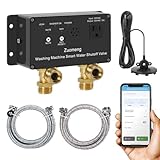
The emergence of smart water shutoff valves, like the Zuomeng ZM-069, represents a paradigm shift from reactive repair to proactive defense. This is not just a gadget; it is an automated hydraulic security system. But how does a small plastic disc detect a leak before it becomes a flood? And how does a motorized valve intervene faster than a human ever could? This article deconstructs the physics of leak detection, the logic of automated intervention, and the engineering principles that separate a reliable safeguard from a nuisance alarm.

Sensing the Invisible: Conductivity and Thresholds
At the core of any leak detection system is the sensor. The Zuomeng system uses a point-source conductivity sensor. The principle is elegant in its simplicity: water is a conductor.
Pure, distilled water is actually an insulator. However, domestic tap water contains dissolved minerals—calcium, magnesium, chlorine—which turn it into an electrolyte solution capable of carrying an electrical charge.
The Circuit Logic
The sensor features two metal probes (electrodes) separated by an air gap. This is an Open Circuit. No current flows.
When water bridges this gap, touching both probes simultaneously, it completes the circuit. The resistance drops from near-infinity (air) to a measurable level (water). The sensor’s internal microcontroller detects this drop in resistance and triggers the alarm signal.
The “False Positive” Dilemma
The challenge in sensor design is not detecting water; it is ignoring moisture. A basement floor in summer can be damp with condensation. A bathroom floor might have a few droplets from a shower. If a sensor is too sensitive, it triggers false alarms, leading to “alarm fatigue” where the user eventually disables the system.
The Zuomeng sensor addresses this with a critical geometric feature: the 1mm Elevated Base. The probes are not flush with the bottom; they are raised slightly.
* Physics of the Meniscus: Water has surface tension. A small droplet tends to bead up. A thin film of condensation might coat the floor but lacks depth.
* The Threshold: By raising the probes 1mm, the sensor requires a specific volume of water to pool before it triggers. The water level must rise high enough to bridge the elevated contacts. This physical threshold acts as a mechanical filter, ignoring humidity and minor splashes while instantly reacting to the accumulating pool of a genuine leak.
The Logic of Intervention: Speed vs. Latency
Detecting a leak is useless without action. In a catastrophic failure (like a burst washing machine hose), water can flow at 6-12 gallons per minute. A delay of 10 minutes means 100 gallons of water on your floor.
The Zuomeng system integrates the sensor directly with the valve controller via a local RF (Radio Frequency) or Wi-Fi link.
1. Signal Transmission: The sensor detects the short circuit.
2. Broadcasting: It sends a “Close” command to the valve actuator.
3. Actuation: The motor turns the ball valve 90 degrees.
Local vs. Cloud Logic
Crucially, the reliability of this chain depends on where the logic lives. If the sensor sends a signal to the cloud server, and the server sends a command back to the valve, the system is vulnerable to internet outages. A robust design often employs local linkage, where the sensor talks directly to the valve hub even if the Wi-Fi is down. While the app notification (“Real-Time Water Leak Alerts”) requires internet, the physical shutoff action should ideally be local. The “instant valve shutoff” capability of the ZM-069 suggests a highly optimized, low-latency control loop designed to beat the flow rate of the leak.
The Actuator: Motorized Torque
The muscle of the system is the Electric Actuator. It must turn a brass ball valve against the friction of its seals and the pressure of the water.
* Torque Requirements: Over time, mineral deposits (scale) can build up inside a valve, increasing the torque required to turn it. A weak motor might stall. The ZM-069 uses a high-torque DC motor geared down to provide sufficient force to shear through minor scale buildup and close the valve fully.
* State Feedback: Smart valves typically include position sensors. The app doesn’t just guess the valve is closed; the actuator confirms it has reached the 90-degree position. This “closed-loop feedback” provides the peace of mind that the command was actually executed.
Conclusion: The Peace of Physics
The Zuomeng ZM-069 is a machine that trades anxiety for physics. It replaces the fallible human observer with an untiring conductivity circuit. It replaces the panic of finding a shutoff wrench with the instant torque of an electric motor.
By understanding the science of the 1mm gap and the logic of the closed circuit, homeowners can appreciate that this is not magic; it is engineering. It is a system built on the fundamental electrical properties of water and the mechanical certainty of a gear train, standing guard to ensure that the fluid which sustains life does not destroy the home.