
The Algorithm of the Kitchen: Programmability and the Economics of Throughput
In the modern culinary landscape, particularly within the Quick Service Restaurant (QSR) and fast-casual sectors, the greatest challenge is not the complexity of the cooking, but the consistency of the execution. A perfectly crafted recipe is worthless if it cannot be replicated identicaly, hundreds of times a day, by a shifting roster of staff with varying levels of skill and fatigue. This is where the commercial kitchen ceases to be an artist’s studio and becomes a manufacturing line.
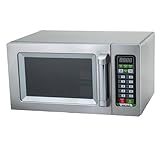
In this context, the Winco EMW-1000ST transforms from a mere heating appliance into a programmable logic controller for food. With its ability to store up to 100 customized cooking programs and its multi-stage cooking capabilities, it offers a digital solution to the analog problems of human error, training turnover, and waste.
This article explores the “software side” of commercial microwave operations. We will delve into the economics of programmable equipment, the concept of “de-skilling” complex tasks, and how the strategic use of presets can optimize kitchen throughput (the rate at which a system generates its products) and protect brand integrity.
The High Cost of Human Error
To understand the value of the Winco EMW-1000ST’s programmable interface, one must first quantify the cost of variability. In a busy kitchen, manual microwave operation is fraught with risk.
* The “Guess and Check” Method: An employee guesses that a muffin needs 20 seconds. It comes out cold. They put it back in for 10 seconds. It comes out molten lava. This trial-and-error process wastes time (two cycles instead of one) and degrades quality.
* The “Nuke It” Reflex: Stressed employees often default to hitting the “high” button for an excessive amount of time just to be “safe.” This leads to dried-out proteins, rubbery breads, and dissatisfied customers.
These micro-failures accumulate. A wasted sandwich is a direct material cost. A slow service time is an opportunity cost (customers leaving the line). A bad Yelp review about a cold center is a reputation cost.
The Programmable Solution: Digital SOPs
The EMW-1000ST allows management to encode their Standard Operating Procedures (SOPs) directly into the machine. The 100 memory slots act as a digital repository of the kitchen’s culinary knowledge.
De-skilling the Line
“De-skilling” is a controversial term, but in high-volume food service, it is a survival mechanism. It involves simplifying tasks so they can be performed effectively by staff with minimal training.
With a fully programmed Winco EMW-1000ST, the training manual changes from:
“Heat the breakfast burrito on High for 45 seconds, unless it’s frozen, then do 90 seconds at 50% power, then 30 seconds on High.”
To:
“Press Button 3 for Burrito.”
This shift is profound. It reduces the Cognitive Load on the staff. They don’t need to remember times or power levels; they only need to identify the product. This drastically reduces the “ramp-up time” for new hires, which is critical in an industry with turnover rates often exceeding 100% annually. The machine carries the expertise, so the employee doesn’t have to.
Multi-Stage Cooking: The Culinary Algorithm
The “Custom Programs” feature of the EMW-1000ST supports multi-stage cooking, which is the secret weapon for quality. A manual user rarely has the patience to program complex sequences, but a preset makes it automatic.
Consider the physics of reheating a dense frozen item, like a lasagna portion.
1. Stage 1 (Defrost): 30 seconds at 50% power. This gently raises the temperature of the ice crystals to liquid water without boiling the edges.
2. Stage 2 (Rest/Equilibrium): 10 seconds at 0% power (a programmed pause). This allows thermal conduction to distribute the heat from the outer layers to the center.
3. Stage 3 (Finish): 40 seconds at 100% power. This brings the entire dish up to serving temperature (165°F/74°C) rapidly.
By programming this “Algorithm of Lasagna” into Button 5, the operator ensures that every single lasagna served is treated with this thermodynamic precision, regardless of who pressed the button. It elevates the microwave from a brute-force heater to a nuanced chef.
The “2x” Multiplier: Scaling Production
The “Quantity Button” (X2) on the EMW-1000ST addresses another common failure point: the physics of load. Microwaves do not cook linearly. Two burgers do not take exactly twice as long as one; they might take 1.8 times as long due to the complex interaction of wave absorption and cavity efficiency.
If an employee simply doubles the time manually, they will often overcook the food. The X2 button allows the manager to pre-program a specific multiplier factor. When the rush hits and the staff needs to heat two items at once, they press “X2” and then the item button. The machine applies the scientifically correct time adjustment automatically. This feature maintains Throughput Velocity during peak hours without sacrificing quality consistency.
Inventory Management and Menu Engineering
The programmability of the microwave also influences Menu Engineering. Knowing that the EMW-1000ST can handle 100 specific items gives chefs the freedom to expand their menu with items that require “finishing.”
For example, a cafe can offer a wide variety of warm pastries (scones, croissants, muffins) that are stored at room temperature or chilled. By dedicating specific programs to each (e.g., “warm croissant” vs. “hot sticky bun”), they can serve a premium “warm” product rather than a “stale” room-temperature one. The reliability of the machine allows the menu to rely on this “just-in-time” heating step.
Furthermore, the digital nature of the settings allows for Fleet Management. For a chain with 50 locations, the corporate chef can develop the settings in the test kitchen and then deploy the exact programming chart to every store. This ensures that a burrito in Location A tastes exactly the same as one in Location B, enforcing brand standards through hardware.
Touch Controls vs. Dials: The Hygiene of Interface
The EMW-1000ST features a touch control pad rather than a mechanical dial. In a commercial environment, this is as much a hygiene feature as a technological one.
Dials and physical buttons create crevices where flour, grease, and bacteria can accumulate. A flat touch panel can be wiped down with a sanitizer cloth in seconds. In the context of the NSF (National Sanitation Foundation) standards mentioned in the previous article, the touch panel contributes to the overall food safety profile of the operation. It also eliminates the mechanical wear and tear associated with moving switches, further contributing to the unit’s longevity.
Conclusion: The ROI of Consistency
The return on investment (ROI) of the Winco EMW-1000ST is not found solely in its purchase price, but in the efficiency it unlocks. By acting as a programmable standardizing agent, it reduces waste, lowers labor training costs, and increases customer satisfaction through consistency.
In the algorithmic kitchen, the microwave is no longer just a box that makes things hot. It is a programmable tool that executes code—culinary code—written by management and executed by the machine. It allows the human staff to focus on the human aspects of service—hospitality and speed—while the machine handles the physics of cooking with digital precision.