The Standard That Never Died: The Science and Utility of ESE Pods

In the noisy marketing war between Nespresso and Keurig, a quiet veteran soldiers on. It is the E.S.E. Pod (Easy Serving Espresso). Created by Illy in the 1970s, it was the world’s first open standard for single-serve espresso. While plastic capsules have taken over the supermarket aisle, the ESE pod remains a favorite of coffee purists and eco-conscious consumers alike.
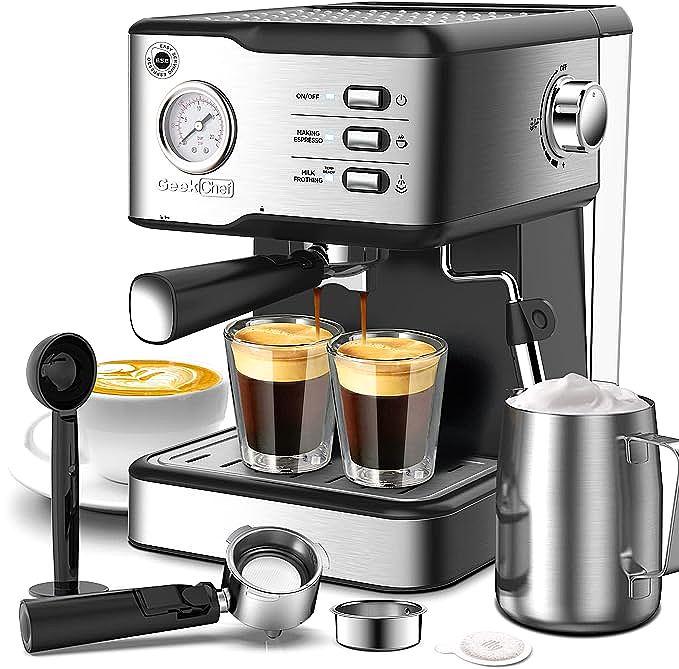
The Geek Chef GCF20B includes a dedicated filter basket for ESE pods. This inclusion is not an afterthought; it is a nod to a standardized system that offers a unique bridge between convenience and quality. Understanding the science of the ESE pod reveals why this paper-based format refuses to die and why it might be the smartest choice for the entry-level barista.
The Physics of the Paper Puck
An ESE pod looks like a tea bag, but structurally, it is a Pre-Tamped Coffee Puck.
* Dimensions: Standardized at 44mm diameter.
* Content: Contains 7 grams of coffee (the classic Italian single shot dose).
* Compression: The coffee is mechanically tamped between two layers of filter paper.
The Permeability Advantage: Unlike plastic or aluminum capsules, which require high pressure to burst foil seals, the paper filter of an ESE pod is naturally permeable. Water can saturate the entire puck evenly from the first second. This promotes a more uniform extraction compared to the “injection point” method of plastic capsules, which can sometimes lead to channeling (uneven flow).
The Filtration Physics: The paper acts as a fine filter, removing sediment and some oils (diterpenes like cafestol). While this might reduce the body slightly compared to a metal filter, it produces a cleaner cup that is often preferred by those monitoring cholesterol levels.
Standardization vs. Proprietary Lock-in
The greatest strength of the ESE system is its Open Architecture.
Nespresso and Keurig are “Walled Gardens.” They make money by locking you into their patent-protected (or formerly protected) shapes.
ESE is an industry standard. Hundreds of roasters, from Lavazza to local artisans, produce ESE pods.
* For the Machine Manufacturer: Including ESE compatibility (like Geek Chef does) adds value without licensing fees.
* For the Consumer: It grants freedom. You are not beholden to one brand. You can buy pods from anyone. This competition drives quality up and prices down.
The Convenience-Quality Compromise
Why use ESE on a machine like the Geek Chef GCF20B, which can also use ground coffee?
It solves the Consistency Problem.
* The Grinder Gap: Most beginners buy an espresso machine but lack a high-quality burr grinder. Using cheap blade grinders results in uneven particle sizes, leading to sour/bitter shots.
* The Tamping Variable: Beginners often tamp too hard or too soft.
* The Solution: An ESE pod is ground and tamped in a factory with industrial precision. It guarantees that the resistance offered to the machine’s pump is always perfect (ideal for that 20-bar pump to work against). It effectively outsources the hardest parts of espresso making—grinding and tamping—to a professional.
Sustainability: The Original Biodegradable Pod
Long before “eco-friendly” was a buzzword, ESE pods were green.
* Material: Paper and coffee. That’s it.
* Disposal: They are fully compostable. You can throw them in your garden.
Compared to the complex recycling chains required for aluminum pods or the landfill destiny of plastic K-Cups, ESE pods are radically simple. For the environmentally conscious user of the Geek Chef machine, this mode offers guilt-free convenience.
Conclusion: The Bridge Between Worlds
The ESE pod is the “manual transmission” of the convenience world. It retains the tactile feeling of locking a portafilter into a group head (unlike dropping a pod into a slot), but removes the mess of loose grounds.
For owners of the Geek Chef GCF20B, the ESE filter basket is a secret weapon. It allows for lazy mornings where you want espresso quality without the grinder noise and mess. It proves that sometimes, the oldest standards survive because they simply work.