The Science of Silence: Understanding the Biomechanics of Low-Impact Cardio and Joint Preservation
There is a familiar narrative among those who run. It begins with enthusiasm—the purchase of new shoes, the crisp morning air, the rhythmic beat of feet on pavement, and the unparalleled feeling of cardiovascular freedom. But for many, the story takes a turn. A subtle twinge in the knee evolves into a persistent ache. The post-run euphoria is gradually replaced by a hobble. This is the runner’s paradox: the pursuit of one of the most effective forms of exercise for heart health is often the very activity that compromises the structural health of our joints. The question that plagues millions is, why?
The answer isn’t found in the motion of running itself, but in the brutal, repetitive physics of the interaction between body and ground. The culprit has a name, and understanding it is the first step toward finding a sustainable path to fitness: Ground Reaction Force.

Anatomy of an Impact: The Unseen Force of Every Step
Every time a runner’s foot strikes the ground, the ground strikes back. This isn’t a metaphor; it’s Newton’s Third Law of Motion in action. The force the ground exerts back on the body is called Ground Reaction Force (GRF). In a gentle walk, this force is roughly equivalent to your body weight. But during running, this force skyrockets. Peer-reviewed studies published in outlets like the Journal of Biomechanics have consistently shown that the peak GRF during running can reach 2 to 3 times an individual’s body weight.
Imagine a 150-pound person. With every single stride, their knee, hip, and ankle joints are subjected to a force of 300 to 450 pounds. Multiplied over thousands of steps in a typical run, the cumulative load is staggering. It is this relentless, high-impact stress that contributes to the breakdown of cartilage—the smooth, protective tissue that cushions our joints—and leads to common running injuries.
So, if impact is the enemy, how do we continue to challenge our cardiovascular system without waging war on our joints? This is where engineering steps in to reshape the physics of exercise.
The Engineering Solution: Designing Impact Out of Motion
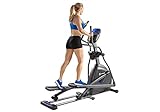
The elliptical trainer was conceived as a direct answer to the problem of GRF. Its foundational genius lies in a simple yet profound mechanical principle: your feet never leave the pedals. By creating a closed-loop, continuous motion, the elliptical cleverly sidesteps the entire impact phase of gait. There is no “foot strike,” and therefore, no “ground reaction.”
The force profile of a person on an elliptical is dramatically different from a runner’s. Research in publications such as the Journal of Sports Science & Medicine confirms that the GRF on an elliptical is significantly lower, often staying well below a user’s actual body weight. The machine’s flywheel, like the 14.3-pound one found in a model such as the Horizon EX-59, helps to smooth out the motion, creating a consistent and fluid momentum that eliminates the jarring peaks and valleys of force. This is the “science of silence”—the quiet operation of a well-designed elliptical is an audible testament to the absence of impact.
However, simply removing vertical impact is only half the battle. A truly safe and comfortable workout must also account for the natural alignment and movement patterns of the human body. This brings us to the more subtle, yet equally critical, aspects of ergonomic design.
Deeper Ergonomics: The Code to Comfort and Safety
Once the primary issue of impact is solved, the focus shifts to refining the movement to match our intrinsic biomechanics. Two often-overlooked parameters are paramount: the Q-Factor and the stride length.
Q-Factor: The Critical Distance Between Your Feet
Q-Factor is the horizontal distance between the center of the two pedals. A wide Q-Factor forces your feet further apart than your hips, causing your knees to angle inward during the stride (a state known as valgus). This unnatural alignment can place significant stress on the medial (inner) structures of the knee.
Conversely, a narrower Q-Factor, as prioritized in designs like Horizon’s SixStar frame, more closely mimics a natural walking or running stance. It allows the hips, knees, and ankles to track in a relatively straight line, minimizing sideways torque on the joints. According to studies in journals like Clinical Biomechanics, minimizing this varus-valgus stress is crucial for long-term knee health. When evaluating an elliptical, a narrower Q-Factor is a strong indicator of superior ergonomic design.
Stride Length: Matching the Machine to Your Motion
Stride length refers to the longest distance between the pedals during their elliptical path. An optimal stride length allows for a full range of motion without over-stretching or feeling choppy. This is highly dependent on an individual’s height and, more specifically, their leg length.
An 18-inch stride length, as featured on the EX-59, is often a good middle-ground that accommodates a wide range of users of average height. However, for individuals who are very tall, it might feel restrictive, while for shorter users, it might feel too long. This highlights a crucial point: while a specific machine can serve as an excellent example of certain design principles, there is no single “perfect” machine for everyone. The principle is what matters: the stride length should feel natural and unforced, allowing your body to move in a way that feels fluid, not robotic.

Conclusion: Beyond Protection to Promotion of Health
The conversation around low-impact cardio often centers on injury avoidance. While this is a profound benefit, the story doesn’t end there. Low-impact exercise does more than just protect our joints; it can actively promote their health. The gentle, consistent motion encourages the circulation of synovial fluid, the viscous substance that lubricates and nourishes our cartilage. In this light, an elliptical workout is not just a retreat from the damage of high-impact activity, but an investment in the resilience and longevity of our joints.
Understanding the biomechanics of Ground Reaction Force and the nuances of ergonomic design empowers you to look beyond marketing claims. It allows you to see a piece of fitness equipment not as a collection of features, but as a dynamic interface with your own body. By prioritizing principles like the elimination of impact, a narrow Q-Factor, and an appropriate stride length, you are not just choosing a machine; you are choosing a smarter, safer, and more sustainable way to pursue a lifetime of health and movement.