
Decoding Home Comfort: Why Your House Can’t Breathe and What to Do About It
It’s a story as old as central air conditioning. You’re in the living room, perfectly comfortable. But your partner in the upstairs bedroom is complaining it feels like a sauna. Meanwhile, the guest room at the end of the hall feels like an icebox. You find yourself in the middle of the “Thermostat Wars,” constantly adjusting the temperature, but never truly making everyone happy. You blame the thermostat, the age of the house, maybe even the sun’s position. But what if the real culprit is invisible? What if your house… is struggling to breathe?
It sounds strange, but your home’s heating, ventilation, and air conditioning (HVAC) system functions a lot like a respiratory system. It has a powerful set of lungs—the blower fan in your furnace or air handler. It has a complex network of airways—the ductwork hidden in your walls and ceilings. And its job is to inhale air from your home, condition it (heat or cool it), and then exhale it evenly into every single room. When this system works perfectly, your entire home feels comfortable. But when it can’t breathe properly, you get those frustrating hot and cold spots, and you start losing the Thermostat Wars. The force governing this entire process, the invisible enemy of your comfort, is something professionals call static pressure.

The Secret Language of Air: Understanding Static Pressure
Forget the technical jargon for a moment. Imagine your ductwork is a city’s highway system, and the air is the traffic. Your furnace’s blower fan is the central dispatch, pushing all the cars (air particles) onto the highways to get to their destinations (your rooms).
Static pressure is simply a measure of traffic congestion in that highway system.
It’s the resistance, the push-back, that the fan has to overcome to move air. Every twist and turn in the ducts, every grille, and especially your air filter, creates a little bit of a bottleneck. A little bit of congestion is normal and expected. But when the congestion gets too high, traffic slows to a crawl. The fan is still working furiously—in fact, it’s working harder than ever—but the air just isn’t getting where it needs to go. Rooms farthest from the fan get starved of air, while those closest might get blasted.
How much congestion is too much? HVAC experts, like those at the Air Conditioning Contractors of America (ACCA), have determined a “healthy” blood pressure for your home’s airways. For most residential systems, the total resistance, or Total External Static Pressure (TESP), should be at or below 0.5 inches of water column (inWC). It’s a tiny unit of measurement, born from early experiments using U-shaped tubes of water, but it’s the gold standard for diagnosing your system’s health. When that number starts to climb to 0.7, 0.9, or even higher, your system is officially suffocating. And the consequences are more than just discomfort; according to research from the Texas A&M University, a mere 20% reduction in airflow can slash your system’s energy efficiency by a staggering 17%. Your fan is spinning its wheels, your energy bill is climbing, and you’re still not comfortable.
Finding the Blockages: The Three Usual Suspects
So, if the ‘blood pressure’ of your home’s circulatory system is too high, where are the likely blockages? It turns out, the culprits are often hiding in plain sight.
1. The Clogged Artery: Your Air Filter
This is, without a doubt, the number one cause of high static pressure. We think of an air filter’s job as cleaning the air, but its primary role is to protect the sensitive internal components of your furnace. When it’s clean, air passes through easily. When it’s clogged with dust, pet hair, and dander, it becomes a formidable barrier. The U.S. Department of Energy notes that a dirty filter can dramatically increase system resistance. A filter that’s supposed to add 0.1 inWC of pressure when clean can easily add 0.3 inWC or more when clogged. That one single component can be responsible for more than half of your system’s “healthy” pressure budget. It’s like forcing your furnace to breathe through a wet cloth.
2. The Constricted Lungs: The Indoor Coil
Inside your system, there are two coils that look like a car’s radiator: the evaporator coil (for AC) and sometimes a heating coil. These are packed with thin metal fins to maximize heat transfer. They are also a magnet for any dust that gets past your filter. Over years, a fine layer of grime can build up, slowly choking off the space between the fins. This is a much more insidious problem than a dirty filter because it’s hidden from view. A dirty coil can easily add an extra 0.2-0.4 inWC of pressure, crippling your system’s airflow without you ever seeing the cause.
3. The Twisted Pathways: Your Ductwork
Your ductwork is the great unknown for most homeowners. Unfortunately, it’s often the source of major problems. According to the ENERGY STAR program, leaky or poorly designed ducts can waste up to 30% of your conditioned air before it even reaches the rooms. From a pressure perspective, several issues can arise:
* Undersized Ducts: The most common issue. Builders may use ducts that are too small to save money, essentially creating a permanent bottleneck.
* Sharp Bends and Long Runs: Every sharp turn is like a kink in a garden hose, dramatically increasing resistance.
* Blocked Vents: A closed vent, or one blocked by furniture, doesn’t just stop air from entering that room. It increases back-pressure on the entire system, like closing off a lane on the highway.
In fact, the National Comfort Institute estimates that over half of all HVAC systems in North America are underperforming due to installation or design flaws, with ductwork being a primary offender.
The Doctor’s Stethoscope: How Pros “Listen” to Your Home
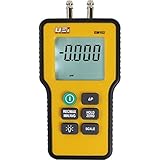
While you can spot some of these issues yourself, pinpointing the exact location and severity of the blockage requires a specialist. And just like a doctor uses a stethoscope to listen to your lungs, an HVAC technician uses a special device to listen to your home’s ‘breath’: a digital manometer.
A tool like the UEi EM152 is a sensitive pressure meter. By inserting small probes into the ductwork before and after the blower fan, a technician can get a precise reading of the TESP—your system’s overall blood pressure. But its real power lies in its differential capability. By measuring the pressure drop across just the air filter, or just the indoor coil, they can tell you exactly how much each component is contributing to the problem. They can turn the invisible world of air pressure into hard numbers, transforming guesswork into a precise diagnosis. It’s this diagnostic ability that separates a true professional from a parts-changer.

Your Home’s Respiratory Health: A Simple Self-Check
You don’t need a manometer to perform a basic health check on your home’s breathing. Here’s what you can do this weekend:
- Check the Filter: Pull it out. If it looks gray and clogged, replace it. This is the single most effective thing you can do.
- Inspect All Vents: Walk through every room. Are any vents closed? Is any furniture, like a couch or dresser, pushed right up against a return air grille? Give them space to breathe.
- Listen to the System: Does the fan sound unusually loud or strained? Do you hear whistling in the vents? These can be signs of high pressure.
- Feel the Flow: Is the airflow coming out of the vents in the problem rooms noticeably weaker than in others? This is a classic symptom.
Conclusion: Let Your Home Breathe Freely
The comfort in your home isn’t just about the number on the thermostat. It’s about the silent, invisible flow of air that connects every room. When that flow is restricted by high static pressure, your home struggles to breathe, leading to discomfort, wasted energy, and premature wear on your expensive equipment.
By understanding this fundamental concept, you’re no longer just a passive participant in the Thermostat Wars. You’re an informed homeowner who understands the language of your home’s most vital system. You know that a simple filter change isn’t just a chore—it’s giving your home a breath of fresh air. And you know that when problems persist, a professional with the right tools can listen to that breath and restore the healthy, comfortable, and efficient balance your home was designed to have.