The Fever Curve Decoded: A Parent’s Guide to Tracking Your Child’s Fever

That glowing number on the thermometer screen—102.4°F. It’s a sight that can make any parent’s heart skip a beat. In an instant, your mind races with questions and anxieties. Your first instinct is to do something, anything, to make that number go down. This feeling, this rush of protective worry, is a profound expression of love. It’s completely normal.
But what if that number wasn’t an alarm bell demanding immediate action, but the first sentence in a story? What if you could transform your role from a panicked firefighter, rushing to douse a flame, into a calm, observant detective, gathering the very clues that will help your child get better? With a modern digital thermometer and a small shift in mindset, you can. This guide will show you how to decode the story of a fever, moving beyond a single, scary number to understand the much more important narrative: the fever curve.

Step 1: Shift Your Mindset – From Firefighter to Detective
First, let’s reframe the enemy. A fever, in itself, is not the illness. It’s a sign that your child’s incredible immune system is firing up and fighting off an infection. A fever is a healthy, active response; it’s a friend, not a foe. Our job as caregivers isn’t necessarily to extinguish this fire, but to ensure our child is comfortable and supported while their body does its work.
When you see yourself as a detective, the goal changes. You’re no longer just trying to lower a number. You’re trying to understand the situation. You’re looking for patterns, noting changes, and collecting information. This simple shift is incredibly empowering. It replaces anxiety with purpose, and panic with a plan.
Step 2: Create Your “Fever Diary” – Your Case File
Your most important tool, besides your love and comfort, is information. A “Fever Diary” is a simple log you keep during an illness. It doesn’t need to be fancy; the notes app on your phone or a simple notepad will do. This diary will become your single source of truth, helping you see the bigger picture and communicate with incredible clarity to your pediatrician.
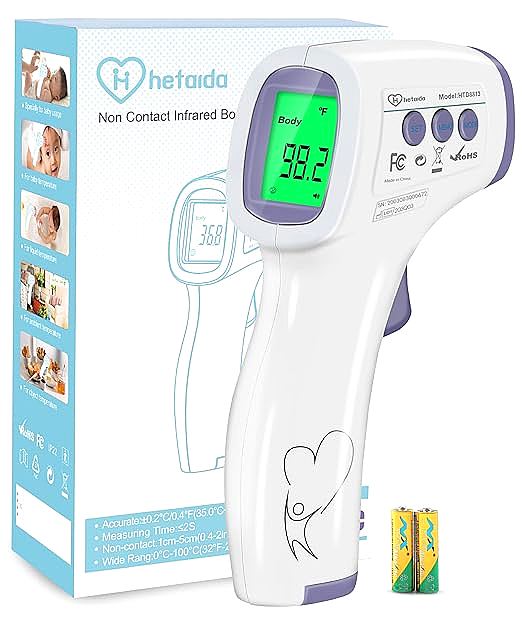
A modern thermometer, like the hetaida HTD8813C, is built for this exact task. Its ability to store up to 50 previous readings means it automatically starts a log for you. You can scroll back through the measurements to fill in your diary if you missed a log entry. The key is consistency. Here’s what to record in your diary at each check-in:
- Time & Temperature: The exact time you took the reading. This is crucial for seeing the pattern.
- Behavior & Mood: This is just as important as the number. Is your child playful and drinking fluids despite a 102°F fever? Or are they listless and refusing to drink with a 101°F fever? Note it down. Use simple words: “Playful,” “Cranky,” “Sleepy,” “Crying.”
- Other Symptoms: Note any other signs. A cough? A runny nose? A new rash?
- Medication: If you give a fever-reducer like acetaminophen or ibuprofen, log the exact time and dosage.
Thanks to features like a Silent Mode, you can be a truly stealthy detective. You can take your child’s temperature while they are sleeping without a disruptive beep, ensuring they get the rest they desperately need while you continue to gather crucial data.
Step 3: Read the Clues – The Trend is More Important Than the Peak
Once you have a few entries in your diary, you’ll start to see something more valuable than a single temperature reading: a pattern. This pattern, or fever curve, is the story of the illness. Learning to read it is your superpower. Ask yourself these questions as you look at your log:
- What is the overall direction? Is the temperature generally trending upwards, staying flat, or slowly coming down over a 24-hour period? A fever that is slowly trending down is a great sign, even if it’s still “high.”
- How does my child act at the peak? A high fever can be scary, but if your child still perks up and plays a little when the fever comes down, it’s a very reassuring sign.
- How is the medication working? Note the temperature before giving medicine and then 1-2 hours after. Did the temperature drop? By how much? This shows how well their body is responding.
The color-coded backlight on many modern thermometers provides an instant clue. Green is good, yellow is a heads-up, and red indicates a significant fever. This visual cue helps you assess the situation at a glance, especially in a dimly lit room, before you even focus on the specific digits.

Step 4: Communicate with Confidence – Presenting Your Findings
When you call or visit the doctor, you are now more than just a worried parent; you are an informed partner in your child’s care. Instead of saying, “He’s had a fever for a couple of days,” you can say:
“His fever started yesterday afternoon. It peaked at 103.2°F last night at 2 a.m. After a dose of ibuprofen, it came down to 101.5°F and he was able to sleep. Today, his temperature has been fluctuating between 101°F and 102.5°F. He’s been drinking well but is much sleepier than usual.”
This level of detail is incredibly valuable to a healthcare provider. It paints a clear picture of the illness’s progression and helps them make a much more accurate assessment. You have provided the key chapters of the story, allowing the doctor to help write the ending.
By embracing your role as a data detective, you transform one of the most stressful parts of parenting into a manageable and meaningful process. You learn to listen to the subtle language of your child’s body, armed not with anxiety, but with the quiet confidence of knowledge. And that, more than any medicine, is a powerful form of love.