The Quantum Leap in Your Coffee Cup: Why a Precision Grinder is a Portal to Flavor

It’s a familiar story of culinary tragedy. You’ve sourced beautiful, ethically grown coffee beans from a specialty roaster, noting the promised flavors of jasmine, bergamot, and ripe stone fruit. You bring them home, your anticipation building. Yet, the resulting cup is a shadow of that promise—a flat, muddled liquid, perhaps tinged with a harsh bitterness or a thin, sour edge. The vibrant soul of the bean seems to have vanished somewhere between the bag and the brew. Where did the flavor go?
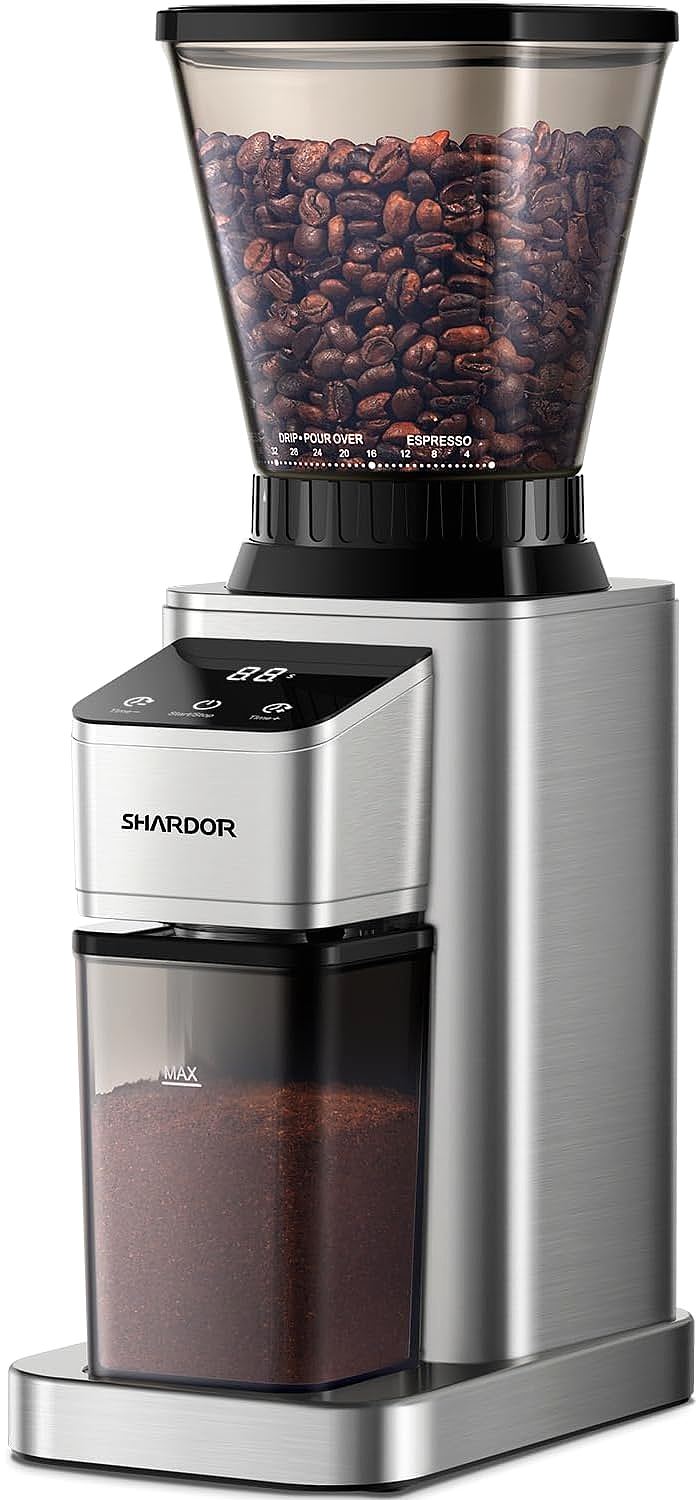
If the beans are innocent, our investigation must turn to the scene of the crime: the grinder. For many, this is a simple, almost brutish, preparatory step. But in reality, the act of grinding is the most critical and violent transformation your coffee will ever undergo. It is here, in a matter of seconds, that the potential for a sublime cup is either unlocked or irrevocably lost. The difference lies in understanding that a high-quality grinder, like the SHARDOR Electric Conical Burr Grinder, isn’t just a kitchen appliance; it’s a scientific instrument, a portal to the microscopic universe of flavor.

The Physics of Uniformity: From Chaos to a Harmonious Chorus
Let’s examine the evidence at a microscopic level. The first clue lies not in what a grinder does, but how it does it. A standard blade grinder operates on a principle of violent, chaotic impact. It’s the equivalent of taking a sledgehammer to a bag of walnuts; you end up with an unpredictable mishmash of large chunks, fine powder, and everything in between. In coffee terminology, these are “boulders” and “fines.” When water is introduced to this chaotic mix, disaster strikes. The fine particles, with their immense surface area, over-extract almost instantly, releasing bitter, astringent compounds. Meanwhile, the large boulders under-extract, contributing sour, underdeveloped notes. The final cup is a tug-of-war on your palate, a muddled brew where no single flavor can truly sing.
This is where the concept of a conical burr grinder introduces a paradigm shift. Instead of smashing, it mills. Imagine two cone-shaped, serrated pieces of steel, one nesting inside the other, turning at a relatively low speed. The beans are drawn down between them and are progressively crushed and ground into particles of a remarkably consistent size. It transforms the chaotic noise of a blade grinder into a harmonious chorus. This uniformity is the bedrock of a balanced extraction. Water flows through the grounds evenly, coaxing out the desirable sugars, acids, and oils at a consistent rate.
A grinder equipped with a wide range of adjustments, such as the SHARDOR’s 48 distinct settings, gives you the power of a conductor. You can dial in the precise particle size required for your chosen brewing method. According to the Specialty Coffee Association (SCA), different methods require vastly different grind sizes to achieve optimal extraction. A grinder’s versatility allows you to navigate this spectrum, from the fine, flour-like grounds needed for the intense, high-pressure extraction of espresso (around 200-400 microns) to the coarse, sandy texture ideal for the long, gentle immersion of a French press (upwards of 1000-1500 microns). This control over particle size distribution is the first, and perhaps most important, step in solving the case of the missing flavor.

The Thermodynamics of Aroma: Preserving the Soul of the Bean
Achieving a uniform particle size is like getting the orchestra to play in tune. But what if the concert hall is on fire? The next culprit we must investigate is an invisible one: heat. Grinding is a process of intense friction, and friction generates heat. This is the silent killer of coffee’s most precious and volatile assets: its aromatic compounds.
These compounds—the delicate florals, the bright citrus notes, the deep chocolatey aromas—are incredibly fragile. Think of them as being sealed within tiny, heat-sensitive capsules inside the bean. Excessive heat generated by a high-speed grinder acts like a premature flame, either destroying these compounds outright or causing them to vaporize and escape before they ever have a chance to reach your cup. Research has shown that a significant percentage of coffee’s aromatic compounds can be lost within minutes of grinding, a process rapidly accelerated by heat.
This is why the low-speed operation of a well-engineered conical burr grinder is so crucial. By minimizing rotational speed, it minimizes the build-up of thermal energy. It’s a gentle process, designed to awaken the bean’s potential rather than shocking it. It carefully unlocks the flavor capsules without melting them down, ensuring that the complex, beautiful aromas developed during roasting are preserved for the final brew. The use of solid stainless steel for the burrs, as seen in the SHARDOR, also aids in heat dissipation, further protecting the coffee’s very soul.
The Electromagnetism of Grinding: Taming the Static Dance
By keeping things cool, we’ve preserved the delicate soul of the coffee. Yet, another gremlin lurks in the process, one that makes a mess of our workspace and can sabotage our extraction. We’re talking about the wild, untamed dance of static electricity.
As coffee beans are fractured and tumbled, friction causes an exchange of electrons—a phenomenon known as the triboelectric effect. This results in the coffee grounds becoming statically charged. The consequences are both annoying and detrimental. Grounds cling stubbornly to the grinder’s chute and collection bin, leading to wasted coffee and a messy counter. More critically, this static can cause clumping and uneven distribution of grounds in your portafilter or brewer, creating dense spots and empty channels. This leads to “channeling” during extraction, where water bypasses most of the coffee and gushes through the weak spots, resulting in a thin, sour, and utterly disappointing cup.
Advanced grinders now incorporate anti-static technology to combat this very problem. While the specific mechanisms can vary, from using conductive materials to optimizing the geometry of the grounds path, the goal is the same: to neutralize the static charge as the coffee exits the burrs. The result, as one user review for the SHARDOR notes, is a grinder that is “so much cleaner than any grinder I have ever used in the past.” This isn’t just a matter of convenience. By ensuring a fluffy, static-free stream of grounds, it allows for a more consistent dose and a more uniform bed of coffee, giving you a fighting chance at achieving a perfect, channel-free extraction, every single time.

Conclusion: Your Grinder as a Scientific Instrument
A truly exceptional cup of coffee is not an accident. It is the result of controlling variables. It is the intersection of art and science. While you, the barista, are the artist, your grinder is your most important scientific instrument. It allows you to control the fundamental physical and chemical properties of your primary ingredient.
Investing in a precision conical burr grinder is about more than just convenience or a desire for kitchen gadgets. It is a conscious decision to take control of your coffee’s flavor. It’s an acknowledgment that the journey from bean to cup is a microscopic marvel, and you want to be its master. By understanding the physics of uniformity, the thermodynamics of aroma, and the electromagnetism of static, you transform a simple morning ritual into a daily act of delicious discovery. You become the lead investigator in your own culinary adventure, and with the right tool, you’ll find that the missing flavor was there all along, just waiting to be unlocked.