Why Your Homemade Coffee Disappoints: The Science of a Perfect Brew

In the quiet hum of countless kitchens each morning, a near-universal quest unfolds: the pursuit of that truly great cup of home-brewed coffee. It’s a ritual, a comfort, often a necessity. Yet, for many, it remains an elusive ideal, a daily gamble fraught with the peril of a brew that’s disappointingly bitter, unpleasantly sour, or simply devoid of life. We’ve all been there, haven’t we? Staring into a mug that promises so much yet delivers so little, wondering if the art of a perfect cup is destined to remain the exclusive domain of our favorite café. But what if the secret isn’t found in ever-more-complex machinery or an arcane set of barista skills, but rather in a return to, and a deeper understanding of, the fundamental science of coffee itself?
This is not a story about magic beans, but about the measurable, repeatable physics and chemistry that transform roasted beans and hot water into liquid poetry. To truly appreciate how to elevate your daily brew from a game of chance to a guarantee of pleasure, we must first become detectives in our own kitchens. So, where do we begin our investigation into these coffee crimes? The first and most crucial piece of evidence is almost always the same: temperature.

The Spark of Flavor – The Critical Role of Water Temperature
Imagine trying to unlock a treasure chest with a key that’s almost, but not quite, the right shape. That’s akin to brewing coffee with water at the wrong temperature. The Specialty Coffee Association (SCA), a leading authority in the global coffee community, has long championed an optimal water temperature range of 195°F to 205°F (approximately 90.5°C to 96.1°C) for optimal extraction. This isn’t an arbitrary window. Within coffee grounds lie hundreds of aromatic and flavor compounds, each with its own ideal solubility characteristics. Water that’s too cool (below 195°F) will struggle to efficiently dissolve the desirable sugars and complex organic acids, leading to an under-extracted brew that tastes disappointingly sour, grassy, or thin. Conversely, if the water is excessively hot (much above 205°F), it can aggressively strip out less desirable compounds, including bitter-tasting alkaloids and phenols, effectively “scalding” the delicate flavors and creating harshness. It’s a delicate balance, a perfectly timed chemical reaction where temperature dictates which products are favorably formed.
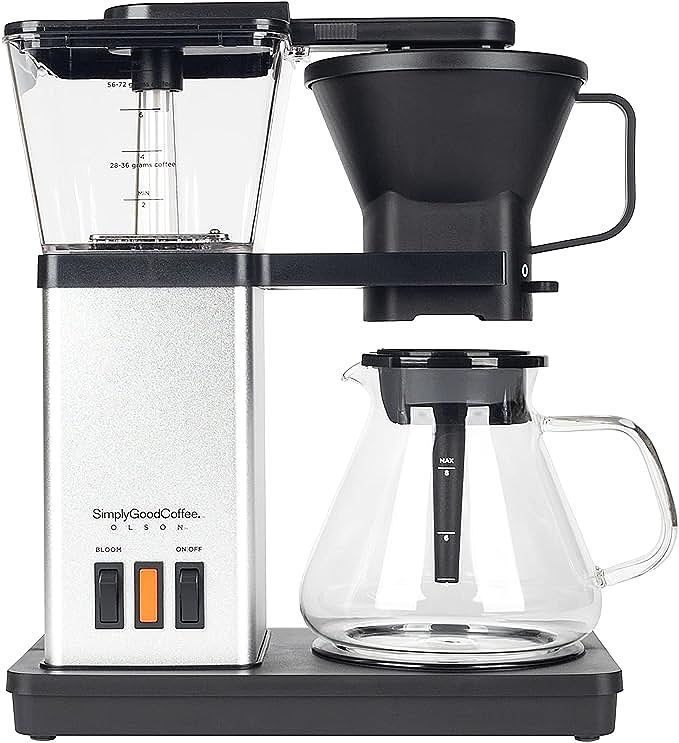
This is where the engineering of a brewer becomes paramount. Many basic coffee makers fail at this first hurdle, never reaching the minimum temperature or experiencing wild fluctuations. A machine designed to conquer this challenge, such as the Simply Good Coffee Olson Brewer, tackles this with a robust 1560-watt heating element. As noted by reviewers like Arne Preuss of Coffeeness, this substantial power isn’t just for show; it ensures the water is rapidly brought up to the ideal brewing temperature and, crucially, maintains that temperature throughout the brewing cycle. The “pumpless design,” as mentioned on the SimplyGoodCoffee FAQ, further contributes to this thermal stability by likely using a thermal siphon system, which avoids injecting cooler water into the heating chamber mid-brew, a common issue in cheaper pump-driven models. This means you’re not just getting hot water; you’re getting precisely heated water, optimized to coax out the full spectrum of your coffee’s potential, from bright, fruity notes to deep, chocolaty undertones.

The Embrace of Water – Achieving Uniform Saturation
Once you have perfectly heated water, the next challenge is ensuring it interacts uniformly with every single coffee particle. If you’ve ever peeked into a filter after a sub-par brew, you might have noticed dry clumps or areas where water seems to have rushed through, carving little channels. This “channeling” is a common culprit behind inconsistent coffee. Areas that receive too much water flow will over-extract, lending bitter notes, while under-saturated areas will contribute sour, underdeveloped flavors. The result is a muddled, unbalanced cup. To combat this, you need two things: a showerhead that distributes water evenly and a brew basket large enough to hold a proper dose of coffee without it turning into a compressed, muddy mess. The ideal coffee-to-water ratio is typically between 1:15 and 1:18 by weight, and cheap brewers often have baskets too small to handle this for a full pot, leading to overflows.
The Olson Brewer is designed with these challenges in mind. It features a showerhead engineered to distribute hot water gently and evenly across the coffee bed. While one reviewer expressed initial concern about its width, others, like Coffee Kevin, highlighted its “wide coverage of water droplets” and praised how evenly the grounds were soaked post-brew, stating it performed “about as well as a manual pour-over.” This even application is crucial. Furthermore, as pointed out by both Barista Magazine and Coffeeness, the Olson boasts an “extra-large” brew basket. This provides ample space for the coffee grounds to expand when wetted (a phenomenon known as the “bloom”), ensuring water can percolate evenly through the entire mass of coffee and preventing messy overflows when using a proper dose for an 8-cup brew.

The Awakening Breath – The Science and Soul of the Bloom
For those new to specialty coffee, the term “bloom” might sound poetic, but it’s a critical, science-backed step. When coffee beans are roasted, carbon dioxide (CO2) gets trapped within their cellular structure. Upon contact with hot water, this gas is rapidly expelled, causing the coffee bed to visibly puff up and bubble. This matters immensely. Firstly, that escaping CO2 can create a gaseous barrier that repels water, hindering even saturation and extraction. Allowing it to dissipate first paves the way for a more thorough brew. Secondly, dissolved CO2 can impart a sour taste. Letting it escape beforehand leads to a cleaner, sweeter cup. It’s like letting a fine wine “breathe” before drinking.
Recognizing this, the Olson Brewer incorporates an optional “bloom” function, activated by a dedicated switch—a feature cherished by manual pour-over enthusiasts but rare at this price point. When selected, the brewer dispenses a small amount of hot water to saturate the grounds, then pauses automatically, allowing that crucial degassing to occur before resuming the main brew cycle. This simple addition translates a professional technique into an effortless, automated step. However, it’s important to be transparent about its practical application. One in-depth review by Ryan Woldt noted that while the feature is unique, its effectiveness is best with smaller batches, suggesting it works best with 30g of coffee or less, as the water dispersed may not fully immerse all the grounds in a larger batch. This is a thoughtful detail for those who often brew smaller amounts and a point to consider for those who exclusively brew full pots.
The Measured Dance – Mastering Brew Time and Extraction
The final piece of this elemental puzzle is time—the total duration the hot water is in contact with the coffee grounds. If water passes through too quickly, it won’t have sufficient time to dissolve the desired soluble solids, leading to a weak, watery, and often sour under-extracted coffee. If the contact time is too long, the water will begin to extract less desirable compounds, resulting in a harsh, bitter, and astringent over-extracted brew. The SCA suggests an ideal contact time for a full pot is typically within the 4 to 8-minute range.
The Olson Brewer is engineered to hit this sweet spot with consistency. Multiple sources report that it brews a full 8-cup pot in as little as six minutes, with a range of 6-8 minutes noted by others. This speed is not arbitrary; it’s a carefully calibrated rhythm that aligns with industry standards for balanced extraction. The efficiency of its heating system and water delivery mechanism work in tandem to ensure the entire process occurs within this optimal timeframe, so you are neither left waiting excessively long nor sacrificing quality for speed.
The Thoughtful Details: Where Engineering Meets Everyday Grace
With the four pillars of extraction—temperature, saturation, blooming, and time—firmly in place, the scientific heavy lifting is done. But the journey from a great brew to a great experience is paved with smaller, yet equally important, thoughtful details. The Olson Brewer includes several. Its glass carafe, for instance, is equipped with an internal mixing tube. This addresses a common issue where the first coffee to drip is stronger than the last; the tube gently circulates the coffee, ensuring a homogenous and consistent pot from top to bottom. Then there’s the hot plate. While purists often fear hot plates “baking” coffee, the Olson’s is pragmatic, with a 40-minute auto shut-off timer that keeps the coffee warm for a reasonable window without stewing it for hours. And perhaps most importantly, as Barista Magazine enthused, this is all achieved with the simplicity of one or two buttons.
It becomes clear that a machine like the Olson Brewer isn’t just a collection of parts. It carries the imprint of its founder, Laura Sommers, a 30-year industry veteran whose philosophy, as quoted, is that “coffee taste is paramount, ease of use is required, and lower cost makes this a great value for millions more households.” It’s about democratizing good coffee by translating established science into an approachable and effective tool.
Redefining Your Morning: From Gamble to Guarantee
The quest for that perfect cup of home-brewed coffee need no longer be a daily game of chance. By understanding the fundamental science—the critical role of precise water temperature, the necessity of even saturation, the awakening power of the bloom, and the delicate rhythm of brew time—we arm ourselves with knowledge. When that knowledge is embodied in a machine meticulously designed to honor these principles with effortless grace, the morning ritual is transformed. It shifts from a source of potential frustration to a moment of quiet confidence. There’s a unique satisfaction in knowing why your coffee tastes so good, in appreciating the subtle interplay of elements that you, with the help of a thoughtfully engineered tool, have orchestrated. This approach doesn’t just make coffee; it offers an invitation to a deeper appreciation of the art and science within your cup, making the pursuit of “simply good coffee” a delightful and consistently achievable reality.