
Your Coffee Maker’s Hidden Manual: An Engineer’s Guide to Better Brewing
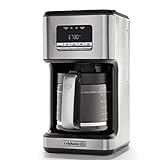
The user manual that came with your coffee maker is a masterpiece of omission. It tells you what each button does: press “Strong,” and the coffee gets stronger. It fails to tell you how it achieves this, why it works, and most importantly, when you should—and shouldn’t—use it. It treats your sophisticated appliance like a simple toaster when, in reality, it’s more like a camera with a hidden manual mode.
This is the guide they should have written. We’re going to pop the hood on your coffee maker, using the Calphalon 14-Cup Programmable model as our example, and decode the engineering logic behind its controls. Forget the marketing names. We’ll explore these features as what they truly are: powerful variables you can manipulate. By the end of this, you’ll be able to tune your machine like a performance vehicle, dialing in the perfect settings for your specific taste.

The Master Switch: Decoding “Strong Brew”
The “Strong Brew” button is perhaps the most misunderstood control on any coffee maker. Does “strong” mean more concentrated? Or does it mean more bitter? The answer, frustratingly, can be both, and it all depends on how you use it.
First, let’s get our terms straight. In coffee, Strength refers to the concentration of dissolved coffee solids in the water (Total Dissolved Solids, or TDS). It’s about how intense the coffee tastes. Extraction, on the other hand, refers to how much of the soluble compounds were removed from the coffee grounds. Under-extraction tastes sour; over-extraction tastes bitter. The goal is a high strength with a balanced extraction.
The “Strong Brew” button is, at its core, a water pump controller. When you activate it, it doesn’t add more coffee or use hotter water. Instead, it changes the rhythm of the water pump, introducing longer pauses between pulses of water. This slows down the overall brewing process, increasing the contact time between the water and the coffee grounds.
Your Tuning Guide:
* Use It When: You’re using light-to-medium roast beans, which are denser and harder to extract. Or, if your coffee consistently tastes a little sour or weak, indicating under-extraction. The extra time will help pull out more sugars and deep flavors to balance the acidity.
* Avoid It When: You’re using very dark roast beans, which are more porous and extract very easily. It’s also a bad idea if your grind is very fine. In these cases, the extended contact time is a direct path to over-extraction, resulting in a harsh, bitter cup. Think of it as a turbocharger: powerful, but if you use it at the wrong time, you’ll blow the engine.

Small Scale, Big Science: The “1-4 Cup” Setting
At first glance, a “1-4 Cup” button seems redundant. Can’t you just put less water in? The existence of this button is an admission of a fundamental physics problem: brewing small batches is inherently different from brewing large ones.
There are two main challenges. First, thermal mass. A small volume of water loses heat more rapidly as it travels through the machine’s tubing than a large volume. This can lead to the brewing water arriving at the grounds below the optimal 195°F temperature. Second, contact time. The water will flow through a shallower bed of coffee grounds much more quickly, reducing the time it has to extract flavor. Both factors conspire to create a weak, sour, under-extracted brew.
The “1-4 Cup” setting is an engineered compensation for these problems. Like the “Strong Brew” function, it manipulates the water pump to significantly extend the brewing time. The machine’s programming is essentially trying to replicate the longer contact time of a full-pot brew. Some advanced models might also pulse the heating element more aggressively to counteract the heat loss.
Your Tuning Guide:
* This is not an optional “flavor booster.” If you are brewing 5 cups or fewer in this 14-cup machine (or less than half in any machine), you should consider this button mandatory. It’s a corrective feature designed to fight physics. Using it ensures your small batches have a fighting chance at a balanced extraction.

The Art of the Pause: “Grab-and-Go” and Its Consequences
The “Grab-and-Go Auto Pause” feature feels like magic. You pull the carafe out mid-brew, and the flow of coffee just stops. But as any engineer will tell you, there’s no magic, only mechanics—and every mechanical solution has consequences.
The mechanism is a simple spring-loaded valve at the bottom of the brew basket. The rim of the carafe pushes a plunger up, opening the valve. When you remove the carafe, the spring pushes the plunger down, sealing the opening. The consequence? The hot water that continues to be showered onto the grounds is now trapped. Instead of flowing through, it sits and steeps, like a French press.
This brief but intense steeping period can cause a localized over-extraction in the saturated grounds. When you replace the carafe, this concentrated, potentially bitter coffee is the first thing to drip into the pot, which can affect the overall taste profile.
Your Tuning Guide:
* Treat this feature as an emergency brake, not a standard function. The best cup of coffee is an uninterrupted one.
* If you absolutely must use it, try to do so very early in the brew cycle or right at the very end, to minimize the impact on the crucial main extraction phase.
The Long Goodbye: Optimizing the Adjustable Warming Plate
We’ve established in our previous “autopsy” that a warming plate is a flavor killer in slow motion. The adjustable plate on the Calphalon is a tool for damage control. The High, Medium, and Low settings are not about “good, better, best”—they are a direct trade-off between temperature and taste.
Your Tuning Guide (A Decision Tree):
* Are you drinking the entire pot immediately? → Set it to Low or, even better, turn the machine off as soon as it’s done brewing.
* Will the coffee be consumed within an hour? → Low is your best bet. It will keep the coffee acceptably hot without rapidly destroying the flavor.
* Do you need to keep it hot for 1-2 hours? → Use Medium, but accept that the last cup will not taste as good as the first.
* Is there ever a reason to use High? → Rarely. The primary scenario is if you plan to immediately transfer the coffee to a large, un-preheated thermal carafe for transport. The extra heat will help offset the temperature loss during the transfer. For direct drinking, it’s almost always too aggressive.

Conclusion: From User to Super-User
Your coffee maker’s control panel is not a collection of mysterious presets. It is a dashboard. Each button offers you a lever to control the fundamental variables of coffee brewing: time, temperature, and flow. By understanding the engineering and science behind them, you move beyond the factory settings and start making the machine work for you.
Stop hoping for a good cup of coffee. Start engineering one. Experiment with these settings. See how the “Strong Brew” function interacts with a slightly coarser grind. Notice the difference in a small batch with and without the “1-4 Cup” mode. You are no longer just the user. You are now the super-user, the true master of your machine.