
The Invisible Data in a Drop of Water: How We Learned to Read Chemistry
A glass of water sits on the table. It’s clear, still, and seemingly simple. But this placid surface hides a universe of information. Within that single drop lies a dynamic chemical reality—a precise balance of acidity, a specific concentration of dissolved minerals, a silent dance of ions. This invisible data dictates the success of a hydroponic farm, the health of a coral reef aquarium, and the safety of our drinking water.
For centuries, this world was inaccessible. Today, we can dip a small, pen-sized device into the water and watch as its chemistry translates into neat, clean numbers on an LCD screen. But this act of translation is a small miracle of engineering. And it begs a more profound question than “What is the pH?”. The real question is: how can we trust the number on the screen?
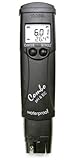
This is not a story about a single product, but about the battle against uncertainty that every measurement scientist and engineer must fight. We’ll use a modern professional meter, the Hanna Instruments HI 98130, not as our subject, but as our guide—a perfect illustration of the ingenious solutions designed to read the invisible.

The Ghost in the Machine: Temperature’s Deception
Before we can measure anything, we must confront the universal saboteur of chemical measurement: temperature. It is the ghost in the machine, silently altering the reality we are trying to observe.
In the world of chemistry, temperature is energy. When water warms up, the ions within it zip around with more vigor. This has two critical consequences. For pH, which relies on the potential difference across a glass membrane, this increased energy changes the sensor’s response characteristics, as described by the Nernst equation. A measurement taken at 10°C and one at 30°C will report different pH values for the exact same water, unless corrected.
For Electrical Conductivity (EC), a proxy for the total dissolved solids (TDS) in water, the effect is even more dramatic. Warmer water is less viscous, and its energized ions move more freely, creating a more conductive “highway” for electricity. The conductivity of a solution can increase by as much as 2% for every degree Celsius it warms.
This is why Automatic Temperature Compensation (ATC) isn’t a luxury feature; it is the absolute bedrock of trustworthy measurement. It’s the instrument’s ability to self-correct, to translate the “hot” reading back to a universal standard, typically 25°C. In the design of a meter like the HI 98130, you’ll notice the temperature sensor is exposed. This isn’t an oversight; it’s a deliberate choice for a fast thermal response, ensuring the compensation algorithm is working with real-time data. Without effective ATC, a digital meter is little more than a high-tech random number generator.
Decoding Acidity: The Finite Life of a Glass Oracle
The concept of pH was born not in a sterile laboratory, but in the Carlsberg brewery in 1909, where chemist Søren Peder Lauritz Sørensen needed a way to control the consistency of his beer. Today, the tool we use to measure it, the glass pH electrode, is a marvel of electrochemistry—and a lesson in the elegant mortality of technology.
Inside that glass bulb is a world of delicate balance. It works by ion exchange. A special, hydrated layer of glass allows hydrogen ions (H⁺) from the sample to swap places with ions within the glass matrix, creating a tiny, measurable voltage potential across the membrane. This voltage, compared to a stable internal reference electrode (typically Silver/Silver Chloride), is what your meter translates into a pH value.
But this process is finite. The glass electrode is, in essence, a very slow-burning chemical battery. With every measurement, it gives away a little piece of itself. Over time, the ion exchange sites become depleted, the hydrated layer clogs, and its response slows. It begins to “drift.” This is why a pH sensor must always be kept wet—let it dry out, and the hydrated layer is irreversibly damaged. It is, by its very nature, a consumable.
This chemical reality informs the engineering. A professional instrument acknowledges this mortality. The HI 98130, for example, features a replaceable electrode cartridge. This is a profound design philosophy: instead of rendering a 200 instrument useless when its 50 sensor dies, the system is modular. It’s designed for maintenance, not just for use. A tiny but brilliant feature, the renewable cloth junction, allows the user to gently pull out a small length of the reference junction’s wick, exposing a fresh, unclogged surface to the solution. It’s a simple, mechanical way to breathe new life into an aging sensor, postponing its inevitable demise.
The Highway of Ions: Reading the Mineral Content
While pH measures a specific ion, EC and TDS give us a broader picture of the “stuff” dissolved in the water. To be precise, EC measures the electrical conductivity, and TDS (Total Dissolved Solids) is an estimation of the dissolved mass based on that conductivity.
The measurement itself is clever. The meter applies an alternating current (AC) across two electrodes. Using direct current (DC) would be a disaster, causing ions to swarm the electrodes (an effect called polarization) and ruin the measurement. The ease with which the AC flows is directly proportional to the number of charge-carrying ions in the solution.
Here, material science becomes paramount. Many basic testers use stainless steel electrodes. They work, but in the high-salt environments of hydroponics or aquaculture, they can corrode or accumulate deposits. The engineering solution is to choose a material that is as chemically indifferent as possible. The HI 98130 uses graphite electrodes. Graphite is inert, resists fouling, and provides a stable, textured surface that is less prone to the polarization effects that can plague metal electrodes. It’s a subtle choice, but one that speaks volumes about designing for long-term accuracy.
This meter also acknowledges the ambiguity of the EC-to-TDS conversion. That conversion factor depends entirely on the type of ions present. A solution of sodium chloride and a solution of magnesium sulfate with the exact same EC value will have different TDS masses. This is why professional meters allow the user to adjust the conversion factor, tailoring the instrument’s algorithm to the known chemistry of their specific application.
The Ritual of Trust: The Unavoidable Act of Calibration
So, we have a device that compensates for temperature, uses purpose-built materials, and is designed for maintenance. But none of it matters without one final, crucial act: the ritual of calibration.
No instrument is perfect forever. Sensors age, electronics drift. Calibration is the process of correcting this drift. It’s the act of telling the meter, “This liquid I’m putting you in is a known, certified pH 7.01. Adjust your internal calculations until you agree.” When you perform a two-point calibration (e.g., at pH 7.01 and 4.01), you are setting both the meter’s zero point and its slope, ensuring accuracy across a range.
This ritual connects your individual instrument to a global chain of scientific consensus, traceable all the way back to primary standard materials held by institutions like the National Institute of Standards and Technology (NIST). It’s how we ensure that a measurement taken in a lab in California means the same thing as one taken in a greenhouse in the Netherlands. The automatic calibration feature on a device like the HI 98130 doesn’t perform magic; it simply makes this vital scientific practice accessible, repeatable, and less prone to human error.
The Story in the Number
The next time you see a digital reading from a scientific instrument, pause for a moment. Don’t just see a number. See the silent compensation for the thermal energy of the universe. See the ghost of a 19th-century brewery and the slow, graceful decay of a glass oracle. See the deliberate choice of an inert material over a cheaper one, and the humble admission that every instrument, no matter how advanced, must be regularly tethered back to a known truth.
To trust a number is to understand the immense scientific and engineering effort expended to make it reliable. The tools we create are not just for getting answers; they are for asking better questions. And in every drop of water, there is a deep and fascinating story waiting to be read. We just need the right way to translate it.