
The Quiet Compromise: Understanding the Pro Breeze PB-02 Dehumidifier
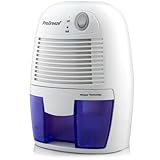
When choosing a dehumidifier, we often chase an impossible ideal: a machine that is powerful, silent, and cheap. But in the world of engineering and physics, you are almost always forced to choose. This is the Dehumidifier Trilemma, a balancing act between Performance, Noise, and Cost. You can have a powerful basement-clearing beast, but it will be noisy and expensive. You can have a cheap unit, but it might be ineffective or loud. The Pro Breeze PB-02 17oz Mini Dehumidifier is a fascinating case study in this trilemma because it doesn’t try to be a jack-of-all-trades. Instead, it makes a radical, unapologetic choice: it masters Noise and Cost by making a deliberate compromise on raw Performance. This article isn’t a simple review; it’s a look under the hood to explain the science behind that choice, helping you decide if this quiet compromise is the right one for you.

The Brute Force Approach: Why Powerful Dehumidifiers Are Loud
To understand what makes the Pro Breeze PB-02 special, we first need to understand its much larger, louder cousins. Most dehumidifiers you see, especially those designed for large rooms or basements, use compressor technology. Think of it as the core mechanism of a refrigerator working in reverse. A compressor squeezes a refrigerant gas, causing it to cool a set of metal coils. A fan then pulls your humid room air across these frigid coils. The water vapor in the air instantly condenses into liquid—just like water droplets forming on a cold glass of iced tea—and drips into a collection bucket.
This method is incredibly effective. It’s a “brute force” solution that can pull gallons of water from the air in a single day, making it essential for dealing with serious dampness. But this power comes at a cost. The compressor itself is a mechanical pump, and it vibrates and hums. The powerful fan needed to move a large volume of air adds another layer of sound. The result is a machine that is undeniably potent but is often too intrusive for a living room, office, or, most importantly, a bedroom where peace is paramount. But what if your battle against dampness isn’t in a sprawling basement, but in the quiet sanctuary of your study? For that, you don’t need a sledgehammer; you need a scalpel. Enter the world of thermo-electric cooling, the engine behind the Pro Breeze PB-02’s silence.

The Whisper Tech Alternative: Deconstructing the Pro Breeze PB-02
The Pro Breeze PB-02 operates on a principle that feels like something out of science fiction: the Peltier effect. Instead of a bulky compressor, its heart is a small, solid-state component called a thermo-electric module. You can think of it as a tiny, electronic heat pump with no moving parts. When you pass a low-voltage electric current through this semiconductor sandwich, one side of the module gets cold while the other side gets hot.
Pro Breeze harnesses this elegant piece of physics brilliantly. A tiny, quiet fan draws air into the dehumidifier. This air first passes over the cold side of the Peltier module, where moisture condenses and drips into the 16-ounce tank below. The now-dry air then passes over the hot side of the module to be warmed slightly before being exhausted back into the room. The only moving part in this entire process is that small, low-speed fan. This is the fundamental science behind the silence.
Decoding the Numbers: What 9 Ounces and 33 Decibels Really Mean
The spec sheet says the PB-02 can remove up to 9 ounces (250ml) of moisture per day. For context, that’s about the volume of a standard drinking glass. Compared to the 50-pint (800-ounce) capacity of a large compressor model, this sounds minuscule. However, this isn’t a flaw; it’s a direct consequence of its design. It’s not meant to dry a flooded basement overnight. It is a marathon runner, not a sprinter. Its purpose is to work slowly and steadily in a small, enclosed space, preventing humidity from reaching the tipping point—typically above 60% Relative Humidity, according to the CDC, where mold and mildew begin to thrive.
Perhaps its most impressive specification is its noise level, rated at around 33 decibels (dB). This is a number that’s hard to visualize. So, consider this: a quiet library is about 40 dB. A whisper from a few feet away is 30 dB. The Pro Breeze PB-02 operates in that near-silent space, making it a background hum that is easily ignored, even on a bedside table. For anyone who has tried to sleep with a traditional dehumidifier droning in the corner, this feature alone can be revolutionary.
The Achilles’ Heel: Temperature and Performance
This remarkable quiet and efficiency at such a low cost seems almost too good to be true. This brings us to the inherent limitation of Peltier technology: its dependence on ambient temperature. The thermo-electric module works by creating a temperature difference. If the room is already cold, it becomes much harder for the “cold side” of the module to get cold enough to effectively condense water. This is why the optimal operating temperature for the PB-02 is between 59-86°F (15-35°C). It will struggle in a chilly garage or a cold basement in winter. This isn’t a defect; it’s simply the physics of the technology.
A Necessary Conversation: Price, Durability, and Customer Support
The Pro Breeze PB-02 is undeniably affordable, typically priced under $50. This accessibility is a huge part of its appeal. However, a scan of user reviews reveals a polarized story. While many users report years of faithful service, a significant number of reviews highlight a critical issue: the unit failing after just a few months. This brings us to a necessary and frank conversation about the most contentious aspect of the PB-02.
It’s reasonable to assume that at this price point, manufacturing consistency can be a challenge. Components, particularly the power adapter which is a common failure point for many small electronics, may not be of the highest grade. This is the unwritten part of the trade-off. However, the story doesn’t end there. A recurring theme, even within the negative reviews, is the mention of “amazing” and responsive customer support. Many users who experienced a failure reported that the company was quick to respond and ship a replacement unit, often with minimal hassle. This transforms the proposition from a simple gamble to a calculated risk. You are buying an inexpensive device that might fail, but it’s backed by a company that appears to stand by its product.

Conclusion: A Checklist for the Quiet Seeker
The Pro Breeze PB-02 is not a one-size-fits-all solution. It is a specialized tool that has deliberately sacrificed raw dehumidifying power for exceptional quietness and a low price point. It doesn’t compete with the basement-drying behemoths; it creates its own category where silence is the ultimate luxury.
So, is this quiet compromise the right one for you? Ask yourself these five questions:
- Is your problem area small and enclosed (under 215 sq ft)? (e.g., a bathroom, closet, RV, or the area around your desk)
- Is silence your absolute top priority? (e.g., for a bedroom, nursery, or quiet office)
- Is your budget a primary constraint?
- Is the room temperature consistently above 59°F (15°C)?
- Are you dealing with persistent, low-level dampness (like window condensation or a musty smell) rather than a serious water leak or flooding?
If you answered “yes” to most of these questions, then the Pro Breeze PB-02 isn’t just a cheap option; it’s likely the smartest, most appropriate tool for the job. You are its target user, and you will likely appreciate the silent, steady work it does in the background of your life.