
The Automatic Alchemist: A Deep Dive into the Belgian Balance Syphon
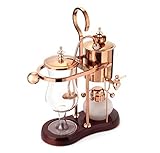
In the modern coffee landscape, a world of one-touch super-automatics and high-pressure espresso precision, there exists a brewer that feels like a visitor from another era. It is at once a scientific instrument, a piece of performance art, and a functional coffee maker. This is the world of the Belgian Balance Syphon, a device that doesn’t just brew coffee—it performs it, transforming a simple morning ritual into a captivating spectacle of physics in motion. To witness it in action is to be transported to a 19th-century drawing room or a mad scientist’s laboratory, where gleaming vessels and a live flame conspire to produce a cup of coffee through a process that feels both magical and meticulously engineered.
This guide posits that the balance syphon, exemplified by accessible modern versions like the Diguo, is far more than a novelty. It is a functional gateway to a deeper appreciation of coffee, a tangible link connecting us to a rich history of innovation and the fundamental physics governing extraction. It represents the democratization of a brewing method once reserved for European aristocracy, offering a unique flavor profile that stands as a compelling alternative to today’s more common methods. Join us as we explore its tumultuous past, deconstruct the elegant science of its operation, analyze the art of its extraction, and provide a practical path to mastering its use.

A Legacy in Steam and Glass: The Tumultuous History of the Vacuum Coffee Pot
The balance syphon’s story is a key chapter in the larger, more intricate history of the vacuum coffee pot—a history that is not a straight line but a tangled web of parallel invention and cross-continental evolution, reflecting the 19th century’s fervent drive for scientific innovation. The core concept of using vapor pressure and vacuum to brew coffee emerged almost simultaneously across Europe. The earliest known patent was filed in the 1830s by Loeff of Berlin, but his design proved commercially unsuccessful.
True commercial success arrived in 1840 with a French woman, Marie Fanny Amelne Massot, known as Mme. Vassieux. She patented and marketed an ornate vertical brewer with two glass “balloons,” designed not for the kitchen but for the drawing-room—a beautiful object meant to impress guests during the opulent salon gatherings of the era. Simultaneously, a Scottish marine engineer named James Robert Napier was developing his own “Naperian Coffee Pot,” an unpatented but celebrated device that validated the brewing principle.
But the crucial leap to automation came in 1844 from another Frenchman, Louis Gabet. He reoriented the chambers to a side-by-side arrangement on a pivoting, balance-like apparatus. His true genius was the addition of a counterweight mechanism that would automatically extinguish the flame once the water had transferred. This single innovation marks the birth of the world’s first “automatic” coffee brewer. The Diguo and its contemporaries are direct descendants of Gabet’s invention. The common name “Belgian” brewer appears to be a historical misnomer, likely arising from the device’s celebrated use at Belgian royal court functions rather than its country of origin, a testament to how an object’s identity can be shaped by its patrons as much as its creators.
The Physics of the Spectacle: Deconstructing the Mechanism
This ingenious device didn’t spring from a vacuum; it was born from a deep understanding of physics, a spectacle where thermodynamics itself becomes the barista. So, let’s pull back the curtain and examine the scientific magic at play, a three-act drama of temperature and pressure.
Act I: The Power of Vapor Pressure. The process begins as an alcohol lamp heats the water in the sealed metal boiling chamber. As the temperature rises toward 100°C (212°F), water molecules gain energy and escape into the air above, becoming steam. This rapidly increases the vapor pressure inside the sealed chamber. When this internal pressure—a combination of heated air and steam—overcomes the external atmospheric pressure, it pushes down on the water’s surface, forcing it up the siphon tube and into the glass brewing carafe, against gravity.
Act II: The Graceful Tipping Point. This is the feature that defines the balance syphon. As water transfers from the metal chamber to the glass one, the metal chamber becomes progressively lighter. Eventually, it becomes lighter than its fixed counterweight. Gravity takes over, and in a moment of mechanical poetry, the lever arm pivots. This elegant motion is linked to a snuffer cap on the burner, which swings over and smothers the flame, instantly cutting off the heat source—a fully automated, hands-free action conceived by Gabet nearly two centuries ago.
Act III: The Vacuum’s Call. With the heat gone, the boiling chamber begins to cool. The steam inside makes contact with the cooling walls and rapidly condenses back into liquid water. A gas (steam) occupies a vastly larger volume than its liquid equivalent; this sudden collapse in volume creates a significant pressure drop—a partial vacuum. The universe, abhorring a vacuum, seeks to equalize this pressure. The external atmospheric pressure, now a powerful, invisible giant weighing down on everything at sea level with about 14.7 pounds per square inch, pushes down on the surface of the brewed coffee in the open glass carafe. This force drives the liquid back through the filter and siphon tube, into the low-pressure boiling chamber, to fill the void. This vacuum-assisted filtration is swift and thorough, efficiently separating the brewed coffee from the spent grounds.
The Art of Extraction: The Flavor Profile of Siphon-Brewed Coffee
This captivating dance of pressure and temperature isn’t just for show. Every step in this physical process is meticulously engineered to achieve one ultimate goal: a uniquely sublime cup of coffee. But what exactly does this ‘siphon signature’ taste like, and why is it so prized?
The answer lies in a perfect storm of brewing principles. First, it’s a full-immersion method, meaning all coffee grounds are saturated evenly for the entire steep time, promoting a complete and balanced extraction. More importantly, the siphon offers exceptional temperature stability. While a pour-over can lose heat rapidly, the siphon’s brewing chamber is held at a consistent, ideal temperature (typically between 90-96°C or 194-205°F) by the rising steam, preventing the sour notes of under-extraction.
The final piece of the puzzle is the cloth filter. Unlike paper filters that absorb many of the coffee’s natural oils (lipids), which are crucial carriers of aromatic compounds, the cloth filter allows these oils to pass into the cup. The result is a coffee that marries the rich body and creamy mouthfeel of a French press with the stunning clarity and clean finish of a high-quality pour-over. You get the best of both worlds: a cup that is simultaneously full-bodied and aromatic, yet delicate, complex, and entirely free of sediment.
A Practical Guide to Mastering the Diguo Balance Siphon
Understanding the history and the science fuels our appreciation, but the true joy lies in creation. Now, it’s time to roll up our sleeves, step into the role of the alchemist, and transform these principles into a tangible, delicious reality. Let’s brew.
The Mise en Place: Fuel, Water, and Beans
- Fuel: Use only denatured alcohol or high-quality bioethanol fuel. Isopropyl (rubbing) alcohol will burn with a sooty, odorous flame, tainting your brewer and your coffee.
- Water: Start with good, filtered water. Crucially, pre-heat your water in a kettle before adding it to the boiling chamber. This is the single most important tip, reducing the heating time from a tedious 15-20 minutes to just one or two.
- Beans: The siphon’s clarity shines with light to medium roast single-origin coffees, allowing their nuanced floral or fruity notes to take center stage.
The Golden Rules: Ratio and Grind
- Ratio: A good starting point for this full-immersion method is a ratio between 1:15 and 1:16 (1 gram of coffee to 15-16 grams of water). For a standard 500ml model, this means about 32 grams of coffee.
- Grind Size: This is critical. Aim for a medium-coarse grind, similar in texture to coarse sea salt. Too fine, and it will clog the filter during the drawdown, leading to over-extraction. Too coarse, and the coffee will be weak and under-extracted.
The Ritual: A Step-by-Step Walkthrough
- Setup: Place your ground coffee in the glass carafe. Pour your pre-heated water into the metal boiling chamber.
- Assemble & Light: Firmly insert the siphon tube (with its clean, attached cloth filter) into the boiling chamber, ensuring a tight seal. Lower the chamber to hold the snuffer cap open, then light the wick.
- Water Transfer: Within a minute or two, water will begin its ascent into the glass carafe.
- Steep & Stir: Once all the water has transferred, start a timer for 60 to 90 seconds. Give the slurry a gentle but thorough stir to ensure all grounds are evenly saturated.
- Automatic Finish: Stand back and watch the magic. The balance arm will pivot, the flame will be extinguished, and the brewed coffee will be drawn back into the metal chamber.
- Serve: Once the drawdown is complete (you’ll hear a final gurgling sound), loosen the top plug on the boiling chamber to release the vacuum. Serve the coffee using the spigot.
The Critical Cleanup: Filter Maintenance
Proper cleaning is not optional. A dirty filter will ruin your coffee.
* Immediate Rinse: As soon as it’s cool, discard the grounds and rinse the cloth filter under running water until it’s perfectly clean.
* Proper Storage: Never let the filter air dry. It will develop an unpleasant smell. The professional method is to store the rinsed, wet filter in a sealed container or zip-top bag with a little clean water in the refrigerator or freezer. This prevents microbial growth and keeps it fresh.
* Deep Clean: Every few weeks, boil the filter in fresh water or soak it in a food-safe, oxygen-based cleaner (like OxiClean) to remove accumulated oils.
Troubleshooting
- Water won’t transfer up? The seal between the siphon tube and the boiling chamber isn’t tight enough. Press it in firmly.
- Drawdown is stalled or very slow? Your grind is likely too fine, clogging the filter. Try a coarser grind next time.
- Drawdown is extremely fast (<30 seconds)? Your grind is too coarse. Tighten it up for a more complete extraction.
Conclusion: Its Place in the Modern Coffee Landscape
The Diguo Belgian Balance Syphon is a machine that brews more than just coffee; it brews a sense of wonder. It stands as a proud anachronism, demanding patience and rewarding it with a performance that is both intellectually stimulating and aesthetically delightful. By exposing the very physics of its operation, it reconnects us to the elemental forces at the heart of coffee extraction.
Its crucial role in the modern landscape is that of a great democratizer. With a price tag around $150, it makes a theatrical and flavorful brewing experience—once the exclusive domain of royalty and wealthy collectors with access to multi-thousand-dollar machines from brands like Royal Paris—accessible to any passionate home enthusiast. It is a challenge, a ritual, and a lesson in physics, all in one. It is a reminder that sometimes, the most captivating way to make coffee is to simply let the laws of the universe put on a show.