The Alchemist’s Engine: The Science & Business Case for the Nuova Simonelli Appia II
The first few weeks of a new cafe are a crucible. The dream of artisanal coffee and serene ambiance quickly collides with the chaotic reality of the morning rush. Amidst the clamor of the grinder and the hiss of the steam wand, a single, brutal equation determines survival: consistency. A perfect shot of espresso served at 8:01 AM is a promise to the customer. A bitter, watery shot served at 8:03 AM is a broken promise, a quiet erosion of trust that no amount of latte art can mend. The central challenge for any coffee business isn’t just making a good espresso; it’s making the same good espresso, hundreds of times a day, under immense pressure, often with staff who are still learning the ropes. This relentless demand for consistency runs headfirst into the unforgiving laws of physics.
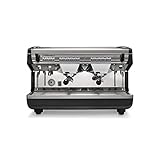
This is the problem Nuova Simonelli set out to solve not with marketing, but with engineering. The Appia II Volumetric is more than a machine; it is a meticulously crafted system designed to master the volatile science of extraction and, in doing so, to serve as a risk management tool for the business owner. By deconstructing its anatomy, we reveal a masterclass in pragmatic design, a machine built with a singular focus: to forge unwavering consistency in the fiery heart of a commercial cafe. This isn’t just a review; it’s an investment thesis.

Taming the Trinity: The Science of Controlled Extraction
To appreciate the Appia II, one must first respect the enemies it was designed to conquer. A great espresso is a fleeting chemical reaction, balanced on the knife’s edge of three variables: temperature, pressure, and time. Deviate slightly, and the sublime becomes undrinkable. The Appia II’s core engineering is a systematic campaign to seize control of these variables.
The first front in this battle is pressure. The industry gold standard, established through decades of research, is a steady 9 bars of pressure. The Appia II achieves this not with a cheap, pulsating vibratory pump found in home machines, but with a commercial-grade rotary pump. This is a critical distinction. A rotary pump, with its spinning vane mechanism, delivers a smooth, unwavering stream of pressure, shot after shot. It’s the difference between a fluctuating garden hose and a calibrated surgical instrument. More importantly, these pumps are built for war, rated for thousands of hours of continuous use and designed for a direct plumbing connection—a non-negotiable for any serious commercial setup. This is the machine’s heartbeat, providing a foundation of absolute pressure stability.
Next is thermal power. The Appia II employs a Heat Exchanger (HX) boiler system. A massive 11-liter copper boiler is kept at steaming temperature, while a separate internal tube flash-heats fresh water to precise brewing temperature on its way to the group head. This design is a masterstroke of commercial pragmatism. It allows for simultaneous brewing and powerful, relentless steaming—essential for a fast-paced latte and cappuccino workflow. While some purists argue for the absolute temperature precision of more expensive dual boiler systems, the Appia II’s thermosyphon system circulates water to keep the group heads thermally stable, providing remarkable consistency that meets and exceeds the demands of all but the most esoteric specialty cafes. It prioritizes robust, real-world performance over a spec-sheet victory, delivering power and speed where it matters most.
Automating Excellence: Removing Human Error from the Equation
With stable pressure and temperature, the machine has set the stage. But the greatest source of inconsistency in any cafe is the human element. The Appia II’s most profound genius lies in how it systematically automates excellence, making the correct procedure the easiest one to follow.
The most obvious example is its volumetric dosing. The “Volumetric” in its name refers to a precision flowmeter that allows a barista to program the exact volume of water for a single or double shot. Once set, every press of the button delivers that precise volume and stops automatically. In a high-pressure rush, a barista might be distracted, ending a manual shot a few seconds too early or too late, creating a cascade of flavor inconsistencies. The Appia II’s volumetric system acts as a governor, removing this critical variable from the barista’s mental load. It ensures that the foundational element of every single drink that goes over the counter is identical, regardless of who is on the bar or how long the order queue is.
Yet, its true masterstroke is the proprietary Soft Infusion System (SIS). This is Nuova Simonelli’s engineered solution to the most common barista error: imperfect tamping. Hitting a dry puck of coffee with 9 bars of pressure can easily create cracks or “channels,” leading to a disastrously uneven extraction. SIS prevents this by first introducing water at a very low pressure. This gentle pre-soak allows the coffee grounds to swell and settle, creating a more uniform and stable puck before the full force of extraction begins. The system is explicitly designed to “compensate for any incorrect coffee tamping,” acting as an invisible, expert hand guiding the water. It is a system of error correction, a technological safety net that makes the entire process more forgiving. This single feature dramatically shortens the learning curve for new staff and ensures a higher baseline of quality, directly reducing waste and protecting the cafe’s reputation.
The Human-Machine Partnership: Ergonomics as a Financial Asset
A machine can be technologically perfect, but if it’s difficult or painful to use, it becomes a bottleneck. Nuova Simonelli’s engineers understood that in the theater of a cafe, the machine and the barista are dance partners. The Appia II’s design is a study in ergonomic intelligence, where every feature is engineered to enhance workflow and protect the user, translating directly into financial gain.
Consider the push-pull steam levers. Instead of traditional knobs that require constant wrist-twisting—a leading cause of repetitive strain injuries (RSI) in career baristas—the Appia II uses simple, low-resistance levers. This isn’t a mere convenience; it’s a long-term investment in employee health, reducing the risk of injury and associated costs. The steam wands themselves are Cool-Touch, heavily insulated to prevent burns and dramatically speeding up cleaning, as milk doesn’t bake onto the surface. Seconds saved on cleaning one wand, multiplied by hundreds of drinks a day, translate into significant labor savings.
The workspace is equally optimized. Raised group heads allow tall takeaway cups to be placed directly underneath, eliminating the extra, time-consuming step of transferring shots from a smaller glass. A polished backplate acts as a reverse mirror, giving the barista a clear view of the extraction without needing to bend down, allowing them to monitor quality while maintaining an efficient, upright posture. These are not small details. They are calculated decisions that shave seconds off every drink’s production time, reduce physical strain, and create a safer, more efficient workstation. In the tight margins of a coffee business, this optimized workflow is pure profit.
Conclusion: More Than a Machine, A Business Partner
The Nuova Simonelli Appia II Volumetric earns its reputation as a “workhorse” not because it is simple, but because it is smart. It is a synthesis of robust science and empathetic design. It systematically identifies the major sources of inconsistency in a commercial environment—unstable pressure, thermal variance, inconsistent dosing, and human error—and deploys a specific, proven technology to neutralize each one.
The result is a machine that creates a high floor for quality. It empowers a business to serve consistently excellent espresso, not as a matter of chance or artistic flair, but as a matter of process. It lowers the barrier to entry for new staff, reduces waste, and enhances the speed of service, all while protecting the physical well-being of the baristas. For the new cafe owner, it is not an expense, but a strategic investment in stability. It is an alchemist’s engine, reliably turning beans and water into the liquid gold that fuels the business. It is, in the truest sense, a partner.
While it is an ideal solution for new cafes, high-volume restaurants, and businesses with high staff turnover, it may be overkill for locations with very low volume or for specialty shops that prioritize the nuanced control of a manual, dual-boiler machine for every shot. The Appia II is built for relentless consistency, and its value shines brightest under pressure.
And yet, technology never stands still. With such a successful formula, one must ask: why was it necessary to create a successor? The evolution to the Appia Life reveals even more about the changing priorities of the coffee world, a story of efficiency and sustainability built upon this unshakable foundation.