
The Science of Hearing Aid Care: A Deep Dive into the PerfectDry LUX
A modern hearing aid is a marvel of micro-engineering. Packed within a casing smaller than a thumbnail are sophisticated processors, microphones, and receivers, all working in concert to reconnect you to the world of sound. This technology, often representing a significant financial investment, is also incredibly delicate. Every day, it faces a pair of silent, invisible adversaries that can degrade its performance and ultimately lead to its failure: pervasive moisture and a thriving microbial ecosystem.
Industry data consistently points to a stark reality: moisture is the number one cause of hearing aid malfunction. But the threat isn’t just about a sudden downpour; it’s the slow, relentless creep of humidity, sweat, and condensation. This is compounded by another, more biological threat. Your ear canal is a naturally warm, moist environment—a perfect incubator for microscopic life. This means the very devices designed to help you are also prime real estate for bacteria and fungi. Traditional maintenance might involve a simple wipe-down, but to truly protect this vital technology, we must look deeper. The science of hearing aid care has evolved beyond passive drying, entering an era of active, precision-controlled micro-environments. This is an exploration of that science.

Anatomy of a Failure: How Moisture Dismantles Your Device
To understand the solution, we must first appreciate the insidious nature of the problem. When we talk about moisture damage, we’re not just talking about waterlogging. The process is far more subtle and corrosive, akin to a slow-motion rusting of the delicate electronics at the heart of your device. Internally, even microscopic amounts of moisture can begin to oxidize the metallic contacts on the battery and circuitry. This corrosion creates resistance, leading to intermittent power, distorted sound, or complete failure.
Furthermore, the sophisticated microphones and receivers in your hearing aids have incredibly fine acoustic ports. Humidity can condense within these tiny openings, creating a film that muffles sound, making speech unclear and frustrating. For the user, this manifests as a gradual decline in performance—a sense that the aids just “aren’t working like they used to.” It’s the primary reason for costly, out-of-warranty repairs that, according to industry surveys, can average between 200 and 400 per incident. The damage is cumulative, and by the time you notice it, significant harm may have already been done.
But moisture is only half of the story. While it attacks the device from within, another, more insidious threat is growing on its surface. If your hearing aids seem to work fine but your ears feel itchy, you might be overlooking the microscopic life thriving on your devices.

The Unseen Colony: Why Your Ear Is a Perfect Incubator
The human ear canal maintains a relatively stable temperature and humidity, creating a welcoming environment for a host of microorganisms. When you insert a hearing aid, you effectively seal this area, increasing local humidity and creating an even more ideal breeding ground. Studies in medical mycology have shown that the presence of an occluding earpiece can significantly alter the ear canal’s natural flora.
This isn’t just an abstract biological fact; it has real-world health implications. An accumulation of bacteria and fungi on your hearing aids can lead to persistent itchiness, skin irritation, and in some cases, painful ear canal infections like otitis externa (commonly known as swimmer’s ear). A simple wipe with an alcohol pad might clean the surface, but it does little to sanitize the nooks, crannies, and vent passages where these colonies flourish. So, we’re faced with a dual threat: corrosion and contamination. A simple desiccant jar might passively absorb some ambient moisture, but it does nothing to address the bacterial colony. To truly protect your investment and your health, you need a system that actively combats both. This is where modern engineering steps in.

The Modern Solution: Inside the PerfectDry LUX Micro-Lab
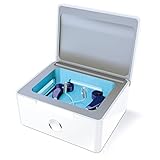
Think of the Audinell PerfectDry LUX not as a simple box, but as a personal, automated micro-laboratory designed to perform two critical functions: precision dehumidification and comprehensive sanitization. It achieves this through a carefully orchestrated system of regulated heat and germicidal light.
The Thermal Cycle: Rapid, Regulated Dehumidification
Unlike traditional passive methods that rely on desiccant crystals slowly absorbing moisture over many hours, the PerfectDry LUX employs an active, dynamic system. It uses a patented pulsed hot air dehumidification process, circulating gently warmed air throughout the chamber. This significantly accelerates the evaporation of moisture from deep within the hearing aid’s casing and tubing.
The most critical parameter here is temperature. The system is engineered to maintain a strictly regulated temperature that does not exceed 45°C (113°F). This is not an arbitrary number. According to extensive research compiled by resources like Battery University, charging lithium-ion batteries—the power source for virtually all modern rechargeable hearing aids—above this exact temperature threshold can lead to accelerated degradation and a shortened lifespan. The PerfectDry LUX operates within this safe zone, ensuring it is effective for all types of hearing aids, including the most advanced rechargeable models, without compromising their delicate power cells. This entire, highly effective drying cycle is completed in just 45 minutes, a fraction of the time required by older technologies.
The Germicidal Shield: A 360° UV-C Sanitization
Drying alone does not sanitize. To address the microbial threat, the PerfectDry LUX incorporates a 360-degree UV-C lamp. UV-C refers to short-wavelength ultraviolet light, specifically in the germicidal range of approximately 254 nanometers. As validated by the CDC, light at this wavelength is highly effective at inactivating microorganisms by disrupting their DNA and RNA, rendering them unable to reproduce and cause infection.
The “360-degree” design is a key innovation. It ensures that the UV-C light reaches all surfaces of the hearing aids, regardless of how they are placed inside, sanitizing areas that a simple wipe could never reach. A common concern is whether this UV light could damage the hearing aids’ plastic shells. However, the exposure is both low-intensity and brief (part of the 45-minute cycle). Medical-grade polymers used in modern hearing aids are formulated for durability and often contain UV inhibitors. The risk of degradation from these controlled, short cycles is negligible compared to the very real risk of damage from daily exposure to sunlight and body oils.
Economic Analysis: Why ‘No Consumables’ Is a Game Changer
For years, the standard for at-home hearing aid drying was a simple plastic jar with a disposable desiccant “brick” or puck. While the initial cost of such a kit is low, it introduces a recurring expense. These desiccants have a limited lifespan, typically needing replacement every 2-3 months at a cost of 5-10 each time.
Let’s conduct a simple Total Cost of Ownership (TCO) analysis over three years—the length of the PerfectDry LUX’s warranty.
- Traditional Desiccant Jar:
- Initial Cost: ~$15
- Desiccant Replacements (5 per year @ ~7 avg for 3 years): ~105
- Total 3-Year Cost: ~$120 (Provides only slow, passive drying with zero sanitization).
- PerfectDry LUX:
- Initial Cost: ~$60
- Consumables: $0
- Total 3-Year Cost: ~$60 (Provides fast, active drying and UV-C sanitization).
From a purely financial standpoint, the advanced electronic solution becomes the more economical choice in under two years. This analysis doesn’t even factor in the cost of a single moisture-related repair, which would immediately tip the scales overwhelmingly in favor of the more effective, preventative system. It represents a shift from a model of recurring expenses to a single, long-term investment in reliability.
Conclusion: An Investment in Clarity and Confidence
The decision to invest in a hearing aid is a decision to invest in connection, communication, and quality of life. Protecting that investment requires more than just careful handling; it requires a commitment to consistent, effective maintenance. The Audinell PerfectDry LUX represents the pinnacle of this modern approach.
It is not merely an accessory; it is a sophisticated, science-backed system engineered to combat the primary threats to your hearing aids’ longevity and performance. By providing rapid, temperature-regulated drying, it preserves the delicate internal electronics and battery life. By delivering 360-degree UV-C sanitization, it promotes better ear health and hygiene. And by eliminating the need for consumable desiccants, it offers a more economical and environmentally friendly long-term solution. Adopting a scientific approach to daily care is the most effective way to ensure your hearing aids deliver the clear, consistent performance you depend on, day after day.