The Signal and the Noise: How Body Fat Analyzers Like the Omron HBF-306C Really Work
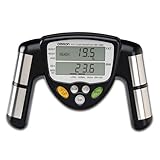
A video in the customer review section for the Omron HBF-306C Handheld Body Fat monitor shows a man holding the device. “This unit is fraudulent,” he declares, demonstrating how he can manipulate the final body fat percentage simply by altering the personal data he inputs. “It does not measure,” he concludes, “it guesses based on the data you enter.” The review is compelling, tapping into a deep-seated suspicion many of us have about consumer health gadgets: are they sophisticated scientific instruments, or just digital fortune tellers dressed up in plastic and LCD screens?
The user’s accusation is potent because it feels intuitively correct. It lays bare a seemingly fatal flaw. But is he right? Or is there a more complex, more interesting science at play? To find out, we must put this technology on trial. Our investigation will not be about this single product, but about the entire class of devices that promise to reveal our body’s secrets with a gentle, invisible current. The journey will take us from the fundamental laws of physics to the messy reality of human physiology, and ultimately, to the statistician’s office where much of the real magic—and controversy—happens.

The Accusation: A Deeper Look at the “Guessing Game”
Let’s first concede the point: the user’s observation is entirely repeatable. Take any bioelectrical impedance analysis (BIA) device, measure yourself, and note the body fat percentage. Now, without re-measuring, simply go into the settings and increase your programmed height by a few inches. The previously stored body fat number will change, sometimes dramatically. This simple experiment seems to prove the case. It feels like a magic trick being exposed—the device is not measuring a stable property of your body, but rather running your inputs through a secret formula.
This creates a central, nagging mystery. If the device is truly sending a current through you and measuring a real physical property, why is the final output so profoundly dependent on the data you provide? Why does it need to know your height, weight, age, and gender to tell you something it is supposedly measuring directly? The answer begins not with an algorithm, but with a flash of electricity on a journey through the most complex conductor imaginable: you.

The Physics of the Current: A Journey Through Your Body’s Inner Space
At its core, Bioelectrical Impedance Analysis rests on a simple principle: different tissues in your body conduct electricity differently. To understand this, we must move beyond the common analogy that “water conducts electricity and fat doesn’t.” The reality is far more nuanced and elegant. Imagine your body not as a uniform blob, but as a vast, intricate circuit board. The primary components of this circuit are your cells and the fluids surrounding them. Your total body water is broadly divided into two compartments: the fluid inside your cells (intracellular fluid, or ICF) and the fluid outside your cells (extracellular fluid, or ECF), which includes your blood plasma.
When a device like the Omron HBF-306C, which uses a single, low-frequency current of 50 kHz, sends its signal, that current primarily flows through the path of least resistance. For a low-frequency current, the lipid bilayer of your cell membranes acts like a formidable wall, or what electrical engineers call a capacitor. This wall resists the current’s passage, forcing the majority of the electrical flow to travel through the highways of your extracellular fluid. Body fat tissue (adipose tissue) is a poor conductor precisely because it is composed of cells packed with non-conductive lipids, with very little extracellular fluid between them. Muscle tissue, conversely, is rich in both ICF and ECF, making it a superb conductor.
The device is therefore measuring impedance, which is the total opposition to the current flow. Impedance itself has two components: resistance and reactance. Resistance is the straightforward opposition you’d find in any simple conductor, primarily from the ions dissolved in your body fluids. Reactance, however, is the opposition caused by those cell membranes acting as capacitors. As the current alternates, they effectively charge and discharge, causing the current’s phase to shift slightly relative to its voltage. Handheld, single-frequency devices are predominantly measuring the resistance component, as their current isn’t well-suited to characterizing the capacitive effect of the cell membranes. They are, however, getting a hard, objective number in ohms that reflects the overall conductivity of the tissues between the electrodes.
The Equation in the Machine: Unmasking the “Guesswork”
So, the device has a real, physical measurement—a value for impedance in ohms. But how does it get from that single electrical data point to a comprehensive-sounding “Body Fat Percentage”? This is where the story moves from the physics lab to the statistician’s office, and where we find the definitive answer to the accusation of “guesswork.” The impedance value is just one variable in a much larger equation.
This is where regression equations enter the picture. Decades ago, researchers in labs around the world began a painstaking process. They would take large groups of people and measure their body composition using a “gold standard” method, which for a long time was hydrostatic (underwater) weighing and is now more commonly Dual-energy X-ray absorptiometry (DXA). Simultaneously, they would measure those same people’s bioelectrical impedance, along with their height, weight, age, and gender. By analyzing all this data, they established powerful statistical relationships. They discovered that body fat percentage, as determined by the gold standard, could be very accurately predicted using a formula that combined the BIA measurement with the person’s physical characteristics.
The algorithm inside a home-use BIA monitor is the result of this research. The formula looks something like this:
Body Fat % = a * (Height² / Impedance) + b * Weight + c * Age - d
(where a, b, c, d are coefficients that differ for males and females)
Suddenly, the mystery unravels. The device is not “guessing.” It is executing a two-step process: first, it measures your impedance directly. Second, it calculates your body fat by plugging that measurement, along with your personal data, into a scientifically validated prediction equation. Your height is critical because it approximates the length of the electrical conductor (your body). Your weight helps estimate its total volume. Your age and gender are proxies for a host of known physiological differences in body composition and hydration. The “Athlete Mode” is not a gimmick; it simply switches the device to use a different set of coefficients (a, b, c, d) in the equation, because the relationship between impedance and body fat is systematically different in highly athletic populations compared to the general population.
The Verdict: A Precise Instrument for Tracking Trends, Not an Oracle of Truth
The verdict, then, is that the user in the video was both right and wrong. He correctly identified that the device’s output is heavily dependent on user-entered data, but he misinterpreted this as evidence of fraud. In reality, it is a necessary component of a sophisticated estimation model. The device is measuring, and it is also calculating. It is a hybrid system. To use it effectively, one must understand this dual nature and appreciate the critical difference between two concepts: accuracy and precision.
Accuracy refers to how close a measurement is to the true, absolute value. If we take a DXA scan as the ground truth, how accurate is a handheld BIA device? Studies published in peer-reviewed journals, such as the Journal of the Academy of Nutrition and Dietetics, have shown that for any single individual, the body fat reading from a BIA device can have a significant margin of error, sometimes ranging from ±3.5% to as high as ±8%. The reasons are twofold. First, the generalized regression equation, developed from a large population, may not be a perfect fit for your unique physiology. Second, a hand-to-hand measurement path, by the laws of physics, sends most of its current through your arms and upper torso, making it inherently less sensitive to the fat stored in your legs and core trunk—often a significant percentage of total body fat.
Precision, however, refers to the consistency or repeatability of a measurement. This is where these devices can excel. If you measure yourself under identical conditions and get nearly the same result every time, the device is precise. And for the purpose of tracking your health journey, precision is infinitely more valuable than accuracy. It doesn’t matter if the device is consistently 3% higher than a DXA scan, as long as it reliably shows you whether your body fat is decreasing, increasing, or holding steady over weeks and months. It is a superb instrument for detecting the trend, which is the only thing that truly matters for assessing progress.

The User’s Protocol: How to Isolate the Signal from the Noise
The device, therefore, provides a signal, but one that is easily drowned out by the noise of our daily physiological fluctuations. The final, and most critical, step is to understand how we, the users, can become expert signal-processing engineers in our own homes. Unlocking the value of a BIA monitor is less about the technology and more about your personal protocol. By strictly controlling the variables, you are effectively creating a laboratory-like environment, ensuring that the changes you see are real biological signals, not random noise.
Here is a strict, science-based protocol for turning your BIA device into a reliable trend-tracker:
- Standardize Time and State: Always measure at the very same time of day and in the same physiological state. The ideal is immediately upon waking, after emptying your bladder, and before eating, drinking, or exercising. This is the most stable and repeatable hydration state your body will be in all day. Measuring after a workout (when you are dehydrated) or after a large meal (when you are hyper-hydrated) will dramatically alter the impedance reading and corrupt your data.
- Standardize Posture: Always adopt the exact same posture as instructed by the manufacturer—typically standing erect, with arms held straight out at a 90-degree angle from the body. Bending your elbows or raising your arms changes the geometry of the conductor, altering the path length of the current and thus the impedance measurement.
- Focus on the Moving Average: Do not obsess over any single day’s reading. Your body’s water content can fluctuate significantly for countless reasons. Instead, log your reading every day under your strict protocol, and pay attention only to the weekly or bi-weekly moving average. This is how you filter out the daily noise and see the true, underlying signal of your body composition changes.
In the end, the Omron HBF-306C and its technological kin are neither fraudulent gadgets nor infallible oracles. They are powerful, accessible, but exceptionally demanding scientific instruments. Their profound value is unlocked not by the sophistication of their internal electronics, but by the user’s disciplined understanding of their principles and the consistent application of a strict measurement protocol. The user in the video was searching for a simple truth-teller and found a complex calculator. But for those willing to engage with the science, these devices offer something far more valuable: a clear, consistent signal through the noise of a long and challenging fitness journey.