The Fourth State of Matter in Your Hands: How Plasma Cutters Forge Steel with Air
In the heart of our sun, matter is subjected to such immense pressure and heat that it ceases to be a gas and becomes a roiling, incandescent sea of plasma. It is the fourth state of matter, the elemental fire from which stars are born, and it is by far the most abundant state of matter in the universe. For millennia, we witnessed its power from afar, in the distant twinkle of stars and the terrifying, fleeting crackle of lightning. The notion that this same cosmic fire could be scaled down, controlled, and held in a human hand to slice through solid steel would have been the stuff of pure fantasy. And yet, in workshops and fabrication bays around the world, this is a daily reality.
This is the story of the plasma cutter, a tool that doesn’t cut with a serrated edge or an abrasive wheel, but with a focused jet of gas heated to a temperature hotter than the sun’s surface. Its origins, surprisingly, lie in the intense scientific fervor of the 1950s space race, born from a need to weld and join exotic metals for rockets and capsules. But its modern legacy is one of accessibility. This is a journey from the fundamental physics of the universe to the engineering genius that allows us to wield that power, transforming the most common substance imaginable—air—into a tool of creation.

The Physics of Tamed Lightning
We are taught from a young age about the three states of matter: solid, liquid, and gas. The progression is intuitive. Add energy in the form of heat to ice, and it becomes water. Add more energy, and it becomes steam. But what happens if you refuse to stop? What happens when you subject a simple gas to an overwhelming torrent of energy? The answer is plasma. The atoms in the gas become so violently energized that they literally break apart, shedding their electrons to become a turbulent, super-heated soup of positively charged ions and free-floating negative electrons. The key to its power is that this chaotic cloud, unlike the gas it came from, is now an excellent conductor of electricity. It is, in essence, a lightning bolt waiting for a path.
A plasma cutter is a device designed to create and control that lightning bolt. It takes in ordinary compressed air and forces it through a tiny, constricting nozzle. At the same time, it generates a powerful electric arc within that gas flow. This arc is the catalyst, the massive energy dump that rips the air apart and initiates the phase change to plasma. The newly formed plasma, violently expanding, is funneled through the nozzle and erupts as a focused, coherent jet traveling at nearly the speed of sound. The temperature within this jet can reach a staggering 25,000°C (around 45,000°F). To put that in perspective, the surface of the sun is a mere 5,500°C. This is not a flame that melts metal; it is a controlled stream of celestial energy that vaporizes the metal and forcefully ejects it, leaving behind a clean, narrow kerf.

The Engineer’s Gambit: From Raw Power to a Precision Tool
But knowing that air can be transformed into a sun-hot jet is one thing. Building a handheld device that can reliably perform this act of alchemy on demand, without self-destructing, is a challenge of an entirely different order. This is where physics ends and the engineer’s gambit begins. The core problems are twofold: how to reliably start this violent reaction, and how to design a system that balances power with the practical frailties of real-world use.
The Ingenuity of the Pilot Arc
The first major hurdle is initiating the cut. The main plasma arc needs to form a complete circuit from the torch’s electrode, through the plasma jet, to the metal workpiece, and back. On a perfectly clean, bare piece of steel, this is simple. But the real world is a messy place, filled with rust, paint, mill scale, and grime—all of which are excellent electrical insulators. Trying to strike a main arc on such a surface is like trying to light a fire with a wet match. This is where the simple genius of the non-touch pilot arc comes into play.
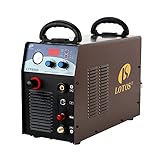
In a machine that uses this technology, like the Lotos LTP8000, a secondary, low-power arc is constantly maintained inside the torch’s nozzle, between the electrode and the nozzle tip. This initial arc creates a small, stable stream of plasma—a “scout” flame that is always ready. When the torch is brought near the workpiece, this conductive stream of plasma provides a perfect, low-resistance path for the main, high-power cutting arc to transfer and ignite instantly, blasting through the insulating layers of rust or paint. It’s an elegant solution that drastically improves ease-of-use and reliability, all without the operator needing to physically scratch the metal to start the cut, a process that rapidly damages consumables. While this technology provides an efficient solution to imperfect surfaces, it is a powerful partner to, not a replacement for, good workshop practice; combining its capabilities with proper surface preparation will always yield the best results and longest consumable life.
The Trade-Offs of Design
The method of generating that initial arc is itself a point of important engineering trade-offs. Many reliable and powerful machines, including the Lotos model, use a high-frequency (HF) start system. This system uses a high-voltage, high-frequency signal to ionize the air in the gap and initiate the pilot arc. It is an extremely effective and dependable method for most applications on solid plates. However, this approach is not without its compromises. The high-frequency discharge can create electromagnetic interference (EMI) that may disrupt nearby sensitive electronics, a consideration in some high-tech workshops. Furthermore, because the system is designed for robust, continuous cuts, it can be less adept at tasks involving frequent interruptions, such as cutting expanded metal mesh. As the torch crosses a void, the arc extinguishes, and some HF systems require a brief reset cycle before re-igniting. This isn’t a flaw, but a classic engineering trade-off, prioritizing power and reliability on solid materials over the niche capability for rapid, intermittent cutting. This demonstrates how the greatness of engineering often lies not in creating a single, perfect tool, but in optimizing a design for its most common and critical purpose.
The Reality of the Cut: Power, Precision, and Pragmatism
Once the arc is lit and the engineering challenges are met, the focus shifts to the workpiece itself. The true measure of a plasma cutter lies not just in its clever design, but in the raw, quantifiable reality of its performance. How does amperage translate to inches of severed steel? And what is the machine’s metabolism—its ability to sustain that performance over time?
The Anatomy of a Powerful Cut
The primary determinant of a plasma cutter’s penetrating power is its electrical current, measured in amperes (A). Amperage is directly proportional to the energy density of the plasma stream. A higher amperage means more energy is being pumped into the gas, creating a hotter, more forceful jet capable of melting and ejecting more material. This is why a machine’s capability is often defined by its amperage. For instance, to cleanly sever a 1-inch thick plate of solid steel, the jet must be powerful enough to not only melt through the entire thickness but also have enough velocity to blow the molten slag clear from the bottom of the cut. An 80-ampere output, as found in a unit like the Lotos LTP8000, is engineered to provide precisely this level of energy, enabling it to perform such demanding tasks consistently.
The Metabolism of a Machine
Raw power is useless without endurance. This is where a critical, yet often misunderstood, specification comes into play: the duty cycle. A plasma cutter generates an immense amount of internal heat, and its duty cycle is a rating of its ability to operate continuously before needing to cool down. It is best understood as the machine’s metabolism. The rating is expressed as a percentage of time over a ten-minute period at a given amperage. The LTP8000‘s rating of “60% at 80A” means that at its full power output, it can cut continuously for six minutes out of a ten-minute window before its thermal overload protection will pause operation to cool. For most manual cutting tasks, which involve stopping to reposition and prepare, this is more than sufficient. It reflects a design that is built not for a theoretical, unending cut, but for the pragmatic rhythm of a human operator.
The Unseen Ingredient
Finally, what is the most critical, yet often overlooked, factor for performance and the longevity of the machine’s expensive consumables? It is not the power setting or the operator’s skill, but the quality of the compressed air. Air from a compressor is often laden with microscopic water droplets and oil vapor. When this contaminated air enters a 45,000°F plasma stream, the water instantly dissociates into hydrogen and oxygen. These rogue elements violently disrupt the stability of the arc, leading to a ragged, poor-quality cut and, more critically, causing the copper electrode and nozzle inside the torch to burn out with astonishing speed. An effective air filtration and drying system is not an optional accessory for a plasma cutter; it is the essential, unseen ingredient for unlocking its true performance and protecting the investment.

The Democratization of Shaping Matter
The journey from a star’s core to a workshop tool is a profound one. It encapsulates the very essence of human endeavor: to observe a fundamental force of nature, to understand its principles, and then, through the painstaking process of engineering, to tame it and turn it into a tool. The plasma cutter is more than just a device for cutting metal. It is a physical testament to our ability to manipulate matter at a fundamental level.
The true genius of modern tools like the Lotos LTP8000 is not just in their raw power, but in their accessibility. Through clever design and pragmatic engineering trade-offs, they package a sliver of cosmic power into a reliable, affordable, and usable form. This act of “democratization” empowers a single artisan, a small garage fabricator, or a curious student to shape and manipulate the physical world with a speed and precision that was once the sole province of heavy industry. It blurs the line between personal creation and industrial production, reminding us that the greatest tools are those that extend not just our hands, but our imagination.