The Engineer’s Ode: How a Telescope Works, Deconstructing the Physics of Starlight
Look up on a clear, dark night. Beyond the veil of city glow, the cosmos unfurls in a silent, glittering spectacle. It’s a sight that has captivated us since the dawn of consciousness, a universal ritual that connects us to our most distant ancestors. But for all its profound beauty, the view offered by the naked eye is a profoundly limited one. It presents us with a grand but impressionistic painting, where entire galaxies are reduced to faint smudges and vibrant planets to wandering, star-like points. To see the brushstrokes of creation—the rings of Saturn, the cratered face of the Moon, the churning clouds of Jupiter—we need a tool that can overcome the fundamental limitations of our biology. That tool is the telescope.
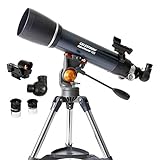
But to truly understand a telescope, you must discard the simple notion of it being a mere magnifier. It is, at its core, a light collector. Think of starlight as a constant, gentle rain of ancient photons, particles that have journeyed across unfathomable voids, some for mere minutes, others for millions of years, only to end their voyage here on Earth. Your eye, even in the darkest conditions with its pupil dilated to a maximum of about 7 millimeters, is a tiny thimble in this cosmic downpour. It’s enough to register the brightest objects, but the vast majority of this photonic rain falls unseen. Now, consider a telescope. It is a vast, wide-mouthed bucket engineered to catch that rain. This is its entire purpose. And by understanding how it performs this single, sacred task, we can unlock the secrets of its design. So, let us place our subject under the lamp. Laid out on our forensic table is a common and illustrative example: the Celestron AstroMaster 102AZ. We will perform a forensic deconstruction, not of a product, but of an idea, to understand the story of the cosmos as told through glass, metal, and the immutable laws of physics.

The Primary Witness: An Examination of the 102mm Objective Lens
Our deconstruction begins not with a whir of electronics or a complex array of buttons, but with a silent, heavy, precisely-ground piece of glass at the very front of the instrument: the 102mm objective lens. This is the heart of the machine, and its size is the single most important specification of the entire system, for it is here that the story of seeing truly begins. The number “102” represents its aperture, a clear diameter of 102 millimeters. This is the opening of our light bucket.
The implications of this size are twofold, governing the two pillars of astronomical observation: brightness and detail. In terms of brightness, the mathematics are simple and staggering. The area of this lens, compared to the 7mm area of your fully adapted pupil, allows it to gather approximately 212 times more light in any given second. Photons that were once too few and far between for your retina to register are now collected and concentrated into a bright, discernible image. This is why a faint, ghostly patch in the constellation of Orion transforms from a barely-there smudge into the glorious, wing-shaped expanse of the Orion Nebula, a stellar nursery 1,300 light-years away.
But aperture does more than just make things brighter; it makes them sharper. The very nature of light, as a wave, sets a hard physical boundary on the amount of detail any optical system can resolve. This is known as the Dawes’ Limit, a fundamental principle stating that the resolving power of a telescope is directly proportional to its aperture. For a 102mm aperture, physics dictates that the finest detail it can possibly distinguish is about 1.14 arcseconds across (an arcsecond is 1/3600th of a degree). This is the theoretical pixel count of your window on the universe. No amount of magnification can add detail that the aperture did not first capture. It is this raw resolving power that allows you to split a single star into a tight double, or to distinguish the Cassini Division—a dark gap—within the rings of Saturn. Magnification can enlarge that resolved detail, but it is the aperture that first makes it visible. It is the king.

Tracing the Path: The Journey of Light and the Inevitability of Compromise
But collecting light is only half the battle. Once these precious photons have passed the gatekeeper of the lens, they embark on a 660-millimeter journey down the telescope tube. This path is not a simple corridor; it is a crucible where the purity of the image is forged, and where the first great compromise of optical engineering must be faced. The lens bends the incoming parallel rays of light into a cone, which comes to a perfect point of focus 660mm away—the telescope’s focal length. The ratio of this length to the aperture (660mm / 102mm) gives us its focal ratio, f/6.5, a number that reveals much about the instrument’s personality.
An f/6.5 ratio is considered relatively “fast” in astronomical terms, much like a fast lens on a camera. It delivers a wide field of view, making it ideal for framing expansive star clusters or scanning the star-rich lanes of the Milky Way. However, this speed comes with an inherent optical challenge rooted in the very nature of light itself. When white light passes through a single glass lens, it behaves like it does in a prism: it splits into a spectrum. This is because different wavelengths (colors) of light bend at slightly different angles. Blue light, with its shorter wavelength, is bent more sharply than red light. The result is chromatic aberration, an optical artifact where all the colors fail to come to the same crisp focus point. On a bright object like the star Vega or the planet Jupiter, this manifests as a faint, ghostly violet halo.
To combat this, the AstroMaster 102AZ uses an achromatic lens, a clever design dating back to the 18th century. It’s a doublet, composed of two separate lenses made from different types of glass—typically Crown and Flint glass—cemented together. Each glass type has a different refractive index, and their shapes are calculated to bring two primary colors (usually red and blue) to a common focus. It’s an elegant and economical solution, but it is not a perfect one. It corrects the most egregious color fringing but cannot eliminate it entirely, leaving behind that residual violet halo. This is not a flaw or a defect; it is a fundamental compromise. To achieve a near-perfect correction (an apochromatic design) would require exotic, expensive glass and three or more lens elements, dramatically increasing the cost. The ghost of violet light, therefore, is the calculated price of admission for an accessible, wide-field view of the cosmos.
The Twist in the Tale: A Prism’s Double Life
Just before this carefully corralled stream of photons can reach the eyepiece and, finally, your eye, it encounters a final, curious obstacle. A small, unassuming right-angle housing that holds a secret. This isn’t just a simple mirror to make viewing more comfortable; it’s a complex prism with a double life, one that perfectly encapsulates the telescope’s dual citizenship between the worlds of earth and sky. This component is an erect-image diagonal, and its primary purpose is a terrestrial one.
A standard astronomical telescope naturally produces an image that is upside down and mirrored left-to-right. While this is irrelevant for observing a spherical planet or a distant star cluster, it makes observing a bird on a branch or a ship on the horizon a dizzying, counter-intuitive experience. The Amici prism inside this diagonal is an ingenious solution. Its “roof edge” design flips the image both vertically and horizontally, presenting a view that is correctly oriented, just as your eyes would see it. This single component transforms the instrument from a specialized astronomical tool into a versatile, dual-purpose spyglass, as useful in the daytime as it is at night.
But, as with all things in optics, this convenience carries a price. The very “roof edge” of the prism that corrects the image also introduces a new artifact into the light path. On a point source of light, like a star, this edge creates a diffraction spike—a thin, bright line that appears to cut through the star. This line is not real; it is a ghost in the machine, an optical signature of the prism’s complex internal reflections. A simpler, 90-degree mirror diagonal used in purely astronomical telescopes would not have this spike (though it would leave the image mirrored). The choice to include the Amici prism is a deliberate act of engineering empathy. It prioritizes user-friendliness and versatility for a beginner over absolute optical purity for a specialist. It is a decision that acknowledges that our first sense of wonder often begins by looking not just up, but also out.
The Foundation of Seeing: More Than Just Optics
The journey of light ends at the eyepiece, but the act of seeing depends on one final, crucial element: stability. The entire optical system rests on an Alt-Azimuth mount, the most intuitive of designs. It moves up-down (altitude) and left-right (azimuth), allowing you to simply point and look. Its simplicity is its strength. Yet, it too reveals a final, subtle challenge. The stars do not move in straight lines across the sky; they trace slow, majestic arcs as the Earth rotates. Following them with an Alt-Az mount requires constant, coordinated nudges in both axes, a celestial dance that takes practice to master.
And even with a perfectly stable mount and flawless optics, your view is ultimately at the mercy of the final lens in the system, one you can never remove: Earth’s atmosphere. The air between you and the stars is a turbulent, roiling ocean of temperature pockets that constantly bend and distort the light passing through them. On nights of poor atmospheric seeing, the air is like a warped, rippling window, blurring fine details and making planets shimmer and boil. On those rare nights of excellent seeing, the air becomes still and transparent, and the full resolving power of your telescope’s aperture is finally unleashed. This is why even the most powerful telescopes on Earth are hostages to the weather, and why a patient observer learns that the atmosphere, as much as the instrument itself, dictates what can be seen.

Conclusion: The Epic of Compromise
So, what is a telescope? As our deconstruction has shown, it is far more than a tube with lenses. It is a story written in the language of physics. It is an epic of compromise, a testament to human ingenuity wrestling with the beautiful, unyielding laws of light. The 102mm aperture is a declaration of ambition, a statement about the desire to gather more of the universe’s faint whispers. The f/6.5 focal ratio is a chapter on calculated trade-offs, balancing a wide, sweeping perspective against the inescapable specter of chromatic aberration. The Amici prism is a verse about versatility, a nod to our dual nature as terrestrial and celestial observers.
To look through a telescope without understanding these principles is to see only the image. To look through it with this understanding is to see the thought, the history, and the physics behind the image. It transforms the user from a passive consumer of views into an informed participant in the profound act of seeing. It reveals that the occasional violet halo around a star or the spike through its heart is not a failure, but a signature—the mark of a tool built not for perfection, but for the noble, accessible, and deeply human purpose of looking up.