Beyond the Box: The Hidden Physics of Keeping Your Off-Grid Power System Alive
Imagine this: you’re miles from the nearest power outlet, parked under a canopy of stars so clear you can see the Milky Way. The only sounds are the gentle hum of the wilderness and the quiet whir of a small fan inside your camper van. In this perfect tranquility, a single blinking LED on a control panel holds the power to either preserve your peace or shatter it with a wave of anxiety. It’s the battery monitor, the silent arbiter of your freedom.
We’ve all felt that pang of “range anxiety,” not just with electric cars, but with our off-grid homes. We invest in solar panels, hefty batteries, and complex wiring, hoping to achieve a state of true energy independence. Yet, for many, the electrical system remains a black box—a source of constant, low-grade worry.
But what if the key to trust wasn’t just buying more powerful gear, but understanding the elegant physics playing out within that box? What if you could see your power system not as a collection of components, but as a dynamic ecosystem governed by fundamental laws of science? This is that story. We’re going to lift the lid and explore the unseen principles that make off-grid life possible, using a modern charge controller not as our hero, but as our perfect, tangible example of science in action.

The Sun’s Fickle Generosity: Taming Solar Power
Solar power feels like a miracle. Free energy, delivered daily from a star 93 million miles away. But this gift comes with a catch: it is incredibly fickle. The power generated by a solar panel isn’t a steady stream; it’s a temperamental torrent that surges and ebbs with every passing cloud, every shift in temperature, and every degree the sun moves across the sky.
The reason lies in the physics of the photovoltaic effect. When photons from the sun strike a solar cell, they knock electrons loose, creating an electrical current. However, the amount of power (Voltage × Amperage) you can actually harvest from this process is described by a specific performance graph called an I-V Curve. Think of this curve as the unique power profile of your panel under a given set of conditions. On this curve, there is a single “sweet spot”—a specific combination of voltage and current where the panel is producing the absolute maximum power it can. This is the Maximum Power Point (MPP).
The problem? This point is a moving target. As the morning sun warms the panel, the voltage drops. When a cloud passes, the current plummets. A simple, old-style charge controller (like a PWM controller) is like a single-speed bicycle; it’s locked into one gear and can’t adapt, often forcing the panel to operate far from its sweet spot and wasting a significant amount of potential energy.
This is where the first piece of elegant engineering comes in: Maximum Power Point Tracking (MPPT).
An MPPT controller is the intelligent gearbox of your solar system. Inside, a microcontroller runs a relentless algorithm, most commonly a version of “Perturb and Observe.” It constantly makes tiny adjustments to the electrical load—the “perturbation”—and measures the resulting power output—the “observation.” If the power increases, it keeps pushing in that direction. If it decreases, it pulls back. It does this hundreds of times a second, constantly hunting for that elusive Maximum Power Point, no matter how fast it moves.
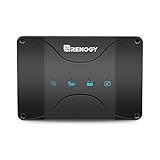
A device like the Renogy 50A MPPT Charge Controller is a physical embodiment of this algorithm. When its spec sheet boasts up to “99% tracking efficiency,” it’s not a marketing gimmick. It’s a measure of how successfully its internal brain can stay locked onto that moving power peak. This is the difference between a trickle of power on a cloudy day and a meaningful charge, and it’s a beautiful example of computational logic taming the wild nature of solar energy.

The Great Voltage Mismatch: Translating Power in a Modern World
So, you’ve harnessed the sun. But what about when you’re driving? Your vehicle’s alternator is a powerhouse, easily generating over a thousand watts of power. The challenge is that your alternator and your expensive “house” battery speak two completely different electrical languages.
An alternator is designed to quickly replenish a rugged starter battery and run the vehicle’s onboard electronics. Its voltage can be erratic. A lithium iron phosphate (LiFePO4) battery bank, on the other hand, is like a finely tuned instrument. It requires a precise, multi-stage charging voltage to ensure its long life and safety. Directly connecting the two is like shouting in the wrong language and hoping for a nuanced conversation—it will end badly.
This problem is amplified in modern vehicles equipped with “smart” alternators. To meet emissions standards, a car’s computer (ECU) now actively controls the alternator’s output, sometimes lowering the voltage dramatically or even turning it off when it deems the starter battery is full. To a traditional charging relay, it looks like the engine has been shut off, and it will stop charging your house battery, even while you’re cruising down the highway.
The solution is an electrical translator: the DC-to-DC converter.
At its core, a DC-to-DC converter is a sophisticated piece of power electronics that takes one DC voltage as an input and produces a completely different, perfectly regulated DC voltage as an output. It’s the universal adapter for your electrical world. When integrated into a charge controller, it performs a critical task: it takes the chaotic, variable voltage from your alternator, and meticulously crafts it into the perfect charging profile for your house battery.
This is precisely what the “DC to DC Battery Charger Function” on a unit like the Renogy 50A controller is doing. It isolates the two systems, ensuring you never drain your starter battery, and it’s smart enough to work with both old-school and smart alternators (via a special ignition signal wire). It’s a bridge between the brute force of automotive power and the delicate chemistry of your energy storage.
A Matter of Chemistry: The Art of Feeding Your Batteries
A battery is not a bucket you simply pour electrons into. It is a complex chemical reactor, and different chemistries demand vastly different “diets.” Charging a lead-acid (AGM) battery is fundamentally different from charging a lithium-ion (LiFePO4) battery. Their internal resistances, voltage windows, and reactions to temperature are worlds apart.
A proper charging process, known as a CC/CV (Constant Current / Constant Voltage) profile, is more like a three-course meal:
- Bulk (Constant Current): The main course. The charger supplies a large, steady current until the battery’s voltage rises to a specific level (e.g., about 80% full).
- Absorption (Constant Voltage): The dessert. The charger holds the voltage steady at a precise level, while the battery’s internal resistance increases. The current it accepts will naturally taper off as it gets closer to 100%. This is the critical “topping off” phase.
- Float (Trickle): The after-dinner coffee. Once full, the voltage is lowered to a “maintenance” level, providing just enough current to counteract self-discharge, keeping the battery healthy without overcharging it.
Applying the wrong profile—for instance, using a simple, single-stage charger on a lithium battery—can drastically shorten its lifespan or, in a worst-case scenario, damage it permanently. This is why a controller’s ability to be programmed for different battery types (“Gel, AGM, and Lithium”) is not a minor feature; it is a declaration of its respect for the laws of electrochemistry.

The Inescapable Heat: An Engineer’s Compromise with Thermodynamics
There’s one final law of physics that every power system designer must confront: nothing is 100% efficient. And inefficiency, in the world of electronics, manifests as heat.
Joule’s Law of Heating is the simple but profound principle at play. It states that the heat generated by a current flowing through a conductor is proportional to the square of the current (P = I²R). When a device is handling 50 amps, as the name of our example controller suggests, that current is squared. The resulting heat is not trivial; it is a significant engineering challenge. If not managed, this heat will damage components and shorten the device’s life.
There are two ways to deal with this heat. The “easy” way is active cooling: add a fan. But fans are noisy, they have moving parts that can fail, and they consume power. In the tight, quiet confines of a camper van or a boat cabin, a constant whirring noise is the last thing you want.
The more elegant solution is passive cooling. This involves using the device’s entire body as a heat sink. By crafting the enclosure from a thermally conductive material like aluminum and giving it fins to increase surface area, engineers can allow the heat to dissipate into the surrounding air through natural convection.
This is a classic engineering trade-off. The fanless design of the Renogy controller prioritizes reliability and silence over raw, brute-force cooling. It’s a bet that for its target user, a peaceful environment is more valuable than the ability to run at maximum power in the most extreme desert heat. It’s a silent, physical testament to the fact that great design is often about choosing what compromises to make.
The next time you look at that little blinking light on your battery monitor, hopefully, you’ll see something more. You won’t just see a number; you’ll see the relentless hunt for the Maximum Power Point. You’ll see the silent, perfect translation of voltage between your engine and your batteries. You’ll see a carefully prepared chemical meal being served to your energy storage. And you’ll feel the inescapable warmth of Joule’s Law being gracefully managed.
True power independence doesn’t come from a box. It comes from understanding the beautiful and inescapable laws of physics that the box so elegantly wrangles.