The Collapse of Latency: How Cloud Technology Is Rewiring Creative Collaboration
In the universe of creative work, our greatest adversary is physics itself. An idea, born in an instant, must traverse a gauntlet of physical barriers to become reality. For filmmakers, musicians, and designers, this battle has historically been fought against latency—the inescapable delay between action and outcome, between a moment captured and a story shared. We can send data around the world at nearly the speed of light, yet the workflow of creation has remained stubbornly tethered to the physical transfer of hard drives and the costly overhead of co-located teams.
This friction, this gap between the speed of thought and the speed of execution, represents one of the final frontiers of digital productivity. But a confluence of mature technologies is beginning to systematically dismantle it. We are witnessing the collapse of latency, driven by a powerful trifecta of cloud computing, intelligent networking, and cleverly engineered hardware that acts as a bridge between worlds. This isn’t just about making things faster; it’s about fundamentally rewiring the geography of collaboration. To understand this shift, we don’t need to look at a massive data center, but at the small, unassuming devices that are bringing its power to the edge.

The Art of the Digital Doppelgänger
The first major hurdle in any modern video workflow is the sheer size of the data. An hour of high-quality 4K footage can easily consume hundreds of gigabytes. Moving this digital mass across the internet is slow and impractical for real-time collaboration. The solution, however, is a concept of elegant simplicity, inherited from over a century of filmmaking craft: you don’t move the mountain; you work with a perfect, lightweight model of it.
In the era of celluloid, a film editor would never dare to physically cut the precious original camera negative. Instead, they worked with a “cutting copy,” an identical replica made for the express purpose of editing. This is the philosophical ancestor of the modern proxy workflow. The principle is to create a digital doppelgänger—a low-resolution, lightweight “proxy” file—that is an exact temporal match to the high-quality original, or “hero,” file.
The engineering beauty lies in the use of different video codecs, which are essentially sets of rules for compressing and decompressing video. For the hero file, you might use a codec like Apple’s ProRes. It’s designed for post-production, using minimal compression to preserve maximum image data and making it easy for a computer’s processor to decode during editing. For the proxy, you use a codec like H.265 (HEVC), a marvel of efficiency designed for transmission. It uses incredibly complex algorithms to discard data the human eye is unlikely to notice, achieving a file size that can be a tiny fraction of the original. One is built for quality, the other for agility.
This dual-recording strategy transforms the workflow. The bulky hero file can remain on-site, while the nimble proxy is uploaded to the cloud almost instantaneously. An editor, located anywhere in the world, can download this proxy in minutes and begin editing. Once the edit is complete, the editing software simply applies the list of decisions made using the proxy back to the original high-quality files for the final export. The creative work happens globally and in parallel, not linearly and in one place.

The Philosophy of the Pipe: A Tale of Two Connections
Once you have a lightweight file, you need a reliable pipe to send it through. In the world of digital signals, there are fundamentally two competing philosophies of connection, and understanding them reveals a fascinating tension between absolute reliability and flexible efficiency.
The first is the philosophy of the Serial Digital Interface (SDI). Born from the world of broadcast engineering, SDI is a standard of brutalist simplicity. It’s a dedicated, point-to-point connection that does one thing: it streams a pure, uncompressed river of video data from one place to another. Its reliability stems from its physical and electrical properties. It uses 75-ohm coaxial cables and BNC connectors, a design choice rooted in the physics of impedance matching. This ensures that the electrical signal flows smoothly down the cable with minimal reflection, allowing for incredibly long cable runs—hundreds of feet—without data loss. SDI is a testament to an engineering philosophy that prizes robustness above all else; it doesn’t ask questions, it just works.
The second philosophy is that of the packet-switched network, the foundation of Ethernet and Wi-Fi. Here, data is chopped up into small “packets,” each with an address, and sent out into a shared network. This is incredibly flexible and efficient for general-purpose computing, but it introduces complexity and potential points of failure like congestion and latency.
The latest iteration, Wi-Fi 6 (802.11ax), tackles this head-on with a technology called Orthogonal Frequency-Division Multiple Access (OFDMA). The best analogy for previous Wi-Fi generations is a delivery truck that had to make a separate trip for every single package, no matter how small. OFDMA allows the truck to be intelligently loaded with multiple small packages for different destinations all in the same trip. It dramatically improves efficiency in crowded environments, which is critical for the real-time demands of video streaming.
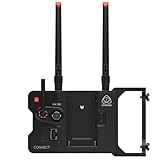
For decades, these two worlds—the steadfast SDI and the flexible internet—remained separate. The crucial innovation of recent years is the creation of devices that act as a Rosetta Stone between them. A perfect case in point is a device like the Atomos Connect, an add-on module for their Ninja series of field monitors. This single piece of hardware elegantly embodies this convergence. It accepts a signal from the robust, professional world of SDI, processes it, and then transmits it to the cloud using the flexible, efficient language of Wi-Fi 6 and Ethernet. It is the physical manifestation of these two philosophies being unified to solve a modern problem.

Aligning the Universe: The Metaphysics of Sync
When you solve the problems of data size and transmission, one final, almost metaphysical challenge remains: time itself. When you have multiple cameras and separate audio recorders, how do you ensure that every single device has the exact same, universal understanding of “now”? Without this, editing is a nightmare of manually aligning dozens of clips by sight and sound.
The solution is timecode, a universal clock for media. It assigns a unique address—in hours, minutes, seconds, and frames—to every moment of a recording. The challenge has always been distributing this master clock signal to all devices on a set. Traditionally, this involved a physical cable to “jam sync” each device.
Modern solutions, however, leverage low-energy wireless protocols. Technologies like Atomos’s AirGlu use Bluetooth LE to create a local network where one device acts as the master clock, constantly broadcasting the correct time. All other devices listen and continuously discipline their internal clocks to match it.
This act of synchronizing a local network of creative tools is a microcosm of a larger principle that underpins our entire digital civilization. The internet itself relies on the Network Time Protocol (NTP) to synchronize servers around the globe with a network of atomic clocks. Without this shared sense of time, secure online transactions, distributed databases, and countless other systems would fail. From the global scale of the internet to the hyper-local scale of a film set, the ability to create and maintain a shared timeline is a fundamental prerequisite for complex, distributed work.
When the Studio Is No Longer a Place
The convergence of these three pillars—instantaneous proxy workflows, unified connectivity, and universal synchronization—is leading to a profound conclusion: the creative studio is no longer a physical place. It is a distributed network of talent, connected by the cloud. The hardware, exemplified by devices like the Connect, acts as the on-ramp, the physical node that links a camera’s sensor to this global, digital workspace.
This shift, of course, introduces new models, such as the move towards subscriptions for the cloud services that power these workflows—a source of consternation for some users. But it reflects a deeper truth: the value is shifting from the standalone hardware to the interconnected service it enables. We are paying not for the box, but for the obliteration of distance it provides.
By conquering latency, we are not merely making the old way of working faster. We are enabling entirely new ways of creating. A director in London can give real-time feedback to a camera operator in Tokyo. A producer in Los Angeles can review dailies from a shoot in the Sahara desert before the crew has even wrapped for the day. This technology is a powerful democratizing force, granting the logistical capabilities of a major Hollywood studio to independent creators. The question that remains is a creative one: now that the tyranny of distance has been broken, what new stories will we tell?