
The Chemistry of the Closed Room: Carbon Monoxide and the Illusion of Safety in Portable Cooking
In the marketing of lifestyle appliances, there is often a dangerous ambiguity between “capability” and “suitability.” A device may be capable of operating indoors, but is it suitable for the biological organisms sharing that space? Nowhere is this question more critical than in the world of high-output portable gas stoves.
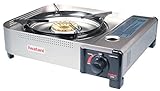
The Iwatani 35FW, with its sleek design and massive 15,000 BTU output, is frequently advertised and used as an “indoor/outdoor” appliance. Users post photos of shabu-shabu parties in their living rooms and hot pot dinners on coffee tables. Yet, buried in the safety manual is a terrifying warning: “Using it in an enclosed space can kill you.”
This contradiction—between the cozy image of indoor dining and the lethal reality of combustion chemistry—is a gap in public understanding. It is not just about “ventilation”; it is about Stoichiometry, Hemoglobin Kinetics, and the invisible, odorless byproduct of incomplete oxidation: Carbon Monoxide (CO). This article explores the chemistry of the closed room and why high-performance stoves demand a level of respect that borders on paranoia.
The Stoichiometry of Combustion: Perfect vs. Imperfect
To understand the risk, we must look at the chemical reaction happening at the burner. Butane (C_4H_{10}) is a hydrocarbon. In a perfect world, with infinite oxygen supply and perfect mixing, the combustion reaction looks like this:
2C_4H_{10} + 13O_2 \rightarrow 8CO_2 + 10H_2O + Heat
The byproducts are Carbon Dioxide (CO_2), Water (H_2O), and Heat. Carbon Dioxide, while a greenhouse gas, is not immediately toxic in low concentrations. We exhale it with every breath.
However, the real world is not perfect. When a 15,000 BTU burner is roaring inside a small apartment, or when a large pot restricts airflow around the flame, the reaction becomes “oxygen-starved.” The stoichiometry shifts. There isn’t enough O_2 to fully oxidize the carbon atoms. The reaction becomes Incomplete Combustion:
2C_4H_{10} + 9O_2 \rightarrow 8CO + 10H_2O + Heat
Instead of harmless CO_2, the reaction produces Carbon Monoxide (CO).
The Invisible Assassin
Carbon Monoxide is chemically insidious. It is colorless, odorless, and tasteless. Our evolutionary biology gave us no sensors to detect it. Smoke triggers coughing; ammonia triggers tearing; CO triggers nothing. You can breathe lethal concentrations of CO without realizing anything is wrong until you lose consciousness.
The Iwatani 35FW is a powerhouse. Because it consumes fuel at a high rate to generate 15,000 BTUs, it also consumes oxygen at a prodigious rate. In a sealed room (like a modern energy-efficient home with tight weatherstripping), the stove acts as an “Oxygen Sink.” As oxygen levels drop, the probability of incomplete combustion rises exponentially. It is a positive feedback loop of death: the fire eats the oxygen, forcing the fire to produce more poison.
The Biological Mechanism: Hemoglobin Affinity
Why is CO so deadly? The answer lies in our blood. Our red blood cells contain Hemoglobin, a complex protein designed to transport Oxygen (O_2) from our lungs to our tissues.
Hemoglobin binds to Oxygen, but it binds to Carbon Monoxide with a affinity that is 200 to 250 times stronger.
* If you have a room full of oxygen molecules and one CO molecule, the hemoglobin will ignore the oxygen and grab the CO.
* Once CO binds to hemoglobin, it forms Carboxyhemoglobin (COHb). This bond is extremely stable. The CO does not let go.
* This effectively permanently deactivates that red blood cell. It can no longer carry oxygen.
As you continue to cook in a poorly ventilated room, your blood is slowly converted from an oxygen-transport system into a useless sludge. The symptoms—headache, dizziness, nausea—are often mistaken for food poisoning or the flu. This leads to the tragedy of whole families perishing after a “cozy” hot pot meal, thinking they just ate something bad, when in reality, they were suffocating on a cellular level.
The Dynamics of “Indoor” Use: Commercial vs. Residential
If the chemistry is so dangerous, why is the Iwatani 35FW certified for “Indoor Use” in commercial restaurants? This is where the definition of “Indoor” becomes critical.
The Commercial Kitchen Environment
A commercial kitchen is an industrial environment. It is mandated by law to have Active Ventilation Systems—massive hoods that suck thousands of cubic feet of air per minute (CFM) out of the building and replace it with fresh make-up air. In this environment, the CO produced by a butane stove is instantly captured and ejected. The ambient CO level remains near zero.
The Residential Living Room
A residential home is a static environment. A typical range hood moves maybe 300 CFM, and that’s only if it’s turned on and vented to the outside (many just recirculate air). A living room or dining table has zero active ventilation.
When a user places the 35FW on a dining table for Korean BBQ or Hot Pot, they are releasing combustion byproducts directly into their breathing zone.
* The “Pot Effect”: Placing a large pot (like a wide donabe or wok) on the stove exacerbates the problem. The large surface area of the pot bottom traps rising exhaust gases and disrupts the airflow to the burner. This “quenching” effect cools the flame and restricts oxygen access, drastically increasing CO production.
* The “Cold Start”: When the heavy brass burner and the pot are cold, the flame is quenched by the cold surfaces, producing a spike in CO until the system warms up.

The image above shows the Double Windbreaker design. While excellent for outdoor wind protection, this feature can inadvertently contribute to indoor risk if not understood. The high walls that protect the flame from wind also restrict cross-ventilation at the burner base. In a stagnant indoor room, this can create a localized pocket of oxygen-depleted air right at the intake ports, forcing the burner into incomplete combustion sooner than an open burner design would.
Safety Engineering: What the Stove Can and Cannot Do
The Iwatani 35FW has advanced safety features, but they are designed to prevent Explosions, not Poisoning.
- Pressure Sensor: It detects if the canister is overheating and ejects it to prevent a BLEVE (Boiling Liquid Expanding Vapor Explosion).
- Magnetic Lock: It ensures a leak-free seal.
It does NOT have an Oxygen Depletion Sensor (ODS).
Some indoor propane heaters have an ODS that cuts the gas if oxygen levels drop below 18%. The 35FW does not. It will happily burn until the room is lethal. It relies entirely on the user’s intelligence to provide ventilation.
The Myth of the “Clean Blue Flame”
Users often believe that a blue flame means “clean” combustion and therefore no CO. This is a dangerous myth. While a yellow flame definitely indicates incomplete combustion (soot), a blue flame can still produce significant amounts of Carbon Monoxide depending on the flame temperature and mixing ratio. You cannot “see” safety.
This is why reliance on visual cues is fatal. The only safety mechanism for indoor use is Air Exchange. Opening windows on opposite sides of the room to create a cross-draft is the minimum requirement. Using a portable fan to circulate air away from the breathing zone is another layer of defense.
Conclusion: The Responsibility of Power
The Iwatani 35FW is a magnificent piece of thermal engineering. Its ability to output 15,000 BTUs makes it a legitimate substitute for a professional range. But power is neutral. The same energy that sears a steak can consume the oxygen in a bedroom.
The marketing of “Indoor Use” is technically correct but practically dangerous without context. It assumes a “Commercial Indoor” environment, not a “Residential Indoor” one. For the home user, this stove should be treated with the same caution as a charcoal grill or a generator. It belongs in well-ventilated spaces, monitored by CO detectors, and respected for the chemical reactor that it is.
In the end, the most important safety feature of the Iwatani 35FW is not the magnetic lock or the pressure sensor; it is the educated mind of the user. Understanding the chemistry of combustion transforms the stove from a potential hazard into a powerful culinary ally. It allows us to harness the fire without becoming its fuel.