
The Mechanics of Processing: Bone Crushing, Torque, and the Value of Biomass
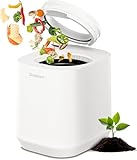
Kitchen waste is not uniform. It ranges from soft lettuce (mostly water) to hard chicken bones (calcium phosphate matrix). A machine that claims to process “food waste” must handle this extreme variability in material properties.
The Ouaken JF6001A claims to handle “chicken bones.” This moves it from the category of a simple dehydrator to a Heavy-Duty Grinder.
This capability relies on the physics of Comminution (size reduction). It involves Torque, Shear Stress, and Fracture Mechanics.
Furthermore, once processed, this material represents a shift in how we view energy. Is it waste, or is it fuel?
This article explores the mechanical engineering required to crush bones on a countertop and the ecological economics of the resulting biomass.
The Physics of Bone Crushing: Torque over Speed
Why can’t a blender crush bones? Because blenders rely on Speed (RPM). High speed creates impact, but low mass means low momentum. Bones are tough; they resist high-speed impact.
The Ouaken composter uses Low-Speed, High-Torque motors.
* Torque (\tau): The rotational force. \tau = Force \times Radius.
* Gear Reduction: The motor spins fast, but a gearbox reduces the speed and multiplies the torque.
Fracture Mechanics
Bones are composite materials (collagen + hydroxyapatite). They have high compressive strength but lower Shear Strength.
The blades of the Ouaken are designed not to chop (like a knife) but to Crush and Shear.
1. Compression: The waste is trapped between the blade and the bucket wall. The torque compresses it until it exceeds its yield strength.
2. Shear: The opposing motion of the blades (or blade against wall) applies force in opposite directions, ripping the material apart.
This mechanical pulverization is critical for Volume Reduction. Bones are hollow or porous. Crushing them collapses their void space. Vegetables are cellular. Crushing them releases intracellular water. The “90% Reduction” is largely a result of this mechanical collapse of structure.
The Output: Characterizing the Biomass
What comes out of the machine?
It is a dry, granular material.
* Homogeneity: The grinder turns a heterogeneous mix (bones, peels, bread) into a homogeneous powder. This uniformity is key for soil application (even distribution).
* Surface Area: As discussed in previous analyses, high surface area speeds up microbial decomposition in the soil. The “Bone Meal” created by crushing chicken bones is an excellent source of slow-release Calcium and Phosphorus.

The image above shows the result of this mechanical violence. What was once recognizable trash is now a generic organic substrate. It is dry to the touch, indicating successful phase change of the water. It is granular, indicating successful mechanical fracture.
Energy Efficiency: The Cost of Crunch
Crushing bones takes energy. Heating water takes energy.
Is the Ouaken efficient?
* Insulation: The “Cooling” phase implies that the machine retains heat well during the cycle (adiabatic process) but must vent it at the end. Good insulation reduces the energy needed to maintain the 100°C kill temp.
* Batch Processing: The 4L capacity encourages processing larger batches. Thermodynamically, it is more efficient to heat one large mass than many small ones (Surface-to-Volume ratio).
The Ecological Balance Sheet
Using electricity to grind bones might seem wasteful compared to tossing them in the trash.
However, bones in a landfill take decades to decompose. In the soil, as bone meal, they provide value.
The machine converts Electrical Energy into Chemical Potential Energy (fertilizer).
Instead of buying mined phosphate fertilizer (which has a huge carbon footprint), you are manufacturing it at home from waste. The energy used by the machine is an investment in Nutrient Recovery.
Conclusion: The Heavy-Duty Recycler
The Ouaken JF6001A distinguishes itself by its mechanical robustness. It tackles the hard problems of waste—bones, fibrous stalks, pits—through brute force engineering (Torque).
It transforms the kitchen from a site of consumption into a site of production. It produces Bone Meal, Dehydrated Vegetable Matter, and Clean Water Vapor.
For the user, it offers a way to close the loop on all organic waste, not just the soft stuff. It is a machine that respects the value of materials, refusing to let even a chicken bone go to waste.