
The Engine of Commerce: Thermodynamics, Workflow, and the Engineering of Consistency
In the high-stakes environment of a busy café, an espresso machine is not merely a tool; it is the central engine of the business. During the morning rush, when the line stretches out the door and tickets are piling up, there is no room for thermal instability, pressure fluctuation, or ergonomic failure. The machine must perform with the relentless consistency of a metronome.
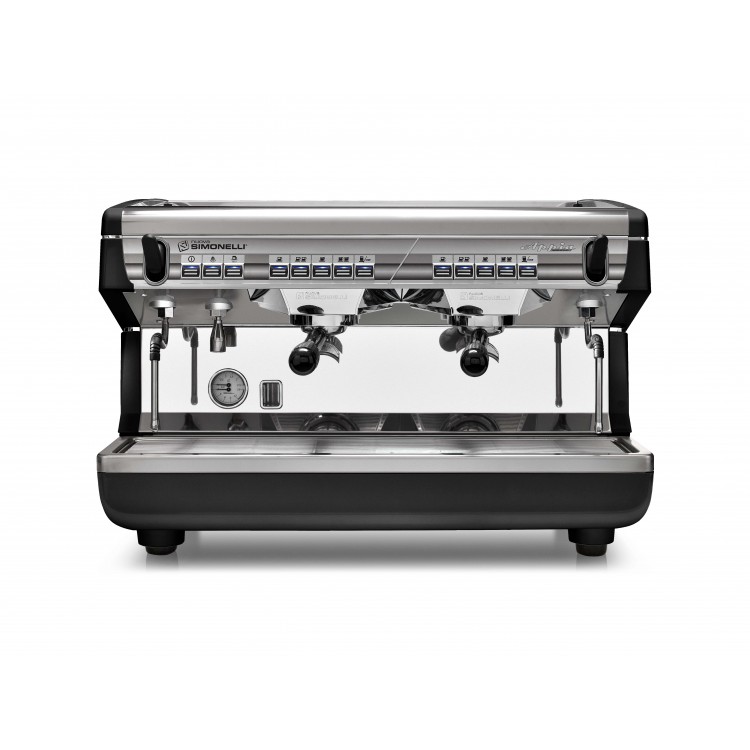
This is the domain of the Nuova Simonelli Appia II Volumetric 2 Group. While it may lack the exotic, experimental features of some “hyper-car” espresso machines, the Appia II is legendary for a different reason: it is the ultimate workhorse. It is engineered with a specific philosophy—to democratize consistency. By leveraging advanced thermodynamics, fluid dynamics, and biomechanics, it mitigates human error and ensures that the hundredth shot of the day is as perfect as the first.
This article deconstructs the engineering beneath the stainless steel panels. We will explore the thermodynamics of its massive heat exchanger system, the fluid dynamics of its patented Soft Infusion System (SIS), and how its ergonomic design translates directly into economic stability for the café owner.
Thermodynamics of the Heat Exchanger: The Power of Thermal Mass
At the heart of the Appia II lies a massive 11-liter copper boiler. In the world of espresso thermodynamics, size matters. This immense volume of superheated water and steam acts as a thermal battery, providing the inertia needed to maintain stability against the rapid-fire demands of a commercial environment.
The HX Architecture
The Appia II utilizes a Heat Exchanger (HX) system. Unlike a dual-boiler system where brew water and steam water are kept in separate tanks, an HX system runs a cold water pipe through the steam boiler.
1. Flash Heating: As cold water from the rotary pump travels through the heat exchanger tube, it is instantly heated by the surrounding thermal energy of the steam boiler (which is kept at ~120-125^\circ C).
2. Thermal Equilibrium: By the time the water reaches the group head, it has achieved the target brew temperature (~92-94^\circ C).
The Thermosyphon Loop
The genius of the Appia II is how it maintains the temperature of the group head itself. It employs a Thermosyphon Loop. This is a passive fluid dynamic circuit. Hot water from the heat exchanger naturally rises to the group head (convection), heats the heavy brass mass of the group, cools slightly, and then sinks back down to the boiler to be reheated.
* Why It Matters: This constant circulation ensures that the group head is always thermally saturated. Even if the machine sits idle for 5 minutes, the first shot won’t be sour (cold) because the metal pathway is already at the perfect temperature. This “thermal readiness” is critical for maintaining quality during intermittent service.
Simultaneous Power
The 11-liter boiler provides a virtually endless supply of dry steam. While the heat exchanger handles the brewing water, the massive steam pocket above it powers the wands. This allows baristas to brew two shots and steam two pitchers of milk simultaneously without a drop in pressure or temperature—a feat impossible for smaller, thermally limited machines.
The Physics of Forgiveness: Soft Infusion System (SIS)
In a commercial setting, staff turnover is a reality. You cannot guarantee that every barista has the “perfect tamp” of a seasoned professional. An uneven tamp leads to channeling—where high-pressure water finds a crack in the coffee puck, rushing through it and leaving the rest of the coffee dry. The result is a shot that is both bitter (over-extracted in the channel) and sour (under-extracted elsewhere).
Nuova Simonelli solves this with the Soft Infusion System (SIS). This is not just “pre-infusion”; it is a mechanical error-correction system.
Progressive Pressure Profile
The SIS creates a specific pressure curve:
1. Low-Pressure Saturation: When the pump engages, the SIS chamber (a mechanical pre-infusion chamber inside the group) allows water to flow gently onto the coffee puck at essentially line pressure (no pump pressure yet). This soft water flow causes the coffee particles to swell and reorganize.
2. Self-Healing: As the coffee swells, it naturally fills in any cracks or unevenness in the tamp. The puck becomes a solid, uniform mass.
3. Pressure Ramp: Only after this saturation phase does the system allow the full 9 bars of pressure to hit the puck.
The Economic Impact: By mechanically fixing tamping errors, the Appia II significantly widens the “sweet spot” for extraction. It ensures that a barista with 3 months of experience can pull a shot almost as good as one with 3 years of experience. This reduces “sink shots” (wasted coffee) and guarantees customer satisfaction regardless of who is on shift.
Ergonomics as Economics: Biomechanics of the Barista
Espresso machines are industrial workstations. A barista might perform the same motions hundreds of times a day. Poor ergonomics lead to fatigue, slowness, and eventually, Repetitive Strain Injury (RSI) like carpal tunnel syndrome. The Appia II treats ergonomics as a business asset.
The Push-Pull Steam Lever
Traditional machines use rotary knobs to control steam. To turn them on and off requires a twisting motion of the wrist, repeated hundreds of times. The Appia II features Push-Pull Steam Levers.
* Biomechanics: A natural downward push opens the valve fully. An upward lift locks it open for hands-free steaming. This motion uses the larger muscle groups of the arm rather than the delicate tendons of the wrist.
* Speed: It is faster to flick a lever than to turn a knob 360 degrees. In a rush, these split seconds add up to faster ticket times.
Cool Touch Wands
The steam wands are insulated, remaining cool to the touch even while piping superheated steam.
* Safety: This eliminates the risk of nasty burns, a common hazard in cramped café bars.
* Cleanliness: Because the wand doesn’t get scorching hot on the outside, milk doesn’t bake onto it instantly. A quick wipe removes all residue, keeping the station sanitary and reducing end-of-shift cleaning labor.
The Reverse Mirror
The backplate behind the drip tray is polished stainless steel, angled to act as a Reverse Mirror. This allows the barista to see the bottom of the portafilter and the flow of the espresso without having to bend over and crane their neck. They can monitor the shot quality (checking for “tiger striping” or channeling) from a comfortable, standing position. This seemingly small detail saves the barista’s back over thousands of cycles.
The 2-Group Advantage: Fluid Dynamics of Volume
Why a 2-group machine? It comes down to the fluid dynamics of throughput.
* Parallel Processing: A 2-group machine allows for the simultaneous extraction of four single shots or two double shots.
* Thermal Recovery: While one group is extracting, the other is recovering its thermal equilibrium via the thermosyphon loop. This alternating rhythm ensures that the machine never “runs out of breath” thermally, even during a relentless rush.
Conclusion: The Backbone of the Café
The Nuova Simonelli Appia II Volumetric is not designed to be a show pony; it is designed to be a draft horse. Its engineering choices—the massive heat exchanger, the forgiving SIS, the ergonomic levers—are all focused on one goal: reliability.
It acknowledges the chaotic reality of the café environment and uses physics to impose order. By managing the thermodynamics of heat and the fluid dynamics of extraction, it frees the barista to focus on hospitality and art. For the business owner, it is an investment in consistency, ensuring that the quality of the product remains high, the waste remains low, and the staff remains healthy and efficient.