The Anatomy of Access: Biometrics, Physics, and the Engineering of the GGUU Smart Lock
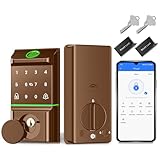
The key is a technology that has remained fundamentally unchanged for 4,000 years. A piece of shaped metal aligns pins inside a cylinder to allow rotation. It is simple, reliable, and fundamentally flawed. Keys get lost, copied, and fumbled in the dark.
The GGUU 2406A Security Smart Lock represents the modern answer to this ancient problem. By integrating Biometrics, Cryptography, and Material Science, it attempts to replace the physical token (the key) with something you are (your fingerprint) or something you know (a code).
Priced aggressively under $100, it also represents the democratization of advanced security technology. But how does it work? Is an aluminum lock secure? And what happens when the batteries die? This article deconstructs the engineering behind the GGUU smart lock, exploring the physics of capacitive sensing, the metallurgy of its chassis, and the fail-safe protocols that keep you from being locked out of your own life.
The Biometric Sensor: Capacitive vs. The Real World
The headline feature of the GGUU 2406A is its fingerprint scanner. But not all scanners are created equal. Early biometric locks used Optical Sensors—essentially tiny cameras that took a black-and-white photo of your fingerprint. These were slow, bulky, and easily spoofed by a high-resolution photocopy.
The Semiconductor Advantage
The GGUU utilizes a Capacitive (Semiconductor) Sensor.
* The Physics: The sensor surface is an array of thousands of tiny capacitor plates. When you place your finger on it, the ridges of your fingerprint touch the surface, while the valleys hover slightly above.
* Dielectric Constant: Your skin acts as a conductive plate. The air in the valleys has a different dielectric constant than the skin ridges. The sensor measures the capacitance difference at each pixel, creating a precise topographic map of your print.
* Liveness Detection: Because it relies on electrical conductivity, this sensor inherently checks for “liveness.” A silicone mold or a paper copy does not conduct electricity like human skin, making it extremely difficult to spoof.
The Moisture Variable
However, capacitive sensors obey the laws of physics. The user review noting that “fingers got too dry and the scanner couldn’t read them” highlights a critical limitation.
* Dry Skin: Lacks moisture, increasing electrical resistance. The sensor sees a weak signal.
* Wet Skin: Water is conductive. Rain or sweat fills the “valleys” of the fingerprint, shorting the capacitive array and creating a “smear” image.
This is not a defect; it is physics. Understanding this helps users realize why the GGUU includes backup methods (keypad, IC card). Biometrics are probabilistic, not absolute.

The Metallurgy of Budget Security: Aluminum vs. Brass
In the lock industry, mass correlates with security. High-end commercial locks are machined from solid brass or stainless steel. The GGUU 2406A is constructed from Aluminum Alloy.
The Engineering Trade-off
- Pros: Aluminum is lightweight, reducing the strain on the door hinges. It is naturally corrosion-resistant (creating an oxide layer), making it suitable for outdoor use. It is also cheaper to die-cast into complex shapes, allowing for the sleek modern design at a low price point.
- Cons: Aluminum has a lower melting point (~660°C) than steel (~1370°C). In a severe structural fire, an aluminum housing might fail sooner. It is also softer than hardened steel, making it theoretically more vulnerable to brute-force drilling attacks.
The Reality of Residential Security
Does this matter? For a residential deadbolt, usually not. The weak point of almost every American home is the Door Jamb (the wood frame), not the lock body. A kick-in attack will splinter the wood long before it shatters an aluminum lock body. Unless you have a steel door frame, the GGUU’s aluminum construction is mechanically sufficient for the threat model of a typical home.
The Connectivity Air Gap: Bluetooth Security Architecture
Unlike Wi-Fi locks that are constantly connected to the internet, the GGUU 2406A uses Bluetooth 4.0 BLE (Low Energy) as its primary communication protocol.
* The Air Gap: Out of the box, this lock is “Air Gapped.” It cannot be hacked from Russia because it isn’t on the internet. To control it, you must be within Bluetooth range (approx. 30 feet).
* The Gateway Option: For users who want remote control (unlocking for a guest while at work), GGUU offers a separate G2 Gateway. This bridge connects the lock’s Bluetooth to the home’s Wi-Fi.
This modular architecture is a security feature. It allows the paranoid user to keep the lock offline, while the convenience-focused user can add the bridge. It puts the choice of “Attack Surface” in the hands of the owner.
Emergency Fail-Safes: The Battery Equation
Electronic locks introduce a new fear: “What if the battery dies?” The GGUU is engineered with a Redundant Power Architecture.
1. Primary Power: 4 AA Batteries. The low-power BLE protocol allows for 6-12 months of life.
2. Low Battery Alarm: The lock monitors the voltage curve. Alkaline batteries have a predictable voltage drop. When it hits a threshold (e.g., 4.8V), the lock screams at you every time you use it.
3. The USB Jump Start: If you ignore the warnings for weeks and the batteries die completely, you are not locked out. On the bottom of the exterior panel is a Micro-USB / Type-C Port. This is not for charging (the batteries are alkaline); it is for Emergency Power. You can plug in a portable power bank, wake up the processor, and enter your code.
4. The Ultimate Backup: Finally, hidden behind a magnetic cover or slide is a standard Mechanical Keyway. Even if the electronics are fried by an EMP, the physical key will manually retract the bolt.

Conclusion: Engineered for Access, Not Fortification
The GGUU 2406A is best understood not as a bank vault for your front door, but as a sophisticated Access Management Device.
It uses capacitive physics to verify identity, aluminum metallurgy to provide deterrence, and redundant power systems to ensure reliability. It acknowledges that in the real world, convenience is the driver of adoption. By providing five ways to open a door (Fingerprint, Code, Card, App, Key), it ensures that authorized entry is frictionless, while unauthorized entry remains a challenge.