The Unseen Battle: How Your CNC Machine Fights a War Against Physics
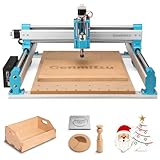
In my garage, amidst the scent of sawdust and machine oil, sits a quiet testament to modern ingenuity. It’s a desktop CNC machine. I can send it a digital blueprint—a ghost of an idea living on my computer—and with a low hum, it begins to coax a real, physical object out of a block of inert material. The process feels like magic. But I know it isn’t.
As an engineer, I see something else. I see a battlefield. Every smooth curve, every sharp edge, every precisely drilled hole is a hard-won victory in a relentless war against the fundamental laws of physics. This machine, and every machine like it, is a soldier in that war. And to truly appreciate the act of making, we must first understand the nature of the enemy.
This is the story of that war, fought on three distinct fronts: a battle against vibration, a battle against uncertainty, and a battle against matter itself. And as our case study, a perfect example of a modern consumer-grade combatant, we’ll occasionally glance at the Genmitsu 4040-PRO, not as a product, but as a physical manifestation of the engineering strategies deployed.

The Battle Against Vibration: A War of Rigidity
The first and most important enemy of precision is vibration. It’s an insidious foe. When the cutting tool, spinning at thousands of revolutions per minute, makes contact with the material, it doesn’t just cut; it strikes, creating a series of high-frequency impacts. These impacts generate vibrations that ripple through the entire structure of the machine. If the machine’s frame is not up to the task, it will begin to resonate, like a poorly made guitar.
This resonance, known to machinists by the menacing name “chatter,” is catastrophic. It leaves a rippled, ugly finish on the workpiece and can destroy dimensional accuracy. The only way to win this fight is with an overwhelming defense, and that defense has a name: rigidity.
Rigidity is a measure of how well a structure resists bending or deforming under load. It is not the same as strength. A material can be strong (hard to break) but still be flexible. For a CNC machine, flexibility is death. This is why the choice of frame material is not a trivial detail; it is the strategic foundation of the entire machine.
Consider the physics. A material’s resistance to bending is quantified by its Young’s Modulus. Steel, for instance, has a Young’s Modulus roughly three times that of aluminum. This means that for two identically shaped beams, the steel one will be three times harder to bend. This is why when you see a desktop machine like the 4040-PRO advertising a “New Steel HSS Frame” and “16mm Steel HSS linear tubes,” it’s not just marketing fluff. It is a declaration of its primary military doctrine. It is choosing the brute-force defense of a castle wall over a flimsy fence. The sheer mass and stiffness of the steel absorb and dampen those enemy vibrations before they can corrupt the final piece. Every pound of steel in that frame is a soldier standing guard against the chaos of chatter.

The Battle Against Uncertainty: A War of Precision
Once the fortress of rigidity is established, the machine must face its second challenge: translating the perfect, platonic ideals of a digital design into the messy, imperfect physical world. How do you command a cutting tool to move from point A to point B, not just approximately, but повторно, with micron-level accuracy?
This is the war of motion control. Here, we see one of the most fundamental philosophical divides in machine design, beautifully illustrated by the choice between a belt-drive system and a lead-screw system. Belts, common in 3D printers, are the sprinters. They are lightweight, fast, and inexpensive. They can whip a lightweight extruder head around at incredible speeds. But they have a fatal flaw in the war for precision: they are elastic. They stretch. Under the heavy load of milling, that stretch introduces a tiny, unpredictable error, a lie between the digital command and the physical action.
Lead screws are the monks. They are slower, heavier, and more deliberate. A lead screw, like the ones used on the 4040-PRO, is a rigid steel rod that converts the pure rotational input of a motor into brutally precise linear movement. The mechanical engagement is direct and uncompromising. This choice represents a profound engineering trade-off: sacrificing raw speed for unimpeachable truth.
But even here, a ghost haunts the machine. It’s called backlash. It’s the tiny amount of “slop” or “play” that exists between the threads of the screw and the nut that rides along it. When the motor changes direction, it must first turn a tiny amount to take up this slack before any actual movement occurs. In the world of everyday objects, this fraction of a millimeter is irrelevant. In the world of precision machining, it is a gaping chasm of uncertainty. Winning this battle requires clever hardware, like anti-backlash nuts that use springs to constantly push against the screw threads, and intelligent software that anticipates and compensates for this gap. It is a microscopic war, fought and won with every change of direction.

The Battle Against Matter: A War of Force
Finally, with a rigid frame and a precise motion system, the machine must confront the material itself. And this is where many aspiring makers face a harsh reality. The physics of cutting wood is a different universe from the physics of cutting aluminum, and the difference is defined by the eternal dance between speed (RPM) and force (torque).
Imagine driving a car. In first gear, you have tremendous torque—the force needed to get the car moving from a standstill. You can climb a steep hill, but your top speed is low. In fifth gear, you have very high speed, but almost no torque; you can’t start the car in fifth gear.
The spindle of a CNC machine is its engine and transmission combined. A standard motor on a hobby-level machine, like the 775-type motor, is a high-RPM engine. It might spin at 10,000 RPM or more, which is fantastic for gliding through soft materials like wood and plastic. It’s the “fifth gear” of machining.
The problem arises when you face a block of aluminum. Aluminum doesn’t want to be sheared away by a screamingly fast but weak cutter. It needs to be forcefully plowed through. It requires torque. It requires first gear. When a user complains that their hobby CNC “struggles with metal,” what they are really observing is a torque-speed mismatch. The high-speed motor, when forced to slow down by the resistant material, falls out of its optimal power band. Its torque plummets, and the cut fails.
This is not a flaw; it is the most brilliant compromise of all. A machine like the 4040-PRO is designed with a “fifth gear” engine to keep it affordable and effective for 90% of hobbyist tasks. But crucially, it is designed with an upgrade path. It allows you to swap out that stock motor for a trim router or a more powerful spindle—a process akin to dropping a V8 engine into your car. This modularity is a profound design philosophy. It acknowledges that the user’s journey is one of growth, and it provides a machine that can grow with them, from a high-speed engraver to a torque-heavy mill. It respects the user’s budget today and their ambition for tomorrow.
The war is never truly over. There will always be a new material to understand, a new micron of accuracy to chase. But in the quiet hum of the garage, as a perfect part emerges from a raw block, there is a moment of peace. It’s the satisfaction of knowing that you, the maker, are not just a user of a tool. You are a general, commanding a sophisticated soldier in an elegant, unending war against the very laws of our physical world. And that is a victory worth celebrating.