The Aerodynamics of Multi-Layer Cooking: Engineering the 14QT Cavity

In the world of air frying, capacity is usually measured in “quarts,” but the true metric of utility is Surface Area. A standard basket air fryer might hold 6 quarts, but you can only cook one layer of wings effectively. To cook more, you must stack them, which destroys crispiness.
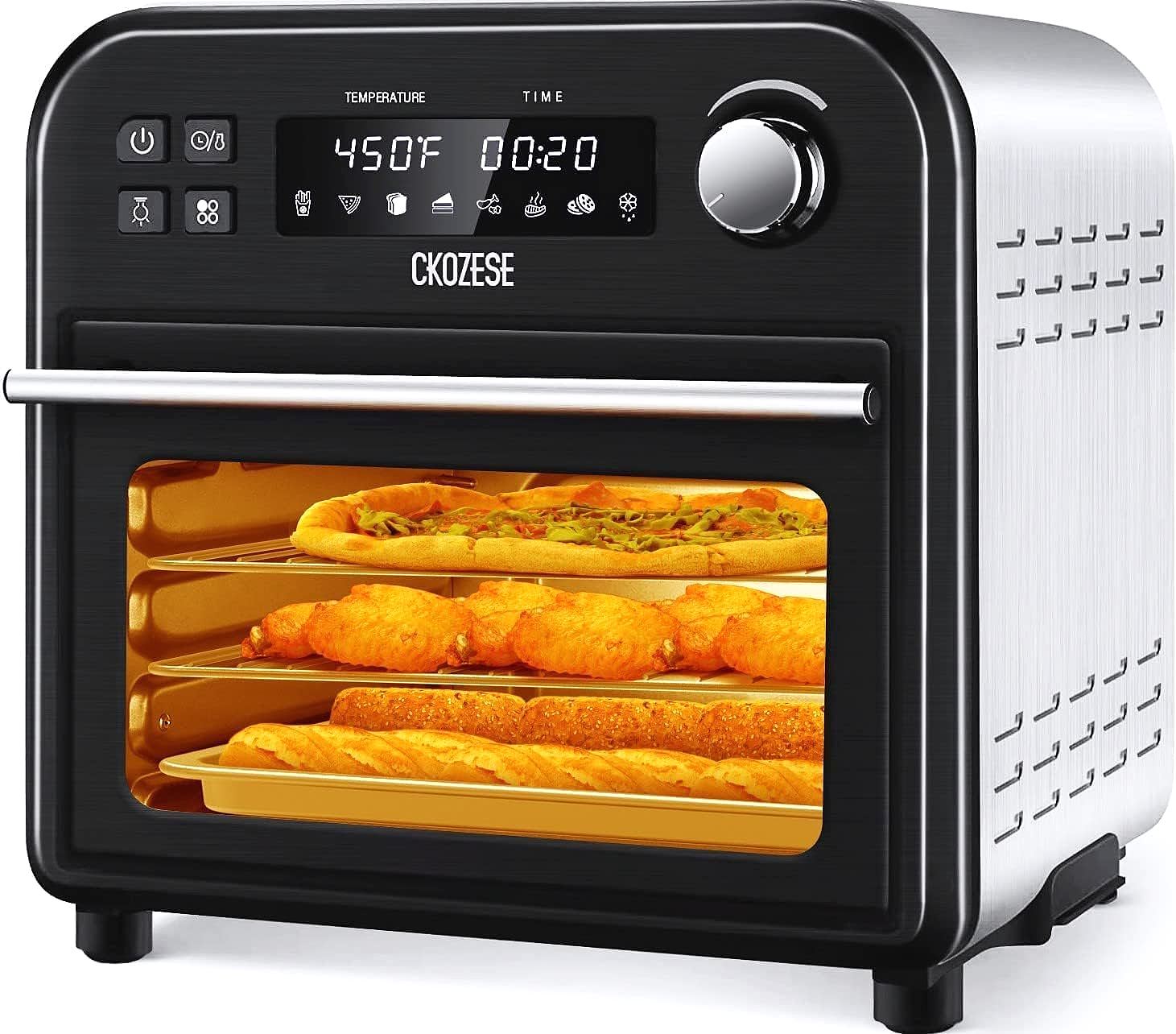
The CKOZESE FM1053 breaks this limitation with a Shelf-Based Architecture. Its 14QT (12.7L) cavity is designed to accommodate three vertical rack positions. This allows for Multi-Layer Cooking—a feat that requires sophisticated aerodynamic engineering to ensure that the food on the bottom shelf cooks as evenly as the food on the top.
This article explores the fluid dynamics of the 14QT cavity. We will analyze the challenge of Flow Resistance in stacked cooking, the mechanics of the 3000 RPM fan, and the phenomenon of Thermal Shadowing that users must navigate.
The Aerodynamics of the Stack: Flow Resistance
When you slide three racks of dehydrated fruit or chicken wings into the oven, you are introducing Baffles into the airflow path.
* The Resistance Problem: Air follows the path of least resistance. In a poorly designed oven, the air would bypass the dense racks of food and flow along the walls, leaving the center stagnant.
* The Pressure Solution: The CKOZESE utilizes a High-Static Pressure Fan (3000 RPM). It doesn’t just move air; it pushes it. This pressure forces the air through the wire racks and the food gaps, rather than just around them.
* Turbulence Generation: The high velocity creates turbulent eddies behind each piece of food. This turbulence maximizes the heat transfer coefficient on the “leeward” side of the food, ensuring 360° cooking even in a crowded cavity.
Thermal Shadowing: The Radiative Constraint
While convection (air) can navigate around obstacles, radiation (light) travels in straight lines.
* The Shadow Zone: The top heating elements (4 Quartz tubes) blast the top rack with intense infrared energy. However, a tray of food on the top rack casts a Thermal Shadow on the middle and bottom racks.
* The Convective Compensation: This is why the bottom rack relies almost entirely on Convection and the Bottom Heating Elements. The bottom elements (2 Quartz tubes) provide a secondary radiant source to heat the underside of the lowest tray.
* The User Algorithm: Users must understand this physics.
* Top Rack: High Radiant Heat (Broiling/Toast).
* Middle/Bottom Rack: High Convective Heat (Baking/Dehydrating).
* Rotation: For perfectly even results on multiple layers, manual rotation is still the most effective method to mitigate shadowing.

The Capacity Equation: 14QT vs. Basket Fryers
The 14QT capacity is a strategic volume. It bridges the gap between the compact 4QT basket fryer and the massive 30QT countertop oven.
* The Pizza Benchmark: The dimensions (13″W \times 13″H) are tuned to fit a standard 9-inch pizza or 4 slices of toast comfortably. This makes it a viable primary oven for small households.
* Volumetric Efficiency: Unlike a basket fryer where 40% of the volume is empty “headroom” for shaking, the shelf design utilizes nearly 100% of the cavity volume for food placement. This is Spatial Efficiency.
The Sound of Speed: 3000 RPM Acoustics
User “joan kaiser” noted that the newer model is quieter, but others still mention noise.
* The Noise Floor: 3000 RPM is fast. The sound comes from Aerodynamic Drag as air rushes through the heater guard and racks.
* Frequency Shift: Newer fan blade designs often shift the noise frequency higher or lower to make it less perceptible to the human ear (Psychoacoustics), even if the decibel level remains similar. The “whir” of the fan is the audible signature of the convection work being performed.
Conclusion: The Vertical Kitchen
The CKOZESE FM1053 proves that verticality is the key to countertop capacity. By engineering a high-velocity airflow system that can penetrate multiple layers of food, it allows the user to cook a complete meal (protein on top, veggies on bottom) in a single cycle.
It is a machine that demands a basic understanding of thermodynamics—knowing where the heat comes from (top/bottom/air) helps the user place food strategically. But once mastered, it offers a density of cooking power that few other form factors can match.