
In Defense of 700 Watts: The Thermodynamics of Gentle Heating
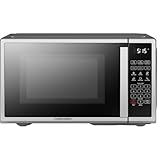
In the specifications war of kitchen appliances, power is the primary metric. 1000 Watts is good; 1200 Watts is better. By this logic, the Chefman RJ55-SS-7, with its modest 700 Watts, is often dismissed as “entry-level” or “underpowered.” User reviews frequently note that “it takes longer” to cook.
However, speed is not the only variable in cooking. In fact, in the realm of thermodynamics, speed often comes at the cost of uniformity. High-power microwaves are notorious for “exploding” butter, rubberizing chicken, and leaving frozen burritos with lava-hot ends and icy centers.
This article presents a physics-based defense of the 700-watt microwave. We will explore the relationship between Power Density and Thermal Conductivity, analyze why lower wattage is superior for reheating (the microwave’s primary use case), and address the ventilation challenges inherent in compact chassis design.
The Physics of Thermal Conductivity vs. Dielectric Heating
Microwaves heat food via Dielectric Heating (exciting water molecules). However, the heat must travel through the food via Conduction.
* The Bottleneck: Water molecules vibrate instantly, but heat travels through a dense lasagna slowly. The rate of conduction is fixed by the food’s physical properties.
* The High-Power Problem: If you pump energy in (1200W) faster than it can conduct away, you create Hot Spots. The water at the absorption site boils and turns to steam before the heat can reach the center. This ruins texture.
* The 700W Advantage: A 700-watt field delivers energy at a rate that is closer to the natural thermal conductivity of many foods. It allows the heat to “soak” in. The temperature gradient from the hot spots to the cold spots is shallower. This results in a more uniform internal temperature without the need for constant stopping and stirring.
Reheating: The Art of Restoration
Most users use microwaves for reheating, not cooking from raw. The goal of reheating is to bring food to serving temperature (165°F) without further denaturing the proteins or drying out the starch.
* Protein Denaturation: Chicken proteins tighten and squeeze out water above 165°F. A high-power blast can spike local temperatures to 200°F+ in seconds, turning the chicken into “shoe leather.”
* The Gentle Ramp: The Chefman’s 700W output acts as a gentle ramp. It raises the temperature slowly, reducing the risk of overshooting the denaturation threshold. For delicate items like melting chocolate or softening butter, 700W reduces the chance of scorching (pyrolysis) significantly compared to a 1200W unit running at “50% power” (which is actually 1200W pulsed).
The Ventilation Paradox: Why Small Microwaves get “Wet”
A common complaint for the Chefman (and all compact microwaves) is “Moisture buildup.” User John F. Vreeland noted, “It does not vent properly and moisture builds up quickly.” This is a matter of Fluid Dynamics in a small volume.
* Volume vs. Surface Area: A 0.7 cu.ft cavity has a small volume. When a bowl of soup heats up, it releases a fixed amount of steam. In a large oven, this steam is diluted. In a small oven, the relative humidity spikes to 100% instantly.
* Condensation Physics: The steam hits the stainless steel walls, which are relatively cool (thermal mass). It condenses immediately.
* The Fan Limitation: To keep the unit quiet (acoustic priority) and compact, the ventilation fan is likely smaller. It struggles to exchange the humid air fast enough. This “sauna effect” actually helps keep food moist during heating (like a steam oven) but requires the user to wipe the interior afterwards. It is a trade-off for compactness and silence.

The Geometry of the 0.7 Cubic Foot Cavity
The cavity size dictates the Standing Wave Pattern.
* Wave Density: In a small box, the microwave reflections are dense. The 10-inch turntable is critical. It moves the food through the peaks and troughs of the wave field.
* The “Center” Issue: Users note that “buns don’t fit.” The 0.7 cu.ft limit means large dinner plates (11″+) may hit the walls or door, stopping the rotation. If rotation stops, the “700W Advantage” is lost, and hot spots will form. The user must respect the geometric limits of the machine to utilize its thermodynamic benefits.
Conclusion: The Right Tool for the Job
The Chefman RJ55-SS-7 is not a replacement for a 1200W family microwave. It is a specialized tool for Controlled Heating.
For the dorm student heating ramen, the office worker warming coffee, or the senior citizen defrosting a single portion, 700 watts is not a handicap; it is a safety buffer. It prevents boil-overs and burnt edges. It demands patience—a few more minutes—but rewards that patience with a thermal consistency that high-speed “blasters” often fail to deliver.