
Scaling Up: The Physics of Large Loaves and Thermal Inertia
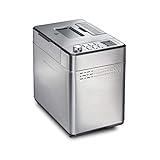
In the world of bread making, size is a thermodynamic variable. Baking a 2lb loaf is not simply a matter of doubling the ingredients of a 1lb loaf. It involves managing a larger Thermal Mass, overcoming greater Thermal Inertia, and ensuring that heat penetrates to the core before the crust carbonizes.
The Hamilton Beach 29888 is designed to handle this “Scale Up,” boasting a 2lb capacity in a sleek stainless steel chassis. However, user reviews point to friction points: a “clunky” control knob and a display that is “hard to read.” These are not just aesthetic flaws; they are engineering decisions that impact the user’s interaction with the machine’s physics.
This article explores the challenges of large-format automated baking. We will analyze the heat transfer dynamics of a 2lb dough ball, the material properties of the stainless steel shell, and the human factors engineering behind the controversial control interface.
The Thermodynamics of the 2lb Loaf
When you scale up a dough ball, the Volume increases faster than the Surface Area (Square-Cube Law).
* The Heat Lag: Heat travels from the outside in via conduction. In a 2lb loaf, the distance from the crust to the center is significantly greater than in a 1lb loaf. This creates a steeper Temperature Gradient.
* The Crust Risk: To get the center to 195°F (the gelatinization point of crumb), the crust must be exposed to heat for longer. This increases the risk of a thick, tough crust.
* The Algorithmic Fix: The Hamilton Beach 29888’s “2.0 lb” setting adjusts the heating profile. It likely uses a lower intensity heat for a longer duration (Soak Heating) compared to the 1.0 lb setting, allowing time for conduction to equalize the temperature without burning the exterior.
Stainless Steel: Thermal Conductor or Insulator?
The machine features a stainless steel exterior. In kitchen appliances, this is often marketed as “Premium,” but it has thermal implications.
* Conductivity: Steel is a conductor (~15 W/m\cdot K). Plastic is an insulator (~0.2 W/m\cdot K). A steel shell allows internal heat to radiate out more easily.
* The Cool-Down Phase: This conductivity helps the machine cool down faster after baking, which is beneficial for the electronics.
* Heat Retention: However, during the bake, the machine must work harder to maintain internal temperature against the losses through the steel shell. This necessitates high-quality internal insulation (fiberglass or air gap) between the oven chamber and the outer skin. If the insulation is insufficient, the exterior gets dangerously hot—a common trade-off in metal-bodied appliances.

The Interface: Rotary Encoders and LCD Physics
User feedback highlights two main UI issues: a “loose” knob and a dim display.
The Rotary Encoder (The Knob)
The dial on the 29888 is likely a digital Rotary Encoder, not an analog potentiometer.
* Detents: It sends digital pulses as it turns. The “loose” feeling often comes from the mechanical Detents (clicks) being too soft or the shaft having too much play (tolerance).
* The Paradox of Choice: A knob is excellent for scrolling through long lists (14 cycles), but it lacks the directness of a button. It introduces a layer of abstraction.
The LCD Visibility Problem
Users complain they have to “stand on tiptoes” to read the display.
* Viewing Angles: Standard Twisted Nematic (TN) LCDs have limited Viewing Angles. If you look from above or below the optimal angle, the contrast ratio plummets, and the screen looks blank.
* Reflective vs. Transmissive: To save cost and power, many appliances use Reflective LCDs (no backlight). They rely on ambient light bouncing off a rear mirror. In a dim kitchen corner, this renders the display invisible. This is a cost-driven engineering choice that prioritizes energy efficiency (and BOM cost) over usability.
The Paddle Problem: Mechanical Binding
The issue of the kneading paddle getting “baked in” is exacerbated by the larger 2lb loaf.
* Hydrostatic Pressure: A larger dough mass exerts more pressure on the paddle during the rise.
* Sugar Cement: Sugars and starches migrate into the gap between the paddle and the shaft. Under the high heat and long bake time of a 2lb loaf, these compounds caramelize into a hard cement.
* Torque Requirement: The motor must provide significant torque to turn a 2lb ball. This requires a robust drive shaft connection, which unfortunately also provides more surface area for binding.
Conclusion: The Balance of Capacity and Control
The Hamilton Beach 29888 attempts to bring large-capacity baking to the countertop. It succeeds thermodynamically, using algorithms to manage the heat gradient of a 2lb loaf. However, it struggles ergonomically, with an interface that feels disconnected from the machine’s premium aspirations.
For the user, success lies in understanding these physical constraints: placing the machine in a well-lit area to read the LCD, trusting the algorithm to bake the large loaf thoroughly, and accepting that the “paddle surgery” is the price of automated kneading. It is a machine of big ambitions, grounded by the realities of physics and cost engineering.