A Simple Guide to Earbud Marketing Terms: What ‘Hi-Fi’ and ‘Waterproof’ Really Mean
You’ve been there. You’re shopping online, staring at two nearly identical pairs of wireless earbuds. One boasts “the most advanced Bluetooth 5.1,” while the other has “cutting-edge Bluetooth 5.2.” One promises “Hi-Fi Stereo Sound,” the other “Immersive 3D Audio.” Is one truly better? Or is it all just noise?
The world of consumer electronics is a sea of technical specifications and marketing jargon designed to sound impressive. But this language often obscures more than it clarifies, leaving you feeling confused and unsure.
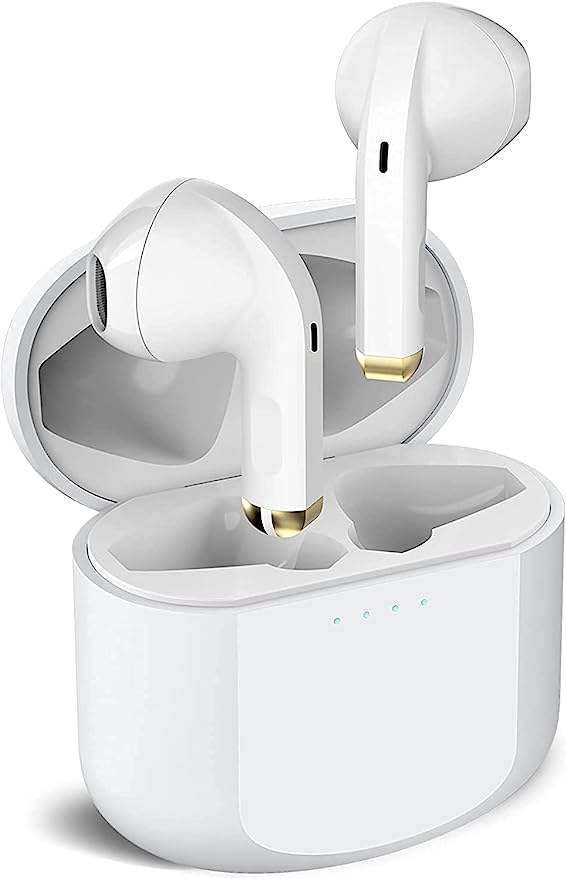
This is not a buying guide for a specific product. Instead, think of it as a translation guide. We’re going to take some of the most common terms you’ll find on a product page—using a typical budget earbud like the Twshouse I12 as our example—and translate them into plain English. The goal is to turn down the volume on the hype so you can make smarter choices.

1. Connectivity: “Latest Bluetooth 5.1”
- What It Sounds Like: A revolutionary, flawless wireless connection that’s vastly superior to anything before it.
- What It Actually Means: A solid, mature technology offering incremental improvements, mainly in power efficiency and connection management.
To be clear, Bluetooth 5.1 is better than older versions like 4.2. The Bluetooth 5.x family of standards generally offers real benefits. According to the Bluetooth Special Interest Group (SIG), the organization that maintains the standard, these versions improve on connection stability, data transfer speed, and, crucially, power efficiency. This means your earbuds and phone can communicate more reliably while using less battery.
However, the difference between sub-versions like 5.1, 5.2, and 5.3 is often minor for the average listener’s audio experience. These updates frequently introduce features for other applications, like direction-finding or broadcasting audio to multiple devices (Auracast).
The Bottom Line: Don’t stress over minor version numbers. Anything in the Bluetooth 5.x family is a modern, reliable standard. The quality of the chip’s antenna and the software implementation matter just as much as the version number on the box.
2. Audio Quality: “Hi-Fi Stereo Sound” & “Extra Bass”
- What It Sounds Like: Professional, recording-studio quality audio that will satisfy the most discerning audiophile.
- What It Actually Means: These are subjective marketing terms with no regulated or technical definition.
“Hi-Fi,” short for High Fidelity, is a term from the golden age of analog stereos. It once meant a system that reproduced sound with minimal distortion, as faithful as possible to the original recording. Today, in the context of a $14 pair of earbuds, the term is effectively meaningless. There is no industry body that certifies a product as “Hi-Fi.” It is purely a marketing descriptor.
“Extra Bass” is more straightforward: it means the earbuds have been digitally tuned to emphasize low-frequency sounds. The manufacturer has programmed the onboard Digital Signal Processor (DSP) with a V-shaped equalization (EQ) curve, boosting the bass and treble while scooping the mid-frequencies. This is a popular tuning for genres like pop, hip-hop, and EDM, but it might sound “muddy” or “unnatural” for acoustic music or podcasts.
The Bottom Line: Ignore vague terms like “Hi-Fi.” Instead of focusing on labels, look for reliable reviews that use descriptive words to characterize the sound. Is it “warm” (rich bass), “bright” (emphasized treble), “V-shaped” (boosted bass and treble), or “neutral” (balanced)? This will tell you far more about whether you’ll enjoy the sound than any marketing buzzword.
3. Durability: “Waterproof for Sport”
- What It Sounds Like: Indestructible. You can probably swim or shower with them.
- What It Actually Means: It likely offers some resistance to sweat and maybe light rain. To know for sure, you need to ignore the word “waterproof” and look for an IP rating.
The only objective measure of an electronic device’s resistance to solids and liquids is its Ingress Protection (IP) rating. It’s a two-digit code defined by the international standard IEC 60529.
The first digit is for dust protection. The second digit, which is the important one for headphones, is for water protection. It’s often written as “IPX” when dust resistance isn’t rated. Here’s a simple breakdown:
* IPX4: Resistant to splashing water from any direction. This is the minimum you should look for in workout earbuds. It means they can handle sweat and light rain without issue.
* IPX5: Resistant to low-pressure water jets. A bit more robust.
* IPX7: Can be submerged in up to 1 meter of water for 30 minutes. You still shouldn’t swim with these (Bluetooth doesn’t work well underwater), but it means they will easily survive being dropped in a puddle or rinsed under a tap.
The Bottom Line: If a product claims to be “waterproof” but doesn’t list an IPX rating, be skeptical. It probably means it has some basic sweat resistance, but the manufacturer hasn’t paid for official certification. For any serious athletic use, look for a certified rating of IPX4 or higher.

The Hype-Free Translation Table
Here’s a quick-reference table to help you decode the jargon on the fly.
| Marketing Term | What It Probably Means | What to Look for Instead |
|---|---|---|
| “Latest Bluetooth 5.X” | A modern, power-efficient chip. | Any Bluetooth 5.x is fine. Focus on reviews about connection stability. |
| “Hi-Fi / Immersive Sound” | A completely subjective marketing term. | Reviews describing the sound signature (e.g., warm, bright, neutral). |
| “Extra Bass / Deep Bass” | The sound is tuned with a V-shaped EQ. | Your personal music preference. Do you like a lot of bass? |
| “Waterproof” | Basic sweat resistance. | An official IPX rating (e.g., IPX4 for sports, IPX7 for high resistance). |
| “Up to 30 Hours Playtime” | This is the TOTAL time including recharges from the case, not continuous use. | The single-charge playtime (e.g., “5 hours on one charge”). |
How to Actually Choose
It’s easy to get lost chasing the highest numbers and the most impressive-sounding features. But a smarter approach is to ignore the noise and focus on what has the biggest impact on your daily experience:
- Comfort and Fit: If it hurts your ears or falls out, the best sound quality in the world is useless.
- Sound Signature: Do you want booming bass for the gym, or clear, neutral sound for podcasts and calls? Match the sound to your life.
- Real-World Features: Will you actually use features like noise cancellation or wireless charging? Don’t pay for features you don’t need.
By learning to speak the language of tech marketing, you shift the power back to yourself. You’re no longer just a target for hype, but an informed consumer ready to make a choice that’s right for you.