Beyond Heat: The Unseen Intelligence in the Tools That Build Our World
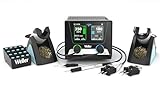
I was hunched over a circuit board the size of a credit card, staring through a microscope at a component smaller than a grain of rice. It had eight microscopic legs, and one of them had a solder joint that looked… questionable. My old soldering iron, a trusted friend for years, felt like a clumsy cudgel in this microscopic world. Too much heat for too long, and I’d kill the chip. Too little, and I’d create a cold joint, an invisible failure waiting to happen. It was a stark reminder of a new reality: in the world of modern electronics, our ingenuity in design has begun to outpace the capability of our traditional tools.
The tools we use are evolving to meet this challenge, but not just by getting hotter or faster. They are becoming intelligent. They’re transforming from simple extensions of our hands into active partners in the act of creation and repair. What follows is not a review of a single product, but an exploration of this profound shift, seen through the lens of a modern rework station. We’ll look at how these tools have mastered the physics of energy, learned the language of data, and finally, donned the armor of digital security. This is the story of the unseen intelligence that underpins the technology we rely on every day.

The Tyranny of Temperature: Mastering Energy at the Microscale
At its heart, soldering is a battle against the laws of thermodynamics. You need to deliver a precise amount of thermal energy to a precise location, for a precise amount of time. On the dense, multi-layered circuit boards of today, this is a formidable challenge. A tiny component has very little thermal mass and can be destroyed by overheating in an instant. Yet, it may be sitting on a large copper ground plane that acts as a massive heat sink, sucking energy away from your soldering tip as fast as you can apply it.
This is why the headline feature of a modern professional station, such as Weller’s WXsmart system, isn’t its maximum temperature, but its heat-up time—often less than three seconds. This speed isn’t for the impatient; it’s for control. A rapid heat-up means the tool can deliver its energy payload to the joint before a damaging amount of excess heat has time to creep into the sensitive component.
But the real genius lies in what happens after the tip touches the board. This is where simple heaters fail and intelligent systems excel, and the core principle is a concept from control theory known as a PID controller. Imagine you’re adjusting the water in a shower. You turn the knob (the control), feel the temperature (the feedback), and adjust again. You are a human PID controller. Now, imagine a system that does this hundreds of times per second. That’s the magic of a closed-loop feedback system. A sensor in the tool continuously measures the tip’s temperature (the process variable) and compares it to the desired temperature (the setpoint). If it detects a drop—say, from touching that heat-sinking ground plane—the PID algorithm instantly calculates the precise amount of extra power needed to compensate. It doesn’t just blindly pump in more heat; it delivers a calculated, stable response. This is the difference between a blunt instrument and a surgical tool.

The Rosetta Stone for a Solder Joint: When Tools Learn to Talk
Perfect heat control solves the physical challenge, but the revolution truly begins when the tool starts to generate data. In high-stakes industries like aerospace, medical devices, or automotive electronics, a single faulty solder joint can have catastrophic consequences. The question for manufacturers isn’t just “was this assembled?” but “can we prove it was assembled correctly?”
This is the domain of data traceability, a cornerstone of the Industry 4.0 philosophy. The goal is to create a digital birth certificate for every step of the manufacturing process. And remarkably, this now extends down to the soldering tip itself. Systems like the WXS2021 feature “smart tips,” each embedded with a unique serial number. When connected to the station, the tool knows exactly which tip is being used. It can log its entire operational history: every second of use, every temperature it was set to, and its last calibration date.
Why is this data the lifeblood of quality control standards like the aerospace industry’s AS9100? Because it provides objective, irrefutable proof of process integrity. It’s the difference between a chef’s brilliant but inconsistent personal recipe and a Michelin-starred kitchen’s standardized process that ensures every plate leaving the kitchen is perfect. By allowing engineers to store specific thermal profiles directly in the handpiece, the system ensures that a repair on a specific component is performed the exact same way every time, by every technician. The tool itself becomes the guardian of the standard.

The Ghost in the Machine: Securing the Workshop of the Future
Once a tool is gathering data and connected to a network, it crosses a critical threshold. It ceases to be a simple piece of hardware and becomes a node in the vast network of Operational Technology (OT)—the technology that controls the physical world. And like any network node, it becomes a potential target.
This might sound like science fiction, but the lesson of industrial cyberattacks like Stuxnet, which targeted and destroyed physical centrifuges by manipulating their control systems, was a stark wake-up call. If your factory is networked, and your tools are on that network, a malicious actor could theoretically alter the temperature profiles of your production line, introducing thousands of invisible, latent defects into a product.
This is why the final layer of intelligence in a modern industrial tool is security. The inclusion of features like TLS encryption and two-factor authentication (2FA) is not a gimmick. TLS creates a secure, encrypted tunnel for any data the station sends or receives, making it unreadable to eavesdroppers. 2FA ensures that only authorized personnel can make changes to the tool’s critical settings. It’s the same level of security you’d expect from your online bank, applied to a device that melts metal. It recognizes that in the interconnected workshop of the future, integrity of process is synonymous with security of data.
From mastering the fundamental physics of heat to speaking the complex language of data and finally, to defending itself in a connected world, the evolution of a tool like a soldering station tells a much larger story. The Weller system is a fascinating case study, but the universal truth is that our tools are co-evolving with our creations. As the things we build become more intricate and intelligent, the tools we use to build them must do the same. The next time you hold a marvel of modern electronics in your hand, remember the invisible web of intelligent, data-aware, and secure tools that made its existence possible. The true magic isn’t just in the device itself; it’s in the deep, hidden intelligence of the process that brought it to life.