The Anatomy of a Compromise: How a $50 Grinder Outsmarts a $500 One

Every product you own is a bundle of compromises. From your car to your smartphone, every design is a story of trade-offs, a delicate balancing act between performance, features, and—above all—cost. This is the engineer’s dilemma. Nowhere is this truer than in the world of high-performance kitchen appliances, where a single feature can separate a 50 gadget from a 500 instrument.
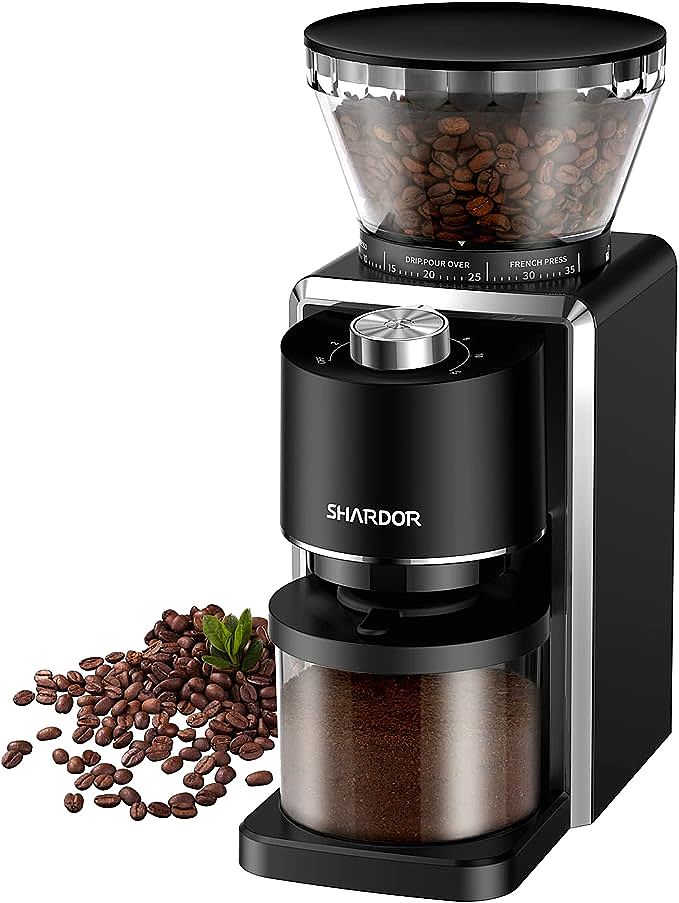
Today, we’re putting one such product on our virtual workbench: the SHARDOR CG9406-UL2 Conical Burr Grinder. It’s a machine that dares to promise the core of a premium coffee experience for the price of a few bags of specialty beans. The question is, how? What corners were cut? And are they clever shortcuts or unacceptable flaws? To find out, let’s put on our engineering goggles and deconstruct its design, piece by piece.

Deconstruction #1: The Illusion of “Cups” — A 50-Cent Timer vs. a $50 Sensor
To understand this machine, let’s start with its most controversial feature: the dose selection dial. It offers settings for 2 to 12 “cups,” which feels precise. But as many users quickly discover, it’s an illusion. The minimum two-cup setting often grinds enough coffee for four, and the relationship between the setting and the output is a wild approximation that changes with bean type, roast level, and grind size.
This isn’t a bug; it’s the product’s most important compromise laid bare. The machine doesn’t _weigh_ the coffee. That feature, called gravimetric dosing, is the hallmark of grinders that cost hundreds of dollars. It requires a precise digital scale, a control board, and sophisticated software—a sensor and logic system that might add $50 to the final retail price. Instead, the SHARDOR uses a simple mechanical timer. It assumes that grinding for X seconds will produce Y grams. It’s a 50-cent component replacing a $50 system.
From a cost-engineering perspective, it’s a brilliant move. But for the user seeking push-button simplicity, it can be frustrating. So, what’s the solution? You embrace the compromise and take manual control. You ignore the “cup” settings entirely. You press the “start” button to begin grinding and press it again to “stop” when you have the amount you need. In an instant, the machine’s biggest “flaw” is transformed. The designers gave you a motor and a set of burrs; the precision, they left to you. This is the first and most critical test: are you willing to trade a little bit of your attention for a massive cost saving?

Deconstruction #2: The Heart of the Matter — Where No Compromise Was Made
If the timer was the compromise, the grinding mechanism is the crown jewel. The single most important element of a coffee grinder is its ability to produce uniformly sized particles, the very foundation of a good extraction. This is where the SHARDOR’s designers focused their limited budget, and it shows.
Inside the machine is a set of stainless steel conical burrs. In the world of budget appliances, this is a non-negotiable feature for quality, and they delivered. To compromise here—by using a blade mechanism that shatters beans or poorly machined ceramic burrs that produce excess fines—would be to render the entire device pointless. This is the core of the product’s value proposition. The designers made a calculated bet: that users would forgive an imprecise timer if the machine delivered on the fundamental physics of a great grind. User feedback largely confirms this bet paid off. While they lament the timer, they praise the consistency of the grounds and the resulting improvement in their coffee’s flavor. They solved the primary problem—particle uniformity—exceptionally well for the price point. The secondary problem—dose consistency—they left for the user to manage.
Deconstruction #3: The Lesser Battles — Static, Noise, and Performance Edges
A great grinder isn’t just about the burrs; it’s also about the daily experience. On these fronts, the SHARDOR presents more nuanced compromises. It boasts “anti-static technology,” yet some users still report a messy counter. This is because completely eliminating coffee static (a stubborn physics phenomenon) is incredibly difficult without more advanced and costly solutions. The provided feature helps, but it isn’t a silver bullet. A simple RDT spritz, as mentioned in our companion physics article, remains the most effective fix.
Similarly, while some users find it quieter than their previous grinders, it is by no means silent. Its performance is also bounded. While it excels at drip and pour-over settings, some find it doesn’t grind quite coarse enough for French press or consistently fine enough for true, unpressurized espresso. These are not failures, but the defined edges of its performance envelope—another compromise to keep the cost down.

The Verdict: Who is This “Imperfect” Machine Perfect For?
This brings us to a concept from behavioral economics: are you a “satisficer” or a “maximizer”?
A maximizer needs the best possible option. They research every detail and are willing to pay a premium to eliminate every inconvenience and achieve peak performance in all areas. For a maximizer, the SHARDOR’s timer, its static, and its performance limits are a series of deal-breakers. They should absolutely invest in a high-end grinder from brands like Baratza or Niche.
A satisficer, however, seeks a solution that is “good enough” to solve their core problem effectively. Their goal is to stop using their blade grinder and get dramatically better coffee without breaking the bank. For the satisficer, the SHARDOR is a near-perfect product. It delivers 80% of the performance of a professional machine for 20% of the price, precisely because it intelligently chose which corners to cut. It understands that for many people, the leap from bad coffee to good coffee is far more important than the jump from good coffee to perfect coffee.
It is, in its own way, an engineering marvel—not of ultimate performance, but of accessible quality. It’s a masterclass in the art of the imperfect, but very, very smart, solution.