The Great Coffee Heist: Why Your Beans Lose Their Soul & How a Burr Grinder Gets It Back

It’s a crime scene familiar to many. The evidence is laid out on the counter: a bag of expensive, ethically sourced, beautifully roasted coffee beans promising notes of jasmine, bergamot, and wild honey. You, the detective in this morning ritual, handle the case with care. You use filtered water heated to a precise temperature. Your brewing technique is practiced, almost meditative. And yet, the final verdict, delivered in the first sip, is a profound disappointment. The vibrant soul of the coffee is gone, replaced by a hollow, lifeless brew, or worse, a bitter, aggressive imposter.
This is the Great Coffee Heist. A robbery that occurs in kitchens worldwide, leaving behind a trail of frustration and wasted potential. You’ve checked the usual suspects—water, temperature, brew time—and they all have alibis. So, who is the real culprit? How is the very essence of your coffee being stolen right before your eyes? The answer lies in an overlooked, often misunderstood accomplice: the grind.

Anatomy of a Heist: The Science of Extraction
Before we unmask the thief, we need to understand the crime itself. When hot water meets coffee grounds, a process called extraction begins. Think of it as a delicate negotiation. The water is trying to persuade the coffee grounds to release their treasure trove of soluble compounds: acids that give coffee its bright, lively sparkle; sugars that provide sweetness and depth; oils that contribute to a rich body and aroma; and complex organic molecules that create the tapestry of flavor.
A successful heist for us—a perfect extraction—is all about balance. The key to this balance is surface area. And the key to controlling surface area is the uniformity of the coffee grounds.
Imagine trying to cook a stew with one giant potato and a handful of potato dust. By the time the giant chunk is cooked through, the dust will have disintegrated into a bitter, starchy mush. The same tragedy befalls your coffee. When your grinder produces a chaotic mix of large chunks (boulders) and fine powder (dust), you create an impossible scenario for extraction. The dust, with its immense surface area, gives up its secrets far too quickly. It over-extracts, releasing an excess of bitter compounds that hijack the cup. Meanwhile, the boulders, stubborn and impenetrable, don’t give up enough. They under-extract, leaving you with a thin, sour, and underdeveloped flavor. The result is a cup of coffee at war with itself—simultaneously bitter and sour, yet lacking any real character. This is how the flavor is stolen.
The Crude Weapon vs. The Precision Tool
Now that we understand the crime, let’s examine the weapons. For years, the most common tool in the home coffee arsenal has been the blade grinder. It operates on a simple, brutal principle: a propeller-like blade spins at high speed, violently chopping the beans into submission. The result is not a grind; it’s shrapnel. A chaotic battlefield of boulders and dust, the very definition of an inconsistent grind. The blade grinder is the crude, blunt instrument of our flavor thief, creating the perfect conditions for a botched extraction. It also generates significant heat from friction, prematurely aging the coffee and baking away its delicate aromatic compounds.
Leaving this world of chaos behind, we now turn to the instrument of precision and control: the burr grinder. This is not a weapon of violence, but a tool of milling. It doesn’t chop; it crushes and grinds. It uses two abrasive surfaces, or burrs, to systematically reduce the size of the coffee beans into particles of a remarkably consistent size. By adjusting the distance between these two burrs, the operator can dictate the exact fineness of the grind with scientific precision.
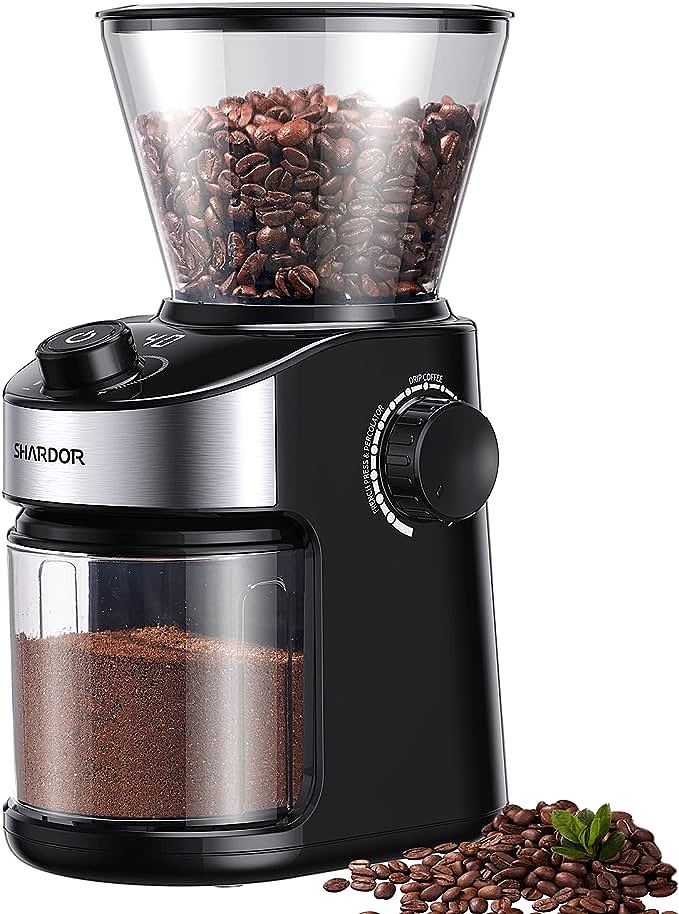
Let’s open up our detective’s toolkit, using the SHARDOR CG836 as a representative example of how this science is put into practice, and see how it closes the case on bad coffee.
Inside the Detective’s Toolkit: A Case Study of the SHARDOR CG836
A good detective relies on well-engineered tools, and a coffee lover is no different. We’ll examine the CG836 not as a product to be reviewed, but as an accessible case study in how thoughtful engineering solves the fundamental problems of grinding.
The Milling Engine: Metallic Flat Burrs
The heart of the CG836 is its metallic flat burr system. Imagine two serrated, parallel discs spinning against each other. Beans are fed into the center and, through centrifugal force, are pulled outwards through the increasingly fine teeth. This journey ensures the beans are milled, not shattered, into a consistent size. This uniformity is the first and most critical step in preventing the extraction chaos we discussed. It creates an orderly bed of coffee grounds where water can flow evenly, allowing for a balanced and complete conversation with every single particle. It’s the difference between a disciplined team executing a plan and a disorganized mob.
The Interrogation Room: 25 Grind Settings
Achieving a uniform particle size is step one. But uniformity alone isn’t enough. A detective knows you can’t use the same interrogation technique on every suspect. Similarly, every brewing method is a different kind of conversation that demands a unique grind size. This is where we enter the interrogation room: the grind adjustment.
The CG836’s 25 settings are the tools of this interrogation.
* For a French Press, where grounds steep in water for several minutes, you need a coarse grind (like rough sea salt, perhaps settings 20-24). This slow, immersive conversation requires large particles to prevent over-extraction and a muddy cup.
* For a Drip Coffee Maker or Pour-Over, the conversation is quicker. You need a medium grind (like coarse sand, settings 12-18) that allows water to flow through at a Goldilocks pace—not too fast to be weak, not too slow to be bitter.
* For Espresso, the conversation is intense, short, and under immense pressure. It requires an ultra-fine grind (like powdered sugar, settings 1-5) to create a dense puck of coffee that provides enough resistance for the water to extract a concentrated, syrupy shot in about 25-30 seconds.
This level of control allows you to become the conductor of your coffee’s symphony, not just a passive listener.

The Ticking Clock: The Digital Timer and the Fight Against Oxidation
Our flavor thief has one last accomplice: Time. The moment a coffee bean is ground, its surface area increases exponentially, and a chemical process called oxidation begins. Precious, volatile aromatic compounds—the very soul of the coffee—start to escape. Research suggests the most dramatic loss of these aromas occurs within the first 15 minutes of grinding. Pre-ground coffee is, therefore, a ghost of its former self.
The SHARDOR CG836’s adjustable 40-second digital timer is a weapon against this ticking clock. It champions the single most important habit for better coffee: grinding only what you need, right before you brew. Furthermore, it ensures dose consistency. By using the timer, you can grind the same amount of coffee, day after day, removing one more variable from your brewing equation and making your results repeatable.

Case Closed: You Are the Master Detective Now
The Great Coffee Heist is not a mystery solved by buying more expensive beans, but by understanding the science of the process. The culprit is inconsistency, the weapon is a poor grinder, and the crime is a failed extraction.
A precision instrument like the SHARDOR CG836 serves as a powerful demonstration of the solution. Its burr system, adjustable settings, and on-demand grinding capabilities are not just features on a box; they are the practical application of scientific principles designed to protect and unlock the flavor potential within every bean.
By mastering the grind, you move from being a victim of circumstance to the master detective of your own coffee experience. You are no longer just making coffee; you are conducting a flavorful investigation. And with the right tools, grounded in a solid understanding of the science, the results can be consistently extraordinary.