The 20-Nanometer Gatekeeper: How Science Conquered the Deadliest Threats in Water
It’s a scene of profound peace: a remote mountain stream, water dancing over ancient stones, clear as liquid glass. It is a primal invitation to cup your hands and drink. Yet, to do so is to place a bet against an invisible world—a microscopic menagerie of bacteria, protozoa, and viruses that have plagued humanity since the dawn of time. For much of our history, the only reliable defense against this unseen threat was the brute force of fire. Today, we carry devices in our backpacks that offer a level of protection our ancestors would have considered magic.
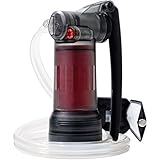
This isn’t a story about one of those devices. It’s the story of the science that makes them possible. It’s a journey into a world measured in nanometers, governed by the unyielding laws of physics, and driven by an engineering philosophy that prioritizes absolute certainty over convenience. To understand how we achieved mastery over the water we drink, we must first understand the nature of the enemy. And to see that science pushed to its absolute limit, we will dissect a fascinating piece of modern engineering that serves as our perfect exhibit: the MSR Guardian purifier.

The Microbial Gauntlet
Imagine a soccer field. On this field is a car. On the hood of that car is a single glass marble.
This absurd difference in scale is a fair approximation of the challenge facing any water purification system. The soccer field represents a protozoan cyst like Giardia, a relatively large microbe measuring about 10 microns across. Most decent backcountry filters can stop these giants. The car represents a bacterium like E. coli, which is significantly smaller, perhaps 1-2 microns in length. A quality filter handles these, too.
But the marble? The marble is a virus, like Norovirus or Hepatitis A. At just 0.02 to 0.4 microns (20 to 400 nanometers), it is orders of magnitude smaller than bacteria. It slips through the pores of a standard water filter with ease. This single, critical distinction is what separates a mere “filter” from a true “purifier.” To defeat the virus is to win the entire game. And for a long time, the only way to do that in the field was with chemical warfare (iodine, chlorine) or radiation (UV light). Physical removal was considered a brute-force solution, too impractical for the nanoscale. Until, that is, a technology perfected for saving lives in hospitals found its way into the wild.

A Fortress of Fibers: The Magic of Nanofiltration
At the heart of any modern, high-performance purifier lies a bundle of what looks like fine, white thread: a hollow fiber membrane. It is one of the unsung marvels of materials science. The technology was not born in an outdoor gear lab, but in the sterile, high-stakes world of medicine. In fact, the very same fundamental principle is used in artificial kidneys, where these fibers perform hemodialysis, filtering waste products from human blood.
Think about that for a moment. The technology trusted to perform the life-sustaining function of a human organ is the same one we can now use to sip from a muddy puddle. This lineage is crucial, as it speaks to a level of reliability born from decades of medical refinement.
These fibers, typically made from robust polymers like polysulfone, are riddled with microscopic pores of a precise, unyielding size. When water is forced against the fiber walls, water molecules are small enough to pass through, but anything larger is physically barred from entry. It is a bouncer at the door of a club with a ruthlessly strict size policy.
This is where our case study, the MSR Guardian, becomes so illustrative. Its engineers specified a pore size of 0.02 microns, or 20 nanometers. This isn’t an arbitrary number. It is the absolute threshold, a line in the sand drawn just below the size of the smallest known waterborne viruses. The 20-nanometer gatekeeper lets nothing pathogenic pass. It is a physical certainty. There are no chemicals to lose potency, no batteries to die, no waiting time. There is only the elegant, immutable law of size exclusion.
But creating such a fine sieve presents a new engineering paradox. The smaller the holes, the harder it is to push water through, and the faster those holes will clog with debris. Achieving both nanoscale precision and a practical flow rate of 2.5 liters per minute is a formidable challenge in fluid dynamics. The solution is found not just in the membrane itself, but in the clever system built around it. With every single stroke of the pump, a small portion of the water is automatically diverted to flush the exterior of the fibers, constantly clearing away the rejected contaminants. It’s a brilliantly simple, self-maintaining system that ensures the gatekeeper is never overwhelmed by the crowd.

The Burden of Proof and the Philosophy of Over-Engineering
In a world of hyperbolic marketing claims, how can one truly trust a life-support device? The answer lies in standardization—brutal, objective, third-party testing. For the most demanding users, including the U.S. Military, the benchmark is NSF Protocol P248.
This is not a simple lab test with clean tap water. To earn a P248 certification, a purifier must be subjected to what’s known as “challenge water”—a foul cocktail of dissolved organics, suspended solids, and frigid temperatures, all spiked with extreme concentrations of live viruses, bacteria, and protozoa. It must consistently remove these threats to a specific logarithmic degree throughout its claimed filter life. To understand the rigor, consider the term “6-log reduction” for bacteria. It doesn’t mean 99% removal. It means 99.9999% removal. For every million bacteria that go in, only one may come out.
Meeting this standard, as the Guardian does, elevates a product from a piece of consumer gear to a tool of verified reliability. This reliability is not just a certification; it’s an entire design philosophy. It shows in the device’s startling robustness—it’s engineered to survive a six-foot drop onto concrete and to withstand freezing. This is not accidental; it is a deliberate choice.
And this brings us to the most interesting part of the story: the trade-offs. The Guardian is heavy (at nearly 500 grams) and expensive. In a market obsessed with “ultralight” and “affordable,” it stands out as an anomaly. But this is not a design flaw. It is a conscious rejection of compromise. The weight comes from thicker, more durable materials. The cost comes from the precision manufacturing required for the 20-nanometer membrane and the robust, self-cleaning pump mechanism.
It represents a philosophy of over-engineering for the “what-if” scenario. It is designed not for the best-case day hike, but for the worst-case expedition or emergency. It concedes points on weight and cost to gain non-negotiable ground on reliability and safety. This is the same philosophy that builds airplanes and medical equipment. You don’t look for the lightest, cheapest option; you look for the one that is guaranteed to work when failure is not an option.
Looking at a device like this, we see more than just a tool. We see a physical manifestation of our centuries-long quest to conquer an invisible world. The journey that began with desperate attempts to settle muddy water and avoid the plague has culminated in a handheld device, born from medical science and hardened by military standards, that allows us to look at almost any water source on Earth and drink with a confidence born not of hope, but of scientific certainty. It is a remarkable testament to how far we’ve come.