The Secret Physics of a Perfect Glass of Beer
Watch a skilled bartender pull a draft beer. There’s a fluid, practiced grace to it—the 45-degree tilt of the glass, the smooth opening of the tap, the final top-off to create a perfect, stable head of foam. It feels like art, a small moment of performance. But behind that fleeting moment lies a cascade of fascinating, and often unforgiving, scientific principles.
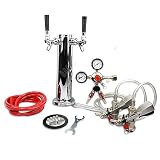
That perfect pint is a temporary truce in a constant war being waged between gas, liquid, and temperature. And the equipment, from the giant walk-in cooler at the bar to a compact home kegerator, is the battlefield. To truly appreciate that beer, we need to stop thinking like a drinker and start thinking like an engineer. Let’s pull back the curtain, using a typical home DIY kegerator conversion kit as our guide, and reveal the hidden physics that make it all possible.

The Ghost in the Machine: Forcing a Gas into a Liquid
Every carbonated beverage you’ve ever had, from soda to sparkling wine to beer, owes its existence to a 19th-century English chemist named William Henry. He discovered a simple, elegant rule we now call Henry’s Law: the amount of gas that can dissolve in a liquid is directly proportional to the pressure of that gas above the liquid.
This is the very soul of carbonation. The bubbles in your beer are carbon dioxide (CO_2) molecules that were forced, under pressure, to dissolve into the liquid. They are, in essence, unwilling guests at a party. As soon as the pressure is released—when the bartender opens the tap—they try to escape, creating the fizz and foam we expect.
In any draft system, the tool that plays the role of gatekeeper is the CO_2 regulator. This device is a marvel of engineering, acting as a translator between two vastly different worlds. On one side, you have a high-pressure CO_2 tank, where the gas is stored at a formidable 800-1000 PSI. The regulator’s high-pressure gauge tells you how much “potential fizz” you have left.
But you can’t just unleash that torrent on the beer. You’d have a foamy disaster. The regulator’s job is to step that immense pressure down to a gentle, precise whisper—typically just 10-12 PSI. This low, constant pressure, shown on the second gauge, is the magic number. It’s just enough to keep the CO_2 happily dissolved in the beer and to provide a gentle push for its journey to your glass.
This entire process is a controlled suppression of chaos. Safety relief valves on the equipment act as vigilant guardians, ready to vent any dangerous pressure spikes. It’s a reminder that we’re dealing with a powerful, invisible force, harnessed for the simple pleasure of a bubbly drink.

Taming the Torrent: A Battle Against Foam
So, the beer is perfectly carbonated, resting peacefully in its keg under a gentle blanket of CO_2. Now comes the hard part: getting it into your glass without everything falling apart. This is where most home draft systems fail, and it’s a pure fluid dynamics problem.
If you’ve ever had a DIY kegerator that pours nothing but a glass of foam, you’ve witnessed a physics lesson firsthand. The culprit, almost always, is a lack of resistance.
Imagine the beer line—the plastic tube running from the keg to the faucet—as an obstacle course. The 12 PSI of CO_2 pressure is the powerful push at the starting line. If the course is too short and too easy, the beer shoots out of the faucet at high speed. This sudden, violent transition from the pressurized line to the open air is called turbulent flow. The pressure plummets instantly, and the dissolved CO_2 molecules, those unwilling guests, seize their chance to escape all at once. The result? Foam. A lot of it.
To get a smooth, laminar flow, you need to balance the system. You have to make the obstacle course harder. In draft science, this is achieved by using a much longer beer line than you might intuitively think. For a typical home system, you often need 10 to 12 feet of 3/16-inch inner diameter tubing. The friction created along the length of this narrow tube slows the beer down, ensuring that when it arrives at the faucet, it’s flowing gently. The pressure drops gracefully, not catastrophically. The pour is perfect.
Even the faucet itself is a piece of precision engineering. High-end, forward-sealing designs prevent beer from drying inside the mechanism, a common source of sticky taps and bacterial growth. It’s a small detail that speaks volumes about the continuous refinement in the pursuit of the perfect pour.
The Unseen Guardian: A Choice in Materials
The final piece of the puzzle is what the equipment is made of. This isn’t just about looking shiny; it’s a crucial decision in material science that directly impacts the taste and safety of your beer.
Beer is slightly acidic. If it comes into contact with reactive metals like raw brass or copper, it can pick up strange, metallic off-flavors. This is why the parts that touch the beer—the keg coupler’s probe, the tower, the faucet—are almost always made of 304-grade stainless steel.
Stainless steel is the unsung hero of the food and beverage industry. Its secret is a microscopic, invisible layer of chromium oxide on its surface, a phenomenon called passivation. This layer acts like a suit of armor, instantly reforming if scratched and preventing the underlying steel from reacting with the beer. It is inert, durable, and easy to clean.
But why isn’t everything made of stainless steel? Look at the body of the keg coupler in a typical kit. It’s often nickel-plated brass. This is a classic example of an engineering trade-off. Brass is strong and much easier and cheaper to machine into complex shapes than stainless steel. The nickel plating provides a protective, non-reactive barrier. Is it as good as solid stainless steel? No. But it performs its structural job perfectly well at a fraction of the cost. It’s a pragmatic choice, a balance of performance, durability, and economics.
This principle even extends to managing temperature. That gleaming steel tower looks great, but it’s also an excellent conductor of heat. On a warm day, the beer sitting inside the tower can quickly warm up, causing—you guessed it—foam on the first pour. This is a thermodynamics problem, which is why advanced setups often include a small “tower cooler” fan to pipe cold air from the refrigerator up into the tower, keeping the entire path chilled.

The Engineered Glass
From the ghost-like presence of a dissolved gas to the turbulent struggle within a plastic tube, a single glass of draft beer is the end result of a remarkable synthesis of physics, chemistry, and engineering. A DIY kit, then, is more than just a product. It’s an invitation. It’s a lens through which we can see the invisible forces shaping a simple, everyday pleasure.
It transforms you from a passive consumer into an active participant in the engineered world. And when you finally dial in your system—when you’ve balanced the lines, set the pressure just right, and pour a glass with a perfect, cascading head—the satisfaction comes not just from the taste. It comes from the understanding.