The Chameleon in Your Gear Bag: Why Adaptive Design is the Future of Creative Tech
There’s a moment every creator dreads. You’re in the zone, the flow state, where ideas are connecting effortlessly. The performance is perfect, the interview is compelling, the ambient sound is magical. You reach for your gear to capture it, and suddenly, you’re not an artist anymore. You’re a technician, lost in a labyrinth of menus, toggling obscure settings, fighting a tool that feels profoundly disconnected from your creative intent. Why do so many of our powerful, feature-packed gadgets force us to adapt to their logic, rather than adapting to ours?
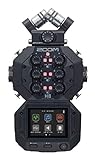
This friction between creation and operation reveals a fundamental design challenge. For decades, the solution was either a hyper-specialized tool that did one thing perfectly, or a jack-of-all-trades that did everything passably. But a new philosophy is emerging, one that promises the best of both worlds. It’s the idea of adaptive design: technology that changes its very form and function to match the task at hand. And a fascinating case study of this philosophy in action can be found in an unlikely place: a handheld audio recorder, the Zoom H8. At first glance, it’s a plastic box with knobs and inputs. But look closer, and you’ll see a chameleon.

The End of “One-Size-Fits-All”
The H8’s most radical feature isn’t a piece of hardware, but an idea manifested in its software. Instead of a single, sprawling interface, its color touchscreen presents three entirely different “apps”: one for Podcasting, one for Music, and one for Field Recording.
This isn’t just a cosmetic skin change; it’s a deep understanding of workflow. The Podcast app presents large, friendly pads to trigger sound effects and multiple clear microphone channels, mimicking a broadcast console. Switch to the Music app, and the screen transforms into a miniature mixing desk, complete with faders, panning, and EQ, the native language of a musician. In the Field app, everything vanishes except for huge, impossible-to-misread level meters, because in location sound, preventing a take from distorting is the only thing that matters.
What we’re seeing here is a brilliant application of a principle from cognitive psychology: Cognitive Load Theory. This theory posits that our working memory is finite. A cluttered, universal interface bombards us with irrelevant options, imposing a high “extraneous cognitive load.” It forces our brain to work overtime just navigating the tool, stealing precious mental resources from the actual creative task. By creating specialized interfaces, the H8 drastically reduces this load. It hides what you don’t need, presenting only the controls relevant to your specific “mental model.” It’s the difference between being handed a Swiss Army knife and being given the precise scalpel, wrench, or paring knife you actually need for the job. The hardware hasn’t changed, but by reshaping its software soul, it has become three different tools.

Building with Blocks: A Philosophy from the Past
This software-level adaptability is paired with a physical one. The top of the H8 features a proprietary port for an ecosystem of interchangeable microphone capsules. The standard unit is a high-quality stereo X/Y microphone. But you can snap that off and click on a capsule with four extra XLR inputs, instantly turning a 6-input recorder into a 10-input monster. You can attach an ambisonic microphone for capturing immersive 360-degree audio for VR.
This is modular design, a philosophy with a rich history, stretching back to the colossal Moog synthesizers of the 1960s. Those early electronic music pioneers didn’t play an instrument; they built one, connecting individual modules—oscillators, filters, amplifiers—with a web of patch cables. That spirit of custom-built functionality, of a system that can grow and change with the user’s needs, is precisely what modularity offers.
In an age of sealed-box electronics designed for obsolescence, this approach feels revolutionary. It suggests a more sustainable, future-proof relationship with our technology. Today you’re a podcaster, but tomorrow you might be scoring an indie film. Your tool shouldn’t become obsolete; it should evolve with you. Much like a photographer chooses a specific lens for a specific shot—a wide-angle for landscapes, a prime for portraits—the H8’s capsule system allows a sound recordist to choose the right “ears” for the sound they want to capture.
The Inescapable Laws of Physics
But this incredible flexibility comes at a price, and that price is paid in volts and amperes. One of the most common criticisms leveled against the H8 is its voracious appetite for AA batteries. It’s tempting to label this a “flaw,” but it’s more accurately described as a “trade-off”—an unavoidable consequence of the laws of physics clashing with ambitious engineering.
Let’s break down the energy budget. First, that bright, full-color touchscreen requires constant power. Second, the powerful Digital Signal Processor (DSP) inside is performing millions of calculations per second to handle up to 12 tracks of high-resolution audio. Third, and most demanding, is phantom power. Professional condenser microphones, prized for their sensitivity, require a +48V electrical charge to function. Supplying this high voltage from a handful of 1.5V batteries is an immense engineering challenge, like trying to power a speedboat with a handful of rubber bands.
This problem is universal in high-performance portable electronics because of a frustrating reality: while processing power has followed Moore’s Law, growing exponentially for decades, the energy density of batteries has improved at a snail’s pace. The chemical potential of lithium-ion batteries is slowly approaching its theoretical maximum. We can make our gadgets smarter and faster at an incredible rate, but we are fundamentally constrained by how much energy we can safely package into a small space. The H8’s battery life isn’t a failure of design; it’s an honest admission of the compromises required to put a feature-rich recording studio in the palm of your hand. It’s the physical manifestation of the engineering equation where extreme portability and professional power are on opposite sides.

The Invisible Tool
We can now return to our creator, who was once struggling with their gear. With an adaptive tool, the interface melts away. The hardware molds itself to the task. The cognitive friction disappears, and the technology recedes into the background, becoming a silent, efficient extension of their will.
The Zoom H8 is not a perfect device, but it is a profoundly important one. It serves as a tangible example of where our creative tools are heading. It champions the idea that a single device can be many things, not by cramming every possible feature into a single, confusing interface, but by intelligently transforming itself to suit the creator’s workflow. This blend of software-defined personality and hardware modularity points toward a future where our tools are no longer rigid obstacles to be overcome, but fluid partners in creation. The ultimate goal, after all, is a tool so intuitive, so perfectly matched to the moment, that it becomes invisible.